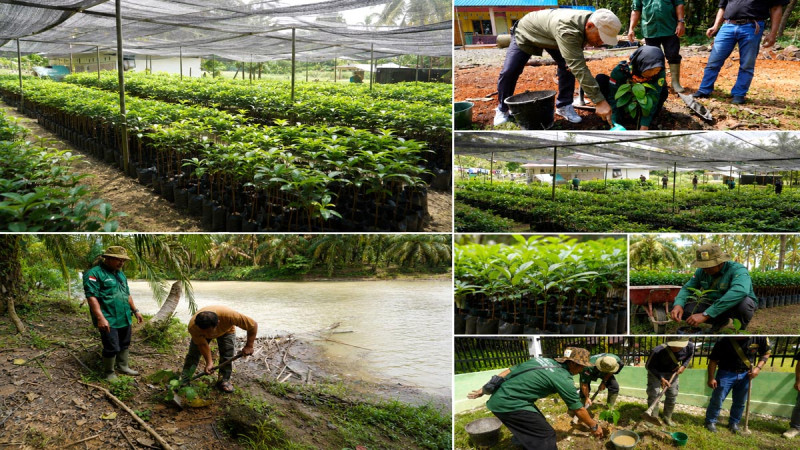
InfoSAWIT, ACEH TAMIANG – A coalition of independent oil palm farmers in Aceh Tamiang has launched an ambitious reforestation initiative, planting around 5,000 trees to restore degraded landscapes, strengthen climate resilience, and demonstrate that sustainable palm oil production can go hand in hand with environmental conservation.
The initiative is being led by the Indonesian Sustainable Palm Oil Farmers Forum (Fortasbi) in collaboration with the Tenggulun Lestari Oil Palm Farmers Association (Pesatri) following ecological damage caused by riverbank erosion and extreme weather events that affected parts of the region in late 2025.
Beginning in March 2026, the partners established a community nursery that successfully produced approximately 5,000 seedlings comprising both fruit-bearing and hardwood species. The program includes 14 different tree varieties, among them 1,500 durian seedlings, 800 avocado, 500 mango, as well as honey guava, duku, longan, jengkol, matoa, mangosteen, candlenut, mahogany, and cinnamon trees.
The main planting campaign took place on July 26 in Sumber Makmur Village, Tenggulun District. Seedlings were planted across strategic locations, including household yards, the banks of the Pantai River near Rengas Dam, schools, village roads, and community forest areas surrounding the Leuser Ecosystem.
The greening effort brought together village authorities, teachers, community leaders, youth organizations, forest farmer groups, and representatives from the Lingkar Temu Kabupaten Lestari (LTKL) network. The collaboration aims not only to rehabilitate eroded riverbanks but also to improve environmental resilience against future climate-related disasters.
Fortasbi Chairman Sutiyana said sustainable palm oil certification should be viewed as the starting point rather than the end goal of environmental stewardship.
"Sustainable palm oil certification is not the finish line. It is the foundation for protecting high conservation value areas and fostering a long-term culture of environmental conservation around independent smallholder plantations," he said in a statement received by InfoSAWIT on Tuesday (July 28).
According to Sutiyana, the tree-planting campaign reflects the principles of regenerative agriculture by integrating plantation productivity with climate change mitigation and biodiversity conservation.
He added that independent smallholders play a vital role beyond producing palm oil. They also contribute to safeguarding ecologically sensitive areas, including river buffer zones and natural habitats surrounding plantation landscapes.
Sumber Makmur Village Head Salihin welcomed the initiative, saying the newly planted trees will help reduce erosion while delivering long-term environmental and economic benefits for local residents.
"The village will become greener and more comfortable. In the future, these trees will also provide benefits for the community, whether planted in household yards or public facilities such as schools and the village office," he said.
Meanwhile, Pesatri Chairman Langkat Ginting described the program as evidence that independent oil palm farmers are capable of adapting to climate change while implementing sustainable agricultural practices.
He expressed hope that similar initiatives would inspire other palm-growing regions to integrate productive agriculture with ecosystem restoration.
Through the planting of thousands of trees, Fortasbi and Pesatri seek to demonstrate that palm oil production and environmental conservation are not mutually exclusive but can instead create more resilient, productive, and sustainable landscapes for future generations. (T3)