InfoSAWIT, NORTH LABUHANBATU – PT Agrinas Palma Nusantara (Persero) has expanded its community engagement around its plantation operations by holding a People’s Market and free health screening for residents of Sukarame Village, Kualuh Hulu District, North Labuhanbatu Regency, North Sumatra.
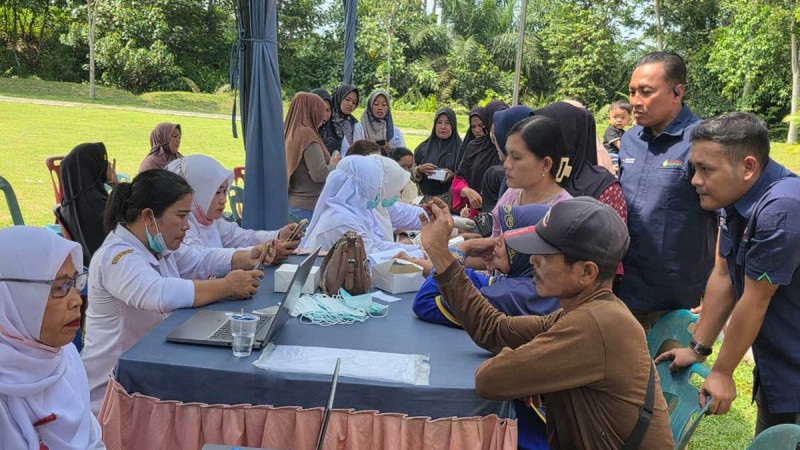
The initiative forms part of the company’s Environmental and Social Responsibility (TJSL) program and was held at the Sukarame Village Office on September 9, 2026. The activities were designed to address two basic community needs: affordable access to essential goods and regular health checks.
Through the People’s Market program, residents received basic-needs packages intended to help ease household spending. At the same time, the free health service gave residents an opportunity to check their health conditions without having to pay.
The event was attended by local stakeholders, including the Kualuh Hulu subdistrict head, the heads of Sukarame and Sukarame Baru villages, the deputy chief of the Kualuh Hulu police sector, the commander of Military Rayon Command 01/Aek Kanopan, the head of Sukarame Community Health Center, as well as Agrinas Palma Nusantara executives and employees.
Sukarnoto, Chief Region Officer for Agrinas Palma Nusantara’s North Sumatra–Aceh region, said the social initiative reflected the company’s commitment to ensuring that its presence creates tangible benefits for communities living around its operational areas.
“We want the presence of Agrinas Palma Nusantara to be felt not only through our business activities, but also through social contributions that directly benefit the community,” Sukarnoto said in an official statement received by InfoSAWIT on Wednesday (September 9, 2026).
He said the People’s Market and free health screening were expected to provide immediate benefits while encouraging greater public awareness of the importance of maintaining health.
“We hope to help ease the community’s needs while also encouraging awareness of the importance of health,” he said.
According to Sukarnoto, constructive relations between plantation companies and surrounding communities are an important foundation for the continuity of plantation operations. The company therefore intends to maintain communication and collaboration with village governments and residents.
“Communities are an important part of the ecosystem surrounding plantation areas. Therefore, we will continue building communication and collaboration with village governments and communities to identify needs that can be supported through the company’s TJSL programs,” he said.
Agrinas Seeks More Targeted Community Programs
Gatut Mukti, Head of Public Relations and TJSL Division at Agrinas Palma Nusantara, said the initiative in Sukarame was part of the company’s effort to ensure that its social programs go beyond ceremonial activities.
According to Gatut, TJSL programs are designed so that their benefits can be felt directly while remaining relevant to the needs of communities around the company’s operational areas.
“Our TJSL programs are designed not merely as ceremonial activities, but to genuinely respond to community needs,” Gatut said.
He described the People’s Market and free health services as concrete examples of the company’s presence among local residents. Beyond delivering short-term assistance, the programs also provide an opportunity to strengthen relationships between the company, the community, and local stakeholders.
“We want to build good and sustainable relationships with communities around plantation areas. Through synergy with village governments and all stakeholders, we hope future social programs can become increasingly targeted and deliver a broader impact,” he said.
Expanding Community Empowerment Around Plantations
Agrinas Palma Nusantara’s contribution to communities around its operational areas is not limited to social assistance. The company is also pursuing a community empowerment approach by involving local residents and economic institutions in plantation activities.
Previously, Agrinas Palma Nusantara had established cooperation with two village cooperatives to support a range of plantation activities, including crop maintenance, harvesting, and transportation of plantation products.
The company has also opened employment opportunities for former employees of PT Grahadura Leidong Prima as well as residents of Sukarame Village. The move is part of an effort to broaden the economic benefits generated by plantation operations for surrounding communities.
Taken together, these initiatives indicate that the company’s TJSL strategy is increasingly linked not only to social assistance but also to strengthening economic and social relationships around its operational areas.
Through the People’s Market, free health services, cooperation with village cooperatives, and local employment opportunities, Agrinas Palma Nusantara is reaffirming its commitment to building more sustainable relationships with surrounding communities.
For the company, the sustainability of plantation operations depends not only on production but also on its ability to maintain harmonious relationships with communities and stakeholders in surrounding areas. (T1)