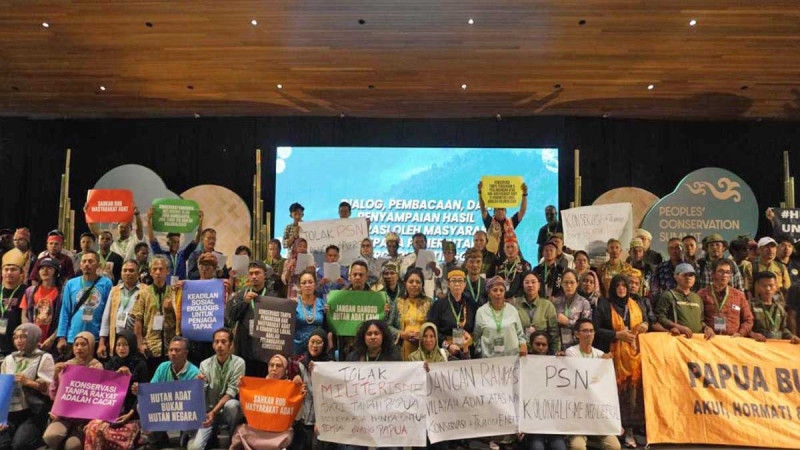
InfoSAWIT, YOGYAKARTA – The Peoples’ Conservation Summit (PCS) 2026 has produced the Indonesia People’s Conservation Declaration, positioning it as a manifesto for a community-based conservation movement and calling for a fundamental shift in the country’s approach to biodiversity conservation.
Held at the Innovation and Creativity Center of Universitas Gadjah Mada (UGM) in Yogyakarta, the forum brought together around 650 participants, including Indigenous Peoples and Local Communities, government representatives, civil society organizations, media, academics, researchers, and other stakeholders from across Indonesia.
According to a press statement from the Peoples’ Conservation Summit (PCS) 2026, as reported by InfoSAWIT on Wednesday (September 9, 2026), the declaration was read by representatives of Indigenous Peoples and Local Communities from different regions before being formally handed to government representatives who remained at the event until its conclusion.
PCS 2026 was held as part of the Road to COP-17 of the Convention on Biological Diversity (CBD) in Armenia. Discussions focused on Indonesia’s conservation and biodiversity challenges while also formulating a new direction that would place communities at the center of environmental and natural-resource management.
The forum highlighted what it described as a worsening biodiversity crisis occurring alongside the loss of living space, agrarian conflicts, plantation and mining expansion, infrastructure development, energy projects, food industrialization, and growing pressure on coastal and marine areas.
Across many regions, Indigenous Peoples and Local Communities are considered among those bearing the social and ecological costs of these development models. The situation became one of the main reasons PCS called for a fundamental transformation of Indonesia’s conservation paradigm.
PCS also raised concerns over what it viewed as unequal policy implementation. Indigenous Peoples and Local Communities often face lengthy and complicated procedures to secure formal recognition, while concessions, investment activities, and extractive projects continue to receive access to land and resources.
Similar conditions, the forum noted, can also be found inside conservation areas. Indigenous Peoples and Local Communities are still frequently labeled as encroachers, despite having protected, managed, restored, and maintained their territories and surrounding environments through customary institutions, traditional knowledge, and practices passed down through generations—often long before conservation areas were formally established.
The forum further pointed to inequality in the recognition of knowledge. Traditional knowledge held by Indigenous Peoples and Local Communities is often marginalized compared with scientific knowledge, even though community-based conservation knowledge remains alive, practiced, developed, and transmitted across generations.
At the global level, PCS noted that Targets 3 and 22 of the Kunming-Montreal Global Biodiversity Framework (KM-GBF), along with the CBD’s Article 8(j) Work Programme, have strengthened recognition of community rights, knowledge, and participation. However, the forum argued that a gap remains between commitments made on paper and realities on the ground.
For PCS, conservation is therefore not simply a question of how nature should be protected, but also of who has the authority to determine how that protection takes place. Questions over who decides which areas should be protected, whose knowledge is considered legitimate, who has decision-making power, and who should be held accountable when environmental damage occurs have become central to the proposed transformation.
Indigenous Peoples Seen as Key Conservation Actors
PCS emphasized that conservation is not a new concept for Indigenous Peoples and Local Communities. Human relationships with nature have long been shaped through spiritual, social, and ecological connections embedded in community life.
Indigenous Peoples and Local Communities are regarded not merely as beneficiaries but as conservation practitioners and key actors. The forum argued that they should therefore have greater authority in determining conservation priorities, while knowledge, resources, and decision-making powers should be distributed fairly, including to women and young people.
PCS stressed that changing the direction of conservation cannot stop at formal recognition. It must also address the underlying drivers of biodiversity loss, including excessive extraction, land and territorial dispossession, agrarian inequality, destructive development models, and systems that contribute to environmental degradation.
Rosita Tecuari of the Indigenous Women’s Organization (ORPA) Namblong in Jayapura, Papua, said she hoped PCS would contribute to policy changes that provide greater protection for communities.
“I hope there will be change, so Indonesia is no longer influenced by colonial governance systems. I hope PCS can produce recommendations for the state and build collaboration in developing policies that favor communities,” Rosita said.
Meanwhile, Yance Arizona of the UGM Faculty of Law expressed hope that the Indonesia People’s Conservation Declaration could become a shared commitment among Indigenous Peoples and Local Communities, civil society organizations, academics, and the government to advance a more just form of people-centered conservation.
“I hope the declaration presented at PCS becomes a shared commitment among Indigenous Peoples and Local Communities, NGOs, academics, and the government to implement just people-centered conservation,” Yance said, adding that academics support and remain committed to the initiative.
13 Demands for a New Conservation Direction
After three days of discussions on experiences, challenges, and ideas, PCS 2026 formulated 13 demands aimed at changing the direction of conservation policy in Indonesia.
The first calls for community-led biodiversity protection models to be recognized, protected, and incorporated into government policy through various mechanisms.
Participants also called for accelerated recognition and protection of Indigenous Peoples’ and Local Communities’ rights over customary territories, forests, agricultural land, coastal areas, and marine spaces. This includes the designation of 1.4 million hectares of customary forests, including areas overlapping with conservation zones.
PCS further called for the repeal of the Conservation of Living Natural Resources and Their Ecosystems Law (UU KSDAHE) and its replacement with legislation that accommodates Indigenous Peoples and Local Communities, recognizes their tenure rights and safety, and positions them as the primary subjects of conservation efforts.
The forum also urged the immediate enactment of the Indigenous Peoples Law and Climate Justice Law, along with a comprehensive revision of the Forestry Law. Indigenous Peoples and Local Communities should also be meaningfully involved in monitoring the implementation of the Indonesian Biodiversity Strategy and Action Plan (IBSAP) and the Nationally Determined Contribution (NDC), including through a dedicated committee or task force.
On financing, PCS called for comprehensive reform of the climate and biodiversity financing architecture. It proposed dedicated funding that is easily accessible and based on trust, with Indigenous Peoples and Local Communities positioned as key decision-makers rather than merely recipients of projects.
The forum also called for the 30x30 target to be implemented through a rights-based approach. This should include mechanisms to resolve conservation-related conflicts, apply the principle of Free, Prior and Informed Consent (FPIC), and uphold the tenure rights of Indigenous Peoples and Local Communities.
PCS additionally urged the immediate adoption of a roadmap for protecting and advancing local wisdom in biodiversity conservation as a concrete implementation of the CBD Article 8(j) Work Programme. Recognition and protection of traditional knowledge, customary legal innovations, and community governance systems were also emphasized.
Indigenous women and youth, meanwhile, should receive meaningful opportunities to participate in decision-making on biodiversity governance, conservation financing, and related policies.
In coastal areas and small islands, PCS called for an end to the dispossession of living spaces. The forum rejected destructive extraction of natural resources and critical minerals and demanded protection of tenure rights and biodiversity management practices rooted in local knowledge.
Another demand concerns data, genetic resources, and research. PCS called on the government to guarantee the full sovereignty of Indigenous Peoples and Local Communities over their data and genetic resources while ensuring that research applies FPIC throughout the entire process, from upstream to downstream.
The forum also called for traditional knowledge to be integrated equally into environmental policy and education through collaboration across different knowledge systems. It proposed reforming STEM curricula through a transdisciplinary approach incorporating the social sciences and humanities.
In terms of development, PCS called for an end to environmentally destructive projects pursued in the name of economic growth. The government was urged to fundamentally reform destructive development models and immediately implement the mandate of MPR Decree IX of 2001 to protect environmental sustainability and people’s living spaces.
Finally, PCS demanded an end to the criminalization of people defending the environment. The state and corporations should be held accountable for environmental destruction, while an anti-SLAPP policy should be enacted to protect Indigenous Peoples, farmers, fishers, environmental defenders, and human rights activists. (T2)