InfoSAWIT, YOGYAKARTA – Indonesia’s palm oil downstreaming agenda must begin with improvements in the upstream sector, Minister of National Development Planning and Head of the National Development Planning Agency (Bappenas) Prof. H. Rachmat Pambudy, MS, said.
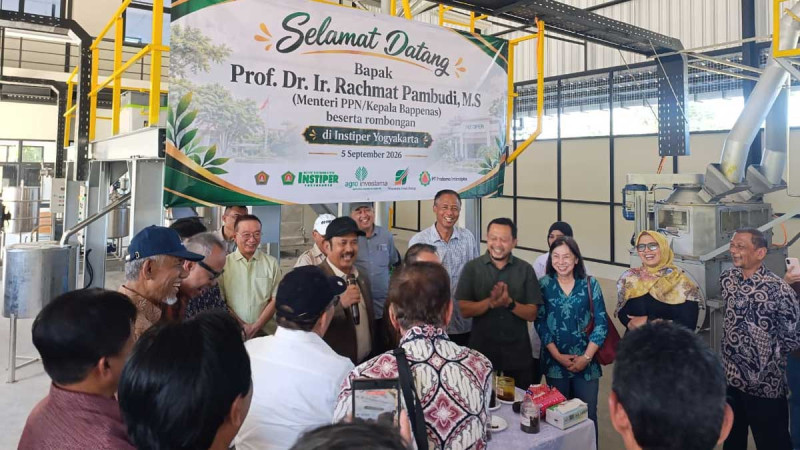
Rachmat made the statement during a visit to a palm oil processing facility using Steamless Palm Oil Technology (SPOT) at the INSTIPER Yogyakarta campus on Saturday, September 5, 2026.
During the visit, Rachmat highlighted the importance of increasing plantation productivity, improving resource efficiency, and strengthening environmental management as part of efforts to reinforce Indonesia’s palm oil industry.
According to him, the government’s downstreaming agenda will not achieve optimal results if problems in the upstream or on-farm sector remain unresolved.
“The essence is that Bappenas has been tasked with handling downstreaming. Palm oil downstreaming can only happen if the on-farm sector is in order, if the upstream sector is in order,” Rachmat said in an official statement received by InfoSAWIT on Tuesday, September 7, 2026.
He emphasized that the upstream sector plays a critical role because the productivity and quality of raw materials directly affect processing efficiency and the competitiveness of downstream products.
Resource Efficiency Becomes a Key Focus
Beyond improving plantations, the government is also encouraging the palm oil industry to use resources more efficiently. Energy consumption, water use, and environmental impact management are considered important components of the downstreaming strategy.
Rachmat expressed the view after observing palm oil processing technology being developed at INSTIPER Yogyakarta. The facility forms part of a Teaching Plant developed through collaboration between the Yogyakarta Plantation Cadre Education Foundation (YPKPY) and PT Nusantara Green Energy (NGE).
Development of the technology began in 2022 through palm oil research funded by the Palm Oil Plantation Fund Management Agency (BPDP).
PT NGE representative Petrus Tjandra explained that the technology uses loose fruit as its raw material, while empty fruit bunches remain in the plantation and can be utilized as a source of organic material.
According to Petrus, the process is designed to reduce energy requirements. SPOT technology also does not use a sterilizer station or the high-pressure steam boiling process commonly applied in conventional palm oil processing.
The approach could reduce water consumption and liquid waste generated during processing. However, the adoption of any processing technology still needs to take into account technical considerations, economic feasibility, processing capacity, and suitability for plantation and industrial conditions in the field.
Creating Higher-Value Palm Oil Products
Downstreaming is also closely linked to efforts to produce palm oil with greater added value. Petrus said the oil produced through the process contains nutrients such as vitamin A, vitamin E, and antioxidants.
He believes these characteristics could create opportunities for the use of palm oil in a range of food products. One example highlighted was the use of palm oil as part of food products that could help expand access to sources of vitamin A.
From a policy perspective, however, Rachmat stressed that increasing added value cannot be assessed solely by looking at the type of products being produced. Production processes must also consider resource efficiency and environmental impacts.
He said the development of Indonesia’s palm oil industry needs to integrate the upstream and downstream sectors. Plantation productivity, processing efficiency, and technological innovation should be positioned within a single, mutually supportive industrial chain.
“Today I will declare palm oil that has low carbon emissions, low energy consumption, and low water consumption, while being high in nutritional content,” Rachmat said. (T2)