
InfoSAWIT, PALEMBANG – The long-term sustainability of Indonesia’s palm oil industry depends not only on plantation productivity and land management but also on the availability of skilled human resources to manage plantations in the future.
This issue was highlighted during a palm oil cultivation training program attended by 174 farmers from Ogan Komering Ulu (OKU), South Sumatra, where farmer regeneration emerged alongside technical plantation training as an important issue for the sector’s future.
According to IPB Training, as cited by InfoSAWIT on Monday, August 31, 2026, the training was held from August 26–31 at Beston Hotel Palembang. It formed part of the 2026 Palm Oil Plantation Human Resources Development Program, implemented through cooperation between the Palm Oil Plantation Fund Management Agency (BPDP), the Directorate General of Plantations at the Ministry of Agriculture and IPB Training.
The participants were divided into six groups, numbered XXIV, XXV, XXVI, XXVII, XXVIII and XXIX.
In addition to learning technical cultivation practices, the farmers were encouraged to consider the role of younger generations in maintaining the continuity of Indonesia’s palm oil plantations.
Farmer Regeneration and Technical Skills
The issue of farmer regeneration was discussed alongside technical lessons on nursery management, particularly during the main nursery (MN) stage.
During the session, participants were introduced to the BPDP scholarship program for children of palm oil farmers. The program was also linked to opportunities for younger generations to develop their skills and contribute to the future of the plantation sector.
Farmer regeneration, however, was not treated as a separate issue from improving the capabilities of current farmers.
Throughout the training, participants continued to receive instruction covering plantation regulations and policies, planting materials, nursery management, land preparation, planting, crop maintenance, fertilization and pest and disease control.
Strengthening Knowledge from the Nursery Stage
Participants received guidance on superior and non-superior planting materials as well as procurement procedures. Some farmers also shared their experiences in managing nurseries independently.
The nursery sessions covered both pre-nursery (PN) and main nursery (MN) management. Farmers learned about polybag requirements, planting techniques, watering, fertilization and transferring seedlings using a ponjok.
The risks associated with poor seedling management were also discussed, including the use of counterfeit seeds and improperly sized polybags.
These issues are significant because the quality and performance of oil palms are closely connected to how planting materials are managed from the earliest stage of cultivation.
From Land Preparation to Crop Maintenance
After the nursery sessions, the training moved into land preparation and planting.
Farmers learned about land suitability, replanting, field lining, plant population and spacing, planting-hole preparation and basal fertilizer application.
Participants also practiced field lining to apply the lessons directly.
For immature oil palms, or TBM, the curriculum included crop consolidation, census activities, circle maintenance, field lanes, harvesting-path preparation, castration and sanitation.
For mature palms, or TM, training covered pruning, harvesting access, production roads and fruit-set management.
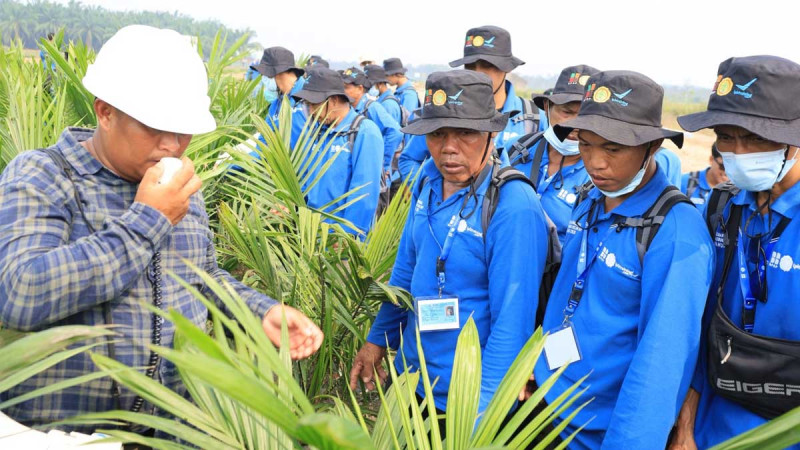
Field visits provided another opportunity for participants to strengthen their practical skills. Farmers practiced using egrek harvesting tools, castration, manual and mechanized circle maintenance, as well as tractor operation.
The field sessions also encouraged active interaction between farmers and trainers, with participants bringing questions and practical experiences from their own plantations.
Preparing Farmers and the Next Generation
The emphasis on regeneration becomes increasingly relevant when the skills developed among today’s farmers are viewed as knowledge that can be passed on to future generations.
The training therefore went beyond immediate technical capabilities. It also created space to discuss the development of younger people connected to the palm oil sector.
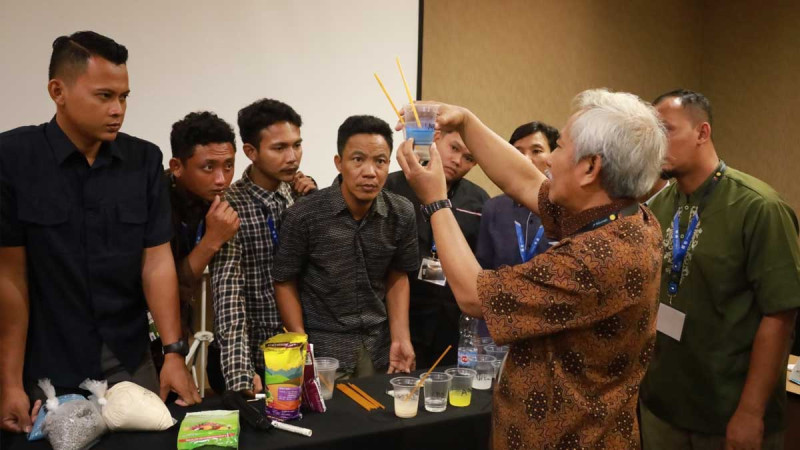
Toward the end of the program, participants returned to fertilizer management and pest and disease control. Practical sessions included measuring soil and fertilizer pH, preparing fertilization plans for immature and mature palms, and learning about integrated pest management and biological control agents.
The six-day program illustrates how human-resource development in palm oil plantations can be pursued through multiple layers.
Strengthening the capabilities of farmers currently managing plantations can go hand in hand with creating opportunities for the next generation to understand, enter and further develop the palm oil sector.
For Indonesia’s palm oil industry, such an approach is increasingly relevant as the sector seeks not only higher productivity but also a sustainable pipeline of skilled farmers and plantation professionals for the future. (T2)