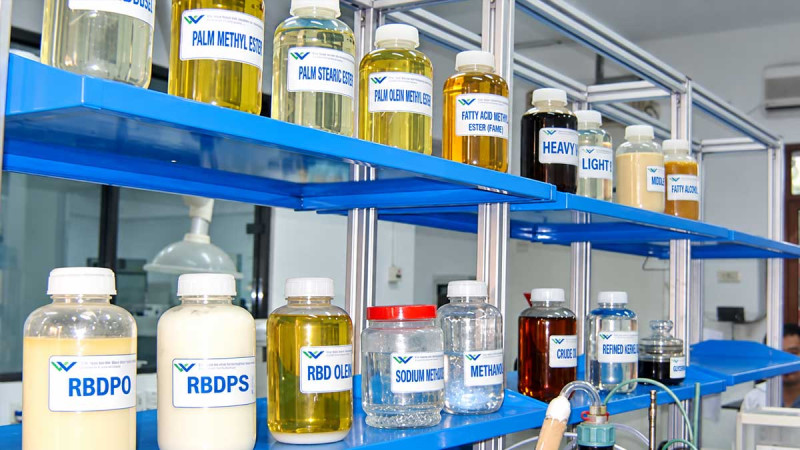
InfoSAWIT, JAKARTA – Indonesia’s palm oil industry needs to move beyond its traditional focus on commodity production and accelerate the development of higher-value downstream products through research, technology, and innovation, according to the National Research and Innovation Agency (BRIN).
The agency is promoting broader diversification of palm oil-based products as part of an effort to strengthen the competitiveness of Indonesia’s palm oil industry and create greater added value from the country’s strategic commodity.
As reported by InfoSAWIT from BRIN on Wednesday (September 9, 2026), Hens Saputra, Head of BRIN’s Research Center for Process Technology, said the development of the palm oil industry should increasingly be viewed through the lens of value creation.
“It's not about how much palm oil is produced, but how much value can be added,” Hens said. In his view, this perspective opens opportunities to position palm oil as part of a broader ecosystem for innovation-based products and industries, potentially making it one of Indonesia’s important industrial strengths in the future.
The issue was discussed during BRIN’s Sharing Session #18 of 2026, titled “Expanding Downstream Product Diversification as a Strategy to Strengthen Indonesia’s Palm Oil Industry,” held online on Friday (September 4, 2026).
The session featured BRIN Principal Expert Engineer Indra Budi Susetyo and Jenny Elisabeth, Director of Politeknik Wilmar Bisnis Indonesia. They discussed opportunities for developing downstream palm oil products to increase added value while strengthening the competitiveness of the national industry.
Indra explained that the palm oil industry has a strategic role in Indonesia’s economy, involving more than 17 million workers directly and indirectly. When family members are included, the sector affects more than 50 million people and generates multiplier effects across other industries.
Given its broad economic impact, the palm oil sector needs to be developed beyond primary commodity production. Technology-based downstream diversification is considered essential to expand palm oil applications and generate greater economic value.
Expanding Palm Oil-Based Industrial Applications
According to Indra, the chemical characteristics of palm oil provide significant opportunities for the development of a wide range of derivatives.
At present, the largest shares of palm oil consumption remain concentrated in food and energy. By comparison, the use of palm oil in basic oleochemicals—particularly for personal care products, cosmetics, and other industrial applications—remains relatively limited.
“The potential for palm oil-based products does not stop there. Palm oil can be developed for a much broader range of industrial applications, including lubricants and polymer-based materials that have extensive uses,” he said.
The challenge for the industry, Indra added, is to create more innovative products with higher added value. Such diversification could expand palm oil applications while increasing demand for the commodity.
Achieving that goal will require stronger technological capabilities, product development aligned with market needs, and research capable of addressing industrial challenges in a sustainable manner.
Against this backdrop, BRIN’s Research Center for Process Technology has proposed the establishment of a Center of Excellence for Oleochemicals (CoE Oleochemicals).
The proposal was put forward by Research Group 8 on Industrial Crop Processing Technology at BRIN’s Research Center for Process Technology.
Lanjar, who represented the research group, said the proposed CoE Oleochemicals would strengthen the research and innovation ecosystem supporting the development of downstream palm oil products.
The initiative is designed to integrate research expertise and resources for oleochemical technology development. The center is expected to bring together researchers, research infrastructure, universities, and industry partners to develop palm oil-based oleochemical technologies and products in a more integrated manner.
The proposed center would also seek to move beyond laboratory-scale research. Its integrated approach is intended to accelerate the translation of research results into technologies and higher-value products that are relevant to industrial needs.
In this model, the CoE Oleochemicals could serve as a bridge between research and technology development and the challenges, requirements, and opportunities facing industry. Stronger alignment between expertise, infrastructure, and market demand would be essential to move research outcomes toward wider commercial and industrial applications.
Palm Oil Food Products Offer Further Diversification Opportunities
Oleochemicals are not the only area with significant potential. The food industry also offers substantial opportunities for further diversification of palm oil products.
Jenny Elisabeth noted that more than 70 percent of palm oil globally is used in food products.
Its applications already include cooking oil, shortening, margarine, bakery products, confectionery, and substitutes for milk fat and cocoa butter. The breadth of these applications, she said, creates opportunities to develop new products with increasingly specific characteristics.
However, continued research is needed to ensure that palm oil-based food products respond to changing market expectations.
Future product development should focus, among other things, on cost efficiency and functional properties that meet specific consumer and industrial requirements.
“Product safety and health are also important considerations. Technology development needs to address contaminants that concern consumers while minimizing the use of trans fats by taking advantage of palm oil fat, which is naturally free of trans fats,” Jenny said.
Sustainability is also becoming increasingly important in determining product acceptance in global markets. As a result, innovation must go beyond functionality and efficiency and respond to increasingly demanding sustainability expectations.
Jenny also highlighted the importance of developing technology and supporting materials to strengthen industrial self-reliance. Various palm oil modification processes still require technological capabilities and processing aids, making domestic research in these areas increasingly important.
These challenges show that downstream palm oil diversification cannot depend solely on the availability of raw materials. Successful downstream development requires technological expertise, the ability to create products that meet market needs, research infrastructure, and strong connections between researchers and industry.
Through the development of the Center of Excellence for Oleochemicals, BRIN is expected to strengthen collaboration among research institutions, technology developers, and industry players.
The proposed center could become a collaborative platform integrating expertise, infrastructure, and research networks to address oleochemical development challenges and broaden palm oil applications into a wider range of value-added products.
Closer collaboration between BRIN, universities, and businesses is therefore considered critical to accelerating downstream palm oil diversification.
A stronger research and innovation ecosystem is expected not only to increase the added value of Indonesia’s palm oil commodity but also to enhance the competitiveness of the country’s oleochemical industry. (T2)