InfoSAWIT, BOGOR – Palm oil farmers continue to occupy a relatively weak position within Indonesia’s palm oil industry ecosystem, despite controlling a significant share of the country’s plantation area.
Muhammad Abdul Ghani, President Director of Agrinas Palma Nusantara (APN), said smallholders manage approximately 42% of Indonesia’s palm oil plantation area, yet their productivity remains only about half that of corporate plantations.
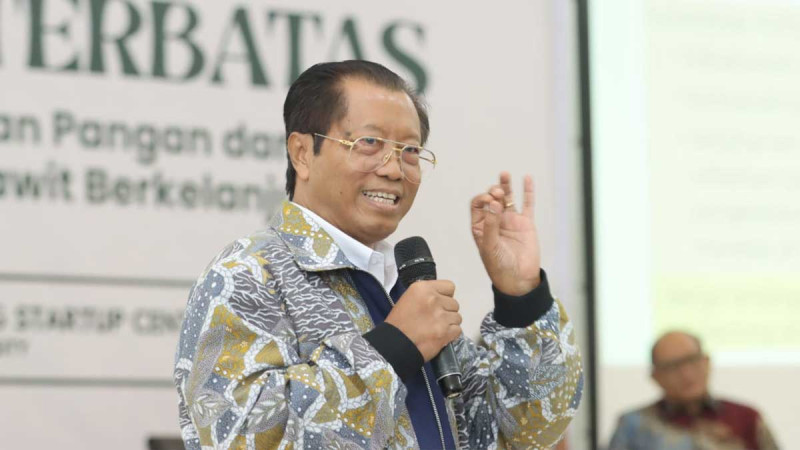
“The industry ecosystem is not working properly. In terms of ownership concentration, Article 33 is not being realized. Farmers control 42%, but their productivity is only half that of corporations,” Ghani said during a Limited Discussion Forum organized by Rumah Sawit Indonesia (RSI) at IPB University in Bogor on Monday, August 31, 2026.
According to Ghani, the imbalance reflects the relatively weak bargaining position of farmers within the palm oil supply chain.
He argued that farmers often face significant pressure when palm oil prices increase only modestly, making it difficult for them to gain a fair share of the value generated by the industry.
“We cannot expect much from a system like this,” he said.
Investment Should Create Broader Economic Benefits
Ghani also linked the issue of farmer welfare to Indonesia’s broader economic growth ambitions.
The government has set a target of achieving economic growth of 8% by 2029, but Ghani stressed that economic expansion should also be accompanied by greater equality.
He said state investment through Danantara should therefore be guided by an investment philosophy that not only seeks to increase corporate returns but also distributes economic benefits more broadly across society.
Ghani illustrated his argument by comparing large-scale industrial investments with agricultural development.
He cited an example of a refinery investment that could require around Rp50 trillion but potentially employ fewer than 500 people directly.
By contrast, he argued, a similar Rp50 trillion investment in palm oil cultivation could potentially create employment for around 5,000 people at the upstream level.
The employment impact, he added, would extend beyond plantation workers once the wider palm oil supply chain is taken into account.
For Ghani, investment policy should therefore consider not only the size of financial returns but also the number of people who can benefit from the resulting economic activity.
Beyond Corporate Social Responsibility
Ghani said plantations and mining are industries that directly intersect with the interests of surrounding communities.
Those relationships can generate mutual benefits, but they can also create social tensions when communities do not receive sufficient economic benefits from activities taking place around them.
He argued that relying solely on corporate social responsibility, or CSR, is insufficient to address the issue.
According to Ghani, a stronger framework could require a portion of corporate profits to be distributed to surrounding communities, particularly in areas where plantation and mining activities have a direct economic and social impact.
Such an approach, he said, would recognize local communities as part of the broader ecosystem supporting the sustainability of a company.
Farmer Empowerment as a Sustainability Foundation
Ghani also connected community welfare with security and long-term business stability.
When communities surrounding plantations or mining operations remain economically disadvantaged, maintaining social stability and security can become more difficult.
For that reason, he said companies need to change the way they view surrounding communities—not simply as external stakeholders, but as an integral part of the ecosystem that supports long-term corporate sustainability.
He called for a shift in the corporate mindset toward greater farmer empowerment.
“The corporate perspective needs to change. My thinking has always been about how farmers can become more empowered,” Ghani said.
The discussion was held under the theme “Building Food and Energy Resilience and Self-Reliance Through a New Nexus for Sustainable Palm Oil Governance.”
The debate highlights a broader question for Indonesia’s palm oil industry: how can the sector maintain its economic contribution while ensuring that farmers and communities participating in the industry receive a more equitable share of its benefits?
For Ghani, strengthening farmers’ bargaining position and expanding the distribution of economic benefits should become an important part of Indonesia’s future palm oil governance. (T2)
Source: InfoSAWIT