JAKARTA, InfoSAWIT – Enforcement against palm oil plantations located within forest areas should not stop at the installation of warning signs or administrative measures. The government needs to follow up by verifying landholders, tracing the history of land control, and determining the legal status of individual plots to prevent policies from targeting the wrong people.
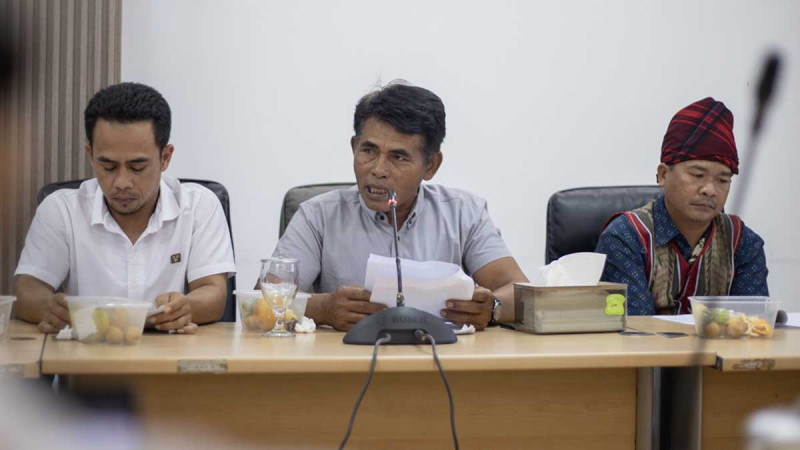
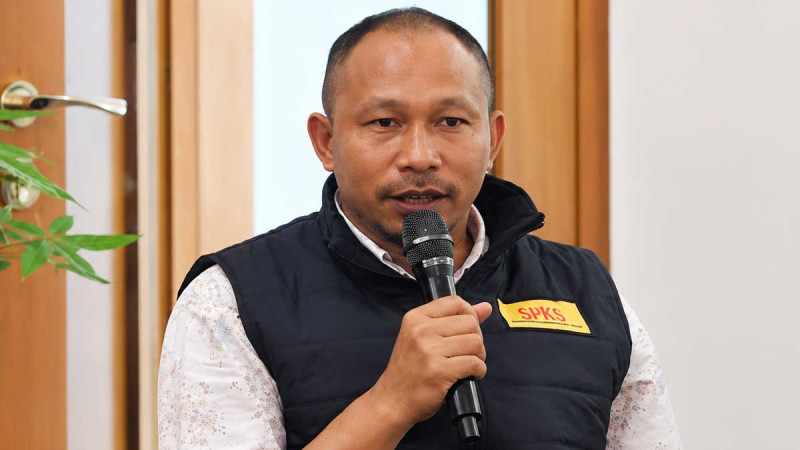
Marselinus Andri, Head of Advocacy at the Smallholders Palm Oil Union (SPKS), made the statement during the Pre-National Conference Webinar on Smallholder Plantations II attended by InfoSAWIT, on Friday, September 4, 2026.
According to Andri, enforcement measures undertaken by the Forest Area Enforcement Task Force (Satgas PKH) have yet to answer the central questions of who owns or controls the land, how control over the land was established, and what legal certainty is available to farmers who have been managing the plantations.
He said spatial mapping is important as an initial step, but it cannot be the sole basis for determining the status of smallholder palm oil plantations.
“The process has been based on spatial maps, and then there will be a further process,” Andri said.
Land History Needs Verification
SPKS is urging the government to examine the factual conditions of individual plantations because the history of land control among farmers varies.
Some plantations have been managed from one generation to another, while others originated through transactions.
Andri cited SPKS investigations in several locations showing the diversity of land ownership histories. In Kapuas Hulu, for example, the organization identified around 259 plots covering approximately 485 hectares.
In Sanggau, meanwhile, around 1,251 plots of land managed by palm oil farmers have also been affected by enforcement measures taken by the Forest Area Enforcement Task Force.
For that reason, Andri said national data on land subject to enforcement should not be treated as though every parcel has the same characteristics.
He referred to a figure of approximately 4.1 million hectares contained in publicly available data. However, he said verification of the entire dataset had not yet been completed.
That situation makes it increasingly important to identify the people involved and establish the characteristics of each landholding.
Enforcement Should Not Stop at Forest Maps
Andri said the issue of palm oil plantations located within forest areas cannot be resolved simply by determining whether a parcel falls inside or outside a forest area on a map.
The government also needs to answer basic questions: Who is the farmer? How long has the land been under their control? What is the history of that control? And are the activities commercial in nature or primarily intended to meet household needs?
Such identification is considered essential to ensure that implementation of the Constitutional Court ruling, which provides a reference for protecting communities in forest areas, does not instead produce policies that miss their intended targets.
Data Transparency Is Key
SPKS is also calling for greater transparency in government enforcement data.
The data, it argues, should contain more than aggregate figures on the size of affected areas. It should also identify the relevant parties, individual plots, polygons, and the legal status of each parcel.
“The 4.1 million figure does not make clear where the land is, who the subjects are, where the plots are, what the polygons look like, or what their status is,” Andri said.
According to him, transparency is important so that communities can understand the basis for government action while also having an opportunity to raise objections and seek remedies if errors occur.
SPKS ultimately wants forest-area enforcement to move toward a process that provides legal certainty. Verification, classification, legal-status determination, and mechanisms for resolving farmers' cases should form part of the policy process rather than enforcement stopping at actions taken in the field.
With such an approach, the government would be able to distinguish between different forms of land control and ensure that enforcement measures target activities that are genuinely subject to legal action, without overlooking the rights and circumstances of farmers who have long depended on their palm oil plantations for their livelihoods. (T2)