InfoSAWIT, BOGOR – Indonesia’s palm oil production is projected to rise again in 2026, signaling a potential recovery after production weakened in 2024. National output is forecast to reach approximately 50.31 million tons of palm oil in 2026, supported by recovering crop conditions, improved fertilizer application and efforts to raise plantation productivity.
The projection indicates that Indonesia’s palm oil industry still has room for growth despite persistent challenges, including aging plantations, the need for accelerated replanting and rising production costs.
According to a presentation by Rizki Amalia of the Palm Oil Research Center (PPKS), PT Riset Perkebunan Nusantara, delivered during the 2026 Plantation Commodity Outlook in Bogor on October 28, 2025, the MODUS forecasting model estimated Indonesia’s palm oil production at 49.50 million tons in 2025. The figure is projected to increase to 50.31 million tons in 2026.
The forecast points to a gradual recovery following weaker production in 2024.
Actual production reached 50.84 million tons in 2023 before declining to 48.16 million tons in 2024. Production was then estimated at 49.50 million tons in 2025 before being projected to rise further in 2026.
Recovery from Drought Supports Production Outlook
One of the factors supporting the projected increase is the recovery of palm oil plantations from the impact of drought experienced in 2023.
Drought can affect palm oil growth and productivity, with its impact potentially becoming visible in subsequent production periods. As plantation conditions recover, the effects can gradually be reflected in higher output.
Fertilizer application is another important factor supporting plantation productivity. The 2026 outlook presentation noted that fertilizer application had increased alongside a recovery in fertilizer prices.
Higher fertilizer application is expected to help maintain crop conditions and support national production.
However, Indonesia’s palm oil sector also faces another structural challenge: the increasing average age of plantations. A growing proportion of old and senescent palms could place pressure on productivity if it is not accompanied by faster replanting.
Smallholder Replanting Remains a Challenge
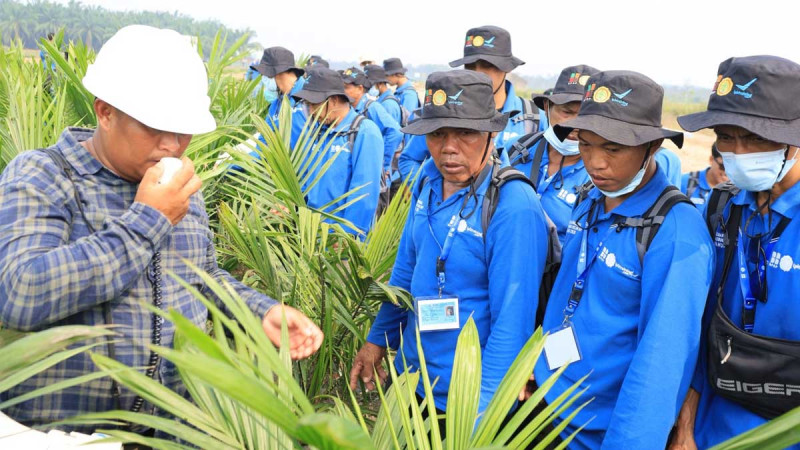
The age profile of plantations is particularly important for smallholders, many of whom require replanting to restore plantation productivity.
Data from the 2026 Palm Oil Commodity Outlook showed that between 2016 and 2025, replanting had covered approximately 384,618 hectares. The program involved 169,494 smallholders, with total disbursements reaching approximately Rp10.86 trillion as of May 2025.
Despite this progress, implementation continues to face a number of obstacles. Social and economic factors, administrative and technical issues, financing mechanisms and partner readiness all influence the realization of replanting programs.
Delays in replanting could eventually affect national productivity. The outlook presentation linked slow replanting to the risk of declining productivity and potential imbalances between palm oil supply and demand.
Productivity Matters Beyond Plantation Expansion
Future growth in Indonesia’s palm oil production will therefore depend not simply on expanding plantation areas. Improving productivity on existing plantations will be equally important.
The commodity performance data presented in the outlook put Indonesia’s total palm oil plantation area at approximately 16.83 million hectares, with mature plantations covering around 13.68 million hectares.
The 2025 plantation profile consisted of approximately 9.16 million hectares of private plantations, 6.90 million hectares of smallholder plantations and 600,000 hectares of state-owned plantations.
The figures highlight the significant role of smallholders in Indonesia’s palm oil industry. Improving smallholder productivity will therefore be a critical component of maintaining national production growth.
The 2026 outlook recommends strengthening the implementation of Good Agricultural Practices (GAP) among smallholders, accelerating replanting through innovative financing schemes and expanding the use of technology and innovation to improve productivity.
A combination of recovering plantation conditions, improved fertilizer application, productivity gains and accelerated replanting could support Indonesia’s palm oil production in reaching the projected 50.31 million tons in 2026.
At the same time, production performance will continue to interact with global market dynamics, domestic consumption, Indonesia’s biodiesel program and movements in palm oil prices.
The second part of the 2026 Palm Oil Commodity Outlook is expected to examine the outlook for CPO prices, the impact of the biodiesel program, and broader challenges and strategies facing Indonesia’s palm oil industry. (T2)
Source: InfoSAWIT