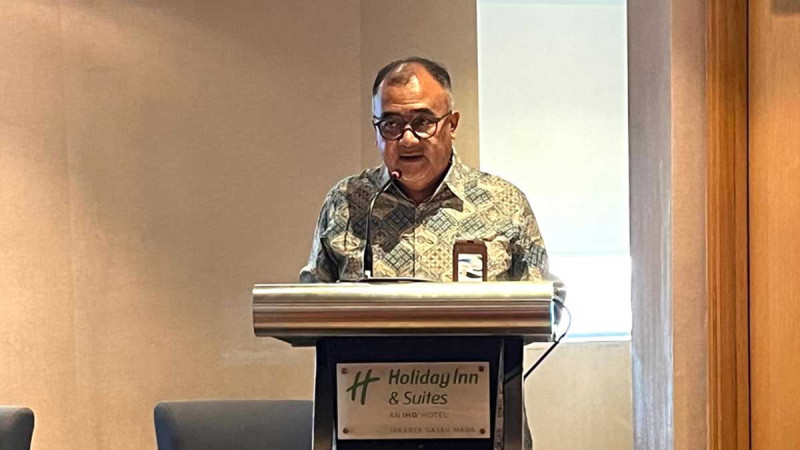
InfoSAWIT, JAKARTA — Chairman of the Indonesian Association of Prosperous Oil Palm Smallholders Forum (POPSI), Mansuetus Darto, warned the government not to pressure the market into absorbing palm oil produced from seized plantations. He said such a move carries high risks and could become an “alarm bell” that undermines the foundation of Indonesia’s palm oil sustainability agenda.
Darto noted that the government may have a strong expectation that palm oil from seized plantations “must be sold,” under the narrative of state plantations for the state. However, if this expectation is translated into pressure on local industry players, the consequences could go beyond commercial transactions and spread into compliance, land legality, and even national palm oil reputation in the global market.
“If this expectation is pursued by forcing the palm oil market in the regions, this is a high-risk danger alarm,” Darto told InfoSAWIT on Sunday (18/1/2026).
Agrinas Palma Without Its Own Mill, Dependent on Other Companies’ Mills
One key issue highlighted by POPSI is the position of Agrinas Palma, which is reportedly operating without its own palm oil mill (POM) to process fresh fruit bunches (FFB) from seized plantations.
Under such conditions, the management of seized plantations through third parties under an Operational Cooperation scheme (KSO) makes Agrinas Palma highly dependent on POMs owned by other companies.
According to Darto, this dependency creates room for pressure on POM operators to accept FFB supply from seized plantations, even though the supply status may generate additional risks within the supply chain.
Global buyers, he stressed, do not recognize the term “state plantation” as justification. What international markets acknowledge is legal certainty, land legality, and compliance with sustainability standards.
“The market only recognizes legal certainty, legality, and compliance with sustainability standards,” he said.
FFB May Enter Mills, But CPO Could Be Hard to Market
Darto did not rule out the possibility that FFB from seized plantations can still be delivered to mills, including mills that do not own plantations. However, the next challenge arises when the processed product—crude palm oil (CPO)—must be marketed.
He observed that many companies, including CPO buyers, have implemented strict standards to ensure products meet sustainability principles, have traceability, and are free from legal and deforestation risks.
In such a situation, mills could face barriers in selling their CPO if their FFB supply originates from sources that still carry unresolved legal disputes or lack legal certainty.
Darto suggested that domestic channels such as cooking oil and biodiesel may become more realistic options. However, he emphasized that this strategy is not simple either.
Downstream ISPO Design Could Backfire
Darto recalled that in the past, the government had designed an ISPO approach for downstream markets, meaning domestic products such as biodiesel and cooking oil would still be required to comply with ISPO standards.
If this scheme is continued today, then the management of millions of hectares of seized plantations by Agrinas Palma would face additional difficulty in marketing its production.
“If this design is continued today, then Agrinas Palma managing millions of hectares will face even greater difficulty in marketing its products,” he said.
Mills Bound by NDPE, Traceability, ISPO-RSPO
Darto emphasized that most POMs in Indonesia are currently bound by NDPE (No Deforestation, No Peat, No Exploitation) commitments, run traceability systems, and follow certification schemes such as ISPO and RSPO.
Although there are still some mills without plantations that are not yet ISPO certified, Darto said buyers still demand a high level of compliance with sustainability requirements.
As a result, if supply is considered non-compliant, palm oil products will likely flow to individual buyers or traders and be “circulated” without clear traceability, leading to lower prices.
“In the end, they will sell to traders/individuals and it will be circulated with unclear origins and cheaper prices,” he said.
Legal and Reputation Risks Shifted to Compliant Mills
POPSI believes that pushing—or forcing—sustainability-oriented POMs to accept palm oil from disputed plantations is equivalent to shifting legal and reputational risks from problematic assets to companies that have consistently complied with sustainability standards.
Darto said the state should not use its power to force the market, as such an approach could weaken Indonesia’s palm oil competitiveness in the eyes of global buyers.
“The state must not force the market with its power,” he asserted.
Threat of Informal Channels: Low Prices, Minimal Oversight
Furthermore, Darto warned that the worst outcome of market pressure is the opening of “informal routes” in the supply chain. Seized palm oil managed through KSO, without its own mill, and without legal certainty, could potentially flow into informal channels through middlemen.
If that happens, palm oil may be sold at low prices with minimal supervision, while new market distortions could emerge and become difficult to control.
“If this happens, the state not only fails to safeguard sustainability, but also creates new market distortions that are difficult to control,” Darto said.
A “Certain Recipe” to Destroy Indonesia’s Sustainability Credibility
In closing, Darto reiterated that forcing the market to absorb seized palm oil is not a solution. Instead, he described it as a “certain recipe” to destroy the credibility of Indonesia’s palm oil sustainability in the eyes of the world.
If the government aims to maintain strong palm oil governance, he said what must be strengthened is not market coercion, but legal certainty, supply transparency, and compliance with internationally recognized sustainability standards.
“Forcing the market to absorb seized palm oil is not a solution, but a certain recipe to destroy the credibility of Indonesia’s palm oil sustainability in the eyes of the world,” Darto concluded. (T2)