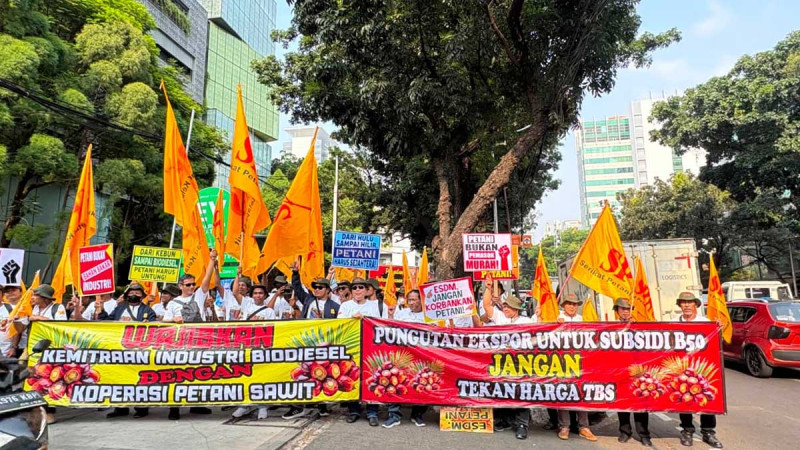
InfoSAWIT, JAKARTA – Indonesia’s palm oil downstream industry is developing faster than the regulatory framework governing the classification of derivative products, prompting the Indonesian Palm Oil Farmers Organization (POPSI) to call for an accelerated update to the country’s product classification rules.
POPSI is urging the Ministry of Industry to revise Ministerial Regulation No. 32/2024 on the classification of palm oil derivative commodities. The organization argues that the gap between product innovation, regulatory classification and trade could create obstacles for exports and eventually affect fresh fruit bunch (FFB) absorption from palm oil farmers.
POPSI Chairman Mansuetus Darto said the government needs a faster mechanism to test, identify and classify new products according to their technical characteristics and specifications.
“We are not asking for every new product to automatically be exempt from regulations. What we need is a fast mechanism to test, identify and classify products,” Darto said in an official statement received by InfoSAWIT on Saturday (September 26, 2026).
New Products Outpace Regulations
POPSI noted that Indonesia had produced around 200 downstream palm oil products by 2024, while Malaysia was historically reported to have developed as many as 300. The organization said diversification continues, particularly in the oleochemical sector.
The challenge arises when new by-products, residues, refined materials and fractions are not adequately covered by existing classification rules. POPSI said technological advances continue to generate new product variants, intermediates and refined derivatives, requiring a more responsive classification mechanism.
The organization also pointed to Malaysia’s Malaysian Palm Oil Board (MPOB), which it said has testing and analytical capabilities to determine the quality profiles and technical specifications of new oleochemical products.
POPSI warned that products which are technically ready for production and already have buyers could still face export delays if their nomenclature or classification has not been updated.
“Do not let a product be ready to produce and already have buyers, but its export is delayed simply because its nomenclature or classification has not been updated,” Darto said.
POPSI is calling for closer coordination among the Ministry of Industry, Ministry of Trade and Directorate General of Customs and Excise, including laboratory testing where necessary. (T2)