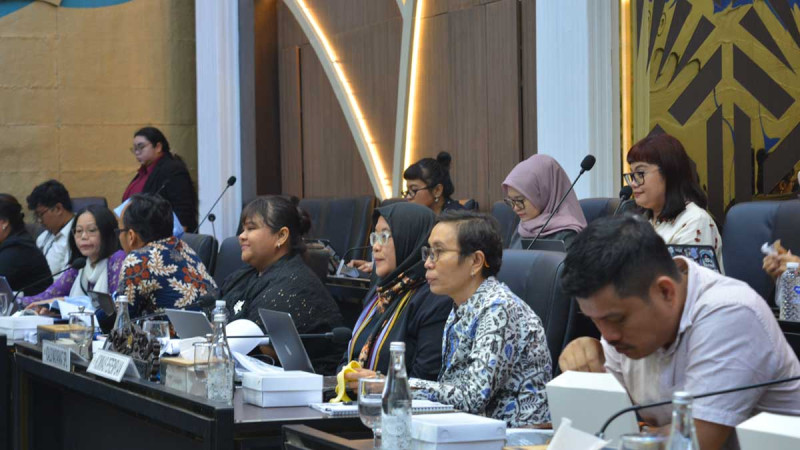
InfoSAWIT, JAKARTA – A civil society coalition has submitted its draft of Indonesia’s Indigenous Peoples Bill to the House of Representatives’ Legislative Body (Baleg DPR RI), highlighting 11 critical issues aimed at strengthening legal protection for indigenous communities and their customary territories.
The Kawal RUU Masyarakat Adat Coalition submitted the civil society version of the bill on September 2, 2026. The coalition said the draft is intended to ensure that the concerns and experiences of indigenous communities are properly reflected in the legislative process.
The coalition stressed that the proposed legislation should go beyond simply recognizing the existence of indigenous peoples. Recognition, it argued, must be accompanied by concrete protection of their rights, particularly when customary territories and sources of livelihood have been violated or taken away.
11 Key Issues in the Indigenous Peoples Bill
The coalition has identified 11 key areas that it believes need to be addressed in the bill.
They include strengthening definitions and terminology related to indigenous peoples and customary territories, simplifying recognition and protection mechanisms, and incorporating the principle of Free, Prior and Informed Consent (FPIC).
Other issues include the protection of indigenous women, the establishment of an Indigenous Peoples Commission, rehabilitation, restitution and compensation, empowerment, indigenous business entities and criminal provisions.
The draft also calls for special measures for indigenous peoples facing particular circumstances, while emphasizing the responsibility of both the state and non-state actors to respect and protect indigenous peoples' rights.
Customary Land Loss Goes Beyond Losing Property
The coalition said the loss or transfer of customary territory can have consequences extending far beyond the loss of land itself.
Indigenous communities may also lose access to food sources, living spaces and traditional knowledge passed from one generation to another. Such losses can also affect the ability of communities to preserve their identity and traditional systems of life.
Habel Simanjuntak, an indigenous community representative from Tano Batak, said indigenous communities are still frequently required to prove their existence and their rights over customary territories.
For Batak communities, he explained, land is not merely a place to live or a source of income. It is closely connected to ancestors, history and collective identity.
He urged the government to consider historical records, community testimony and customary rules in verification processes, rather than relying solely on formal certificates or documents.
Indigenous Women Seek Greater Participation
The protection of indigenous women is another issue highlighted in the proposed legislation.
The coalition said indigenous women can face different experiences and vulnerabilities when conflicts occur or communities lose access to their customary territories.
Women often play important roles in securing food, preserving knowledge, maintaining health and supporting the continuity of families and communities. Indigenous children and young people also face challenges in preserving their identity, language, knowledge and connections to their communities and customary territories.
Maria Amotey, an Indigenous Wambon woman from Boven Digoel, South Papua, said forests and customary territories are closely connected to the daily lives of indigenous women.
Women rely on forests for food and water, farming activities, traditional clothing materials and natural medicines. For that reason, she said indigenous women should be involved in decisions concerning land transfers and the management of customary territories.
Coalition Calls for Stronger Rights Recovery Mechanisms
Beyond recognition, the coalition is calling for clear mechanisms to resolve conflicts and restore indigenous rights.
Indigenous communities are often considered to be in a weaker position when dealing with permits, development projects and investment interests. During disputes, communities may once again have to prove their existence and defend their territories, including amid the risk of criminalization.
The civil society draft also places responsibility on corporations and other non-state actors to respect indigenous rights when their activities affect customary territories and community livelihoods.
The coalition hopes the draft will ensure that the experiences and needs of indigenous peoples remain central throughout the legislative process.
It also argues that recognition should no longer be layered, conditional and sectoral. Instead, the state should record indigenous communities rather than determine their existence, while customary territories should receive clear legal recognition and protection.
The coalition is urging Baleg DPR RI to ensure that deliberations on the Indigenous Peoples Bill remain open and participatory, with indigenous communities meaningfully involved in both the drafting process and decision-making.
For the coalition, legal recognition will not be sufficient if indigenous peoples continue to face territorial conflicts, displacement, criminalization and difficulties in recovering lost rights. (T2)
Source: InfoSAWIT