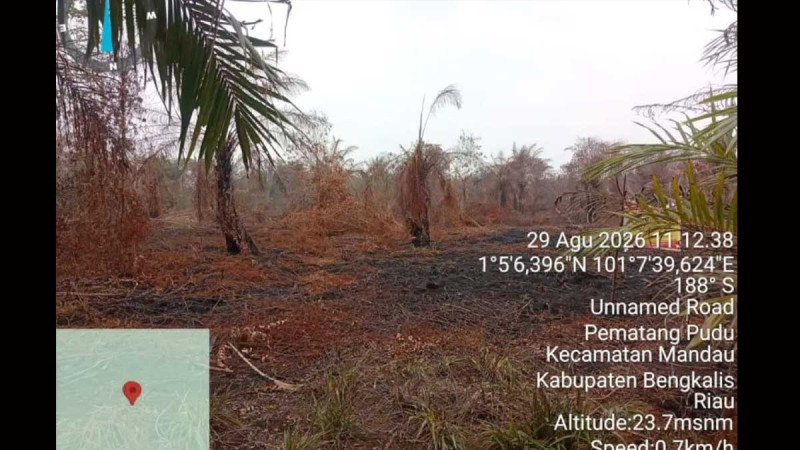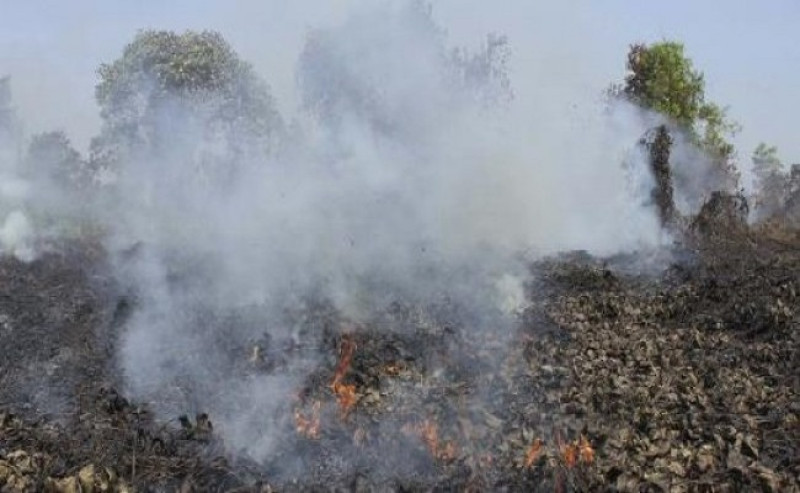
InfoSAWIT, PONTIANAK – Forest and land fires have once again become a major concern in West Kalimantan, with thousands of hotspots detected across the province during August 2026. Link-AR Borneo has urged the government to address not only firefighting, but also deeper issues surrounding land governance, plantation expansion and the distribution of land control.
According to a statement from Link-AR Borneo received by InfoSAWIT on Thursday, September 3, 2026, data from Indonesia’s Ministry of Forestry’s SiPongi monitoring system showed 6,526 hotspots in West Kalimantan as of August 29, 2026.
The figure was nearly double the number recorded one day earlier and placed West Kalimantan second among Indonesia’s six priority provinces for forest and land fire management, behind Central Kalimantan. Across the six provinces, 20,378 hotspots were recorded.
Hazardous Air Quality Raises Public Health Concerns
The fires have also contributed to severe air pollution in parts of West Kalimantan.
IQAir monitoring showed that Pontianak’s air quality index reached 987 on August 30, 2026, a level categorized as hazardous. PM2.5 concentrations were reported at 570 micrograms per cubic meter.
Link-AR Borneo said fires had also spread toward residential areas, destroying homes and threatening orangutan habitat and other wildlife. Smoke from the fires was reportedly carried across the border toward Sarawak, Malaysia.
The organization argued that recurring fires demonstrate that the problem cannot be addressed solely through emergency response measures.
Plantation Expansion Under Scrutiny
Link-AR Borneo said large-scale forest and land fires have repeatedly occurred in West Kalimantan, including during the major fire seasons of 1997–1998, 2015, 2019 and 2026.
The organization linked the recurring crisis to broader land-use and governance issues, including the expansion of oil palm plantations and industrial timber plantations since the 2000s.
According to the group, large-scale land conversion has contributed to forest loss, land degradation and increased fire vulnerability during the dry season.
Peatland areas are considered particularly vulnerable. The organization noted that land clearing accompanied by canal and drainage construction can lower groundwater levels, leaving peat drier and more susceptible to fire. Once ignited, peat fires can also spread underground, making them difficult to control.
3.8 Million Hectares of Non-Forest Area Allocated to Oil Palm
Land allocation for plantations has become one of the key issues raised by Link-AR Borneo.
West Kalimantan covers approximately 14.68 million hectares, of which around 8.39 million hectares, or 57.2%, are classified as forest and water conservation areas.
Within production forest areas, 63 Forest Utilization Business Licensing (PBPH) concessions reportedly cover approximately 2.77 million hectares.
Outside forest areas, the province has around 6.3 million hectares classified as Other Use Areas (APL). Citing 2025 data from the West Kalimantan Plantation Agency, Link-AR Borneo said approximately 59.95%, or 3.8 million hectares, had been allocated for oil palm plantations.
A total of 366 companies were reported to hold plantation business permits covering 2.94 million hectares, with approximately 2.14 million hectares already planted.
The organization also highlighted a potential oil palm expansion target of around 3.797 million hectares. That would represent a potential addition of approximately 1.65 million hectares compared with the area already planted.
Link-AR Borneo said such expansion plans should be comprehensively reviewed while the province continues to face recurring forest and land fires and haze.
Calls for Fairer Law Enforcement
The organization also questioned the pattern of law enforcement in forest and land fire cases.
Based on data cited by Link-AR Borneo, Indonesia’s Criminal Investigation Agency had named 72 people as suspects in land-burning cases, most of whom were reportedly small-scale individual farmers.
At the same time, the organization argued that investigations involving large-scale companies remained limited.
Link-AR Borneo said firefighting operations, water bombing and weather modification alone would not resolve the underlying problem. In its view, addressing unequal land ownership and improving concession governance should form part of a broader fire-prevention strategy.
Government Urged to Review Palm Oil and Land Policies
Link-AR Borneo called on the government to review policies concerning traditional farming practices by indigenous communities, including the instruction to revoke West Kalimantan Regional Regulation No. 1 of 2022 on land clearing based on local wisdom.
The organization said the regulation had governed limited controlled burning for traditional cultivation, including a maximum area of two hectares per household, the use of mineral soils, firebreaks and supervision.
Link-AR Borneo argued that small-scale traditional farming practices should be distinguished from large-scale land clearing that can potentially generate fires and haze across much wider areas.
The organization has called for the 2026 forest and land fire and haze crisis to be declared a national disaster, stronger oversight of traditional land-clearing practices, and evaluations of PBPH, plantation business and mining concession holders whose areas are found to be affected by fires.
It also urged the government to avoid criminalizing small-scale farmers, restore damaged peatland hydrology, protect forest areas and reassess licensing governance across the forestry, oil palm and bauxite mining sectors.
For Link-AR Borneo, without fundamental improvements in land governance and natural resource management, recurring fires and haze could continue to place pressure on communities and ecosystems across West Kalimantan. (T2)