
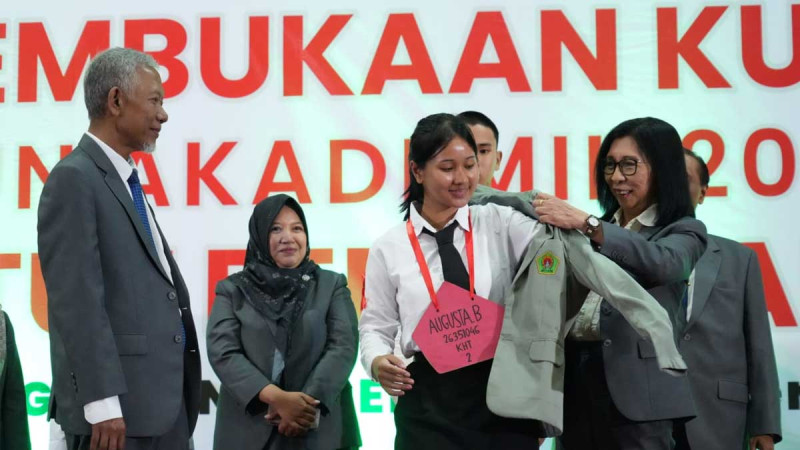
InfoSAWIT, YOGYAKARTA – Institut Pertanian Stiper (INSTIPER) Yogyakarta has welcomed 1,135 new students for the 2026/2027 academic year, including 150 recipients of the Palm Oil Plantation Human Resources (SDM PKS) scholarship program.
The growing intake reflects the university's continued role in preparing skilled human resources for Indonesia's plantation, forestry and agroindustry sectors.
In an official statement received by InfoSAWIT on Friday (September 4, 2026), INSTIPER said its new student intake increased by 218 students, or 20.8 percent, from the previous academic year, when 876 undergraduate students enrolled.
Of the 1,135 new students this year, 1,058 are enrolled in undergraduate programs, while 77 are pursuing postgraduate studies.
At the undergraduate level, the Faculty of Agriculture attracted the largest number of students, with 766 students, representing around 72.4 percent of the intake. The Faculty of Agricultural Technology enrolled 196 students, or 18.5 percent, while the Faculty of Forestry welcomed 96 students, or approximately 9 percent.
The new students come from 28 provinces across Indonesia. North Sumatra recorded the largest number of incoming students, followed by Riau, Central Kalimantan, West Kalimantan and Central Java.
150 Students Receive Palm Oil Human Resources Scholarships
Scholarship support remains an important part of INSTIPER's efforts to develop skilled professionals for Indonesia's plantation sector.
For the 2026/2027 academic year, 329 new students, or around 29 percent of the total intake, received scholarships.
Of that number, 150 students received the Palm Oil Plantation Human Resources scholarship provided through the Directorate General of Plantations at the Ministry of Agriculture in cooperation with the Palm Oil Plantation Fund Management Agency (BPDP) under the Ministry of Finance.
The program is intended to help prepare graduates with the skills and competencies needed to contribute to the development of Indonesia's palm oil industry.
Other scholarships came from companies and regional governments. PT Riau Andalan Pulp and Paper (RAPP), for example, sent 35 scholarship recipients to pursue undergraduate studies at INSTIPER's Faculty of Forestry. RAPP has reportedly supported INSTIPER's scholarship program for 16 years.
Asian Agri Group provided scholarships to 13 students, Karyamas Plantation to 59 students, PT London Sumatra Indonesia to 20 students, and PT Bumitama Gunajaya Agro to nine students.
Additional support came from Mahitala Ingkeng Gemah for two students, the Ngada Regency Government for five students, and the KIP Kuliah program for 36 students.
INSTIPER Strengthens Plantation Competencies
INSTIPER Yogyakarta Rector Dr. Harsawardana, M.Eng., said the confidence shown by industry and government partners was an important part of the university's efforts to improve educational quality and student competencies.
He said INSTIPER's core competencies in plantation and forestry had helped strengthen partnerships with companies and government institutions.
Harsawardana also emphasized the importance of equipping students with skills that go beyond academic knowledge, including Higher Order Thinking Skills (HOTS) and the six C competencies: communication, collaboration, critical thinking, creative thinking, computational logic and compassion.
These competencies are expected to help graduates become better prepared to enter the workforce, particularly in the plantation, forestry and agroindustry sectors.
Research and Innovation Key to Plantation Competitiveness
As part of the opening of the 2026/2027 academic year, INSTIPER also hosted a public lecture by Puji Lestari, Ph.D., Head of the Agricultural and Food Research Organization at Indonesia's National Research and Innovation Agency (BRIN).
The lecture focused on "The Role of Research and Innovation in Increasing the Competitiveness of Plantation Products."
Puji said plantation commodities play a crucial role in Indonesia's economy, making research and innovation essential to improving the competitiveness of plantation products from upstream production through downstream processing.
She highlighted commodities including palm oil, cocoa, coffee, coconut, sago, areca nut, pepper and tobacco.
According to Puji, plantation development should focus on improving productivity, product quality, efficiency, added value and market access.
Beyond classroom learning, INSTIPER also provides students with additional training through the INSTIPER Academy, a curriculum-support program designed to strengthen graduate competencies.
New students will subsequently take part in the Campus Orientation and Plantation Familiarization program, known as OKKABUN, running from August 31 to September 9, 2026. The program includes a plantation familiarization session at KP2 Ungaran from September 5–7.
Through these programs, INSTIPER aims to provide students with not only an understanding of campus life and academic culture but also early exposure to the plantation sector.
With a growing student intake and expanded scholarship support, including the Palm Oil Plantation Human Resources scholarship program, INSTIPER is strengthening its role in preparing professional talent for Indonesia's plantation, forestry and agroindustry sectors. (T2)