
InfoSAWIT, JAKARTA – Scientific evidence increasingly shows that oil palm is not the water-hungry crop it is often portrayed to be. Yet across many plantation regions, communities continue to experience more frequent flooding during the rainy season and worsening water shortages during dry periods. The apparent contradiction highlights a deeper issue: the problem may not be how much water oil palm consumes, but how landscapes are managed after forests are converted into plantations.
For years, oil palm has faced criticism for allegedly draining rivers, drying up wells, and disrupting natural water cycles. Industry advocates, however, argue that the crop is more water-efficient than many agricultural alternatives. Between these opposing narratives, scientific research offers a more nuanced perspective.
Where Does the “Water-Guzzling” Label Come From?
The term “water-guzzling crop” is widely used in public debates, yet it lacks a formal scientific definition.
Hydrologists typically assess plant water use through concepts such as evapotranspiration (ET)—the process by which water is transferred from soil to the atmosphere through plant leaves—and soil water storage capacity. According to internationally recognized crop water-use models developed by the Food and Agriculture Organization, crop water requirements depend on a combination of plant characteristics, climate conditions, and soil properties.
As a perennial tropical crop with year-round foliage, oil palm naturally consumes substantial amounts of water. However, soil type and landscape conditions often play an equally important role. Sandy soils, for example, retain significantly less moisture than clay-rich soils, while compacted land reduces water infiltration and accelerates surface runoff.
The implication is clear: water use cannot be attributed solely to the crop itself. It is the interaction between vegetation, soil, and climate that determines how water behaves across a landscape.
What the Data Actually Shows
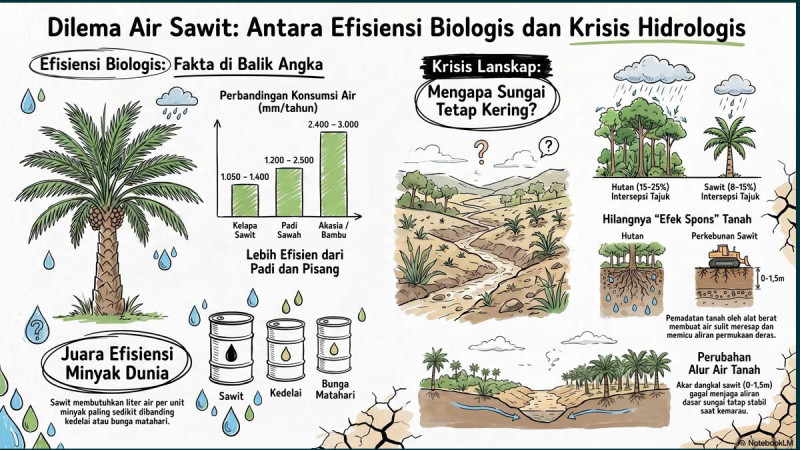
Studies using sap-flow measurements and watershed water-balance assessments in Sumatra and Kalimantan indicate that annual evapotranspiration in oil palm plantations typically ranges between 1,050 and 1,400 millimeters per year.
Those figures place oil palm in a surprising position relative to other land uses:
Comparable to many tropical rainforests it replaces.
Lower than fast-growing plantation species such as acacia and bamboo, which can exceed 2,400–3,000 mm annually.
Similar to or lower than crops such as irrigated rice, sugarcane, and bananas commonly cultivated across Southeast Asia.
Research on global water footprints has also shown that oil palm is among the most efficient oil-producing crops in terms of water consumed per unit of vegetable oil produced. Compared with soybean, sunflower, and rapeseed, oil palm generally requires less water to generate the same volume of edible oil.
From a productivity perspective, therefore, oil palm is often considered highly water-efficient.
The Real Difference Lies in How Water Moves
Scientists argue that the more important question is not how much water oil palm consumes, but how water moves through the landscape after forest conversion.
Tropical rainforests function as highly effective natural sponges. Dense canopies intercept a significant share of rainfall before it reaches the ground, deep root systems access groundwater during dry periods, and porous forest soils allow water to infiltrate gradually before feeding rivers through stable base flows.
Oil palm plantations operate differently.
Canopy interception is lower, meaning more rainfall reaches the soil surface directly. Root systems are generally concentrated in shallower soil layers, while plantation roads and repeated machinery traffic often compact the soil, reducing infiltration capacity.
As a result, watersheds converted from forest to large-scale monoculture plantations frequently experience higher flood peaks during heavy rainfall and reduced streamflow during dry seasons.
In other words, the issue is not necessarily that oil palm consumes more water than forests, but that land conversion alters the pathways through which water is stored, absorbed, and released.
Beyond the “Water-Hungry” Debate
The scientific consensus suggests that labeling oil palm as simply “water-intensive” oversimplifies a much more complex hydrological reality.
While oil palm remains one of the most productive and water-efficient oil crops globally, large-scale forest conversion without proper watershed management can generate significant environmental consequences, including:
Increased flooding during periods of intense rainfall.
Reduced river flows during drought conditions.
Greater vulnerability of shallow community wells to seasonal drying.
Experts from organizations such as the FAO and the International Commission on Irrigation and Drainage have long cautioned against evaluating agricultural systems solely through evapotranspiration figures. Instead, they emphasize the importance of landscape-level water management.
Among the measures commonly recommended are maintaining forest buffers along rivers, reducing soil compaction through improved agricultural practices, and implementing integrated drainage and water-retention systems across plantation landscapes.
A Question of Management, Not Just Water Use
For Indonesia, the debate over oil palm and water extends far beyond academic discussions. It affects rural communities facing seasonal floods, farmers struggling with declining water availability, and river systems under increasing environmental pressure.
Oil palm is neither the sole culprit nor an environmental cure-all. Other agricultural commodities, including rice and sugarcane, can consume equal or greater volumes of water. The real challenge lies in ensuring that plantation expansion is guided by sound land-use planning, science-based agronomy, and responsible watershed management.
Ultimately, the key question is no longer whether oil palm is a water-hungry crop, but whether society is managing water resources intelligently within landscapes where oil palm is grown. (*)
This article is based on an opinion piece by Ts. Dr. Muhamad Askari, Indonesian diaspora scholar and Senior Lecturer at the Faculty of Sustainable Agriculture, Universiti Malaysia Sabah. The views expressed are solely those of the author and do not necessarily reflect those of InfoSAWIT.