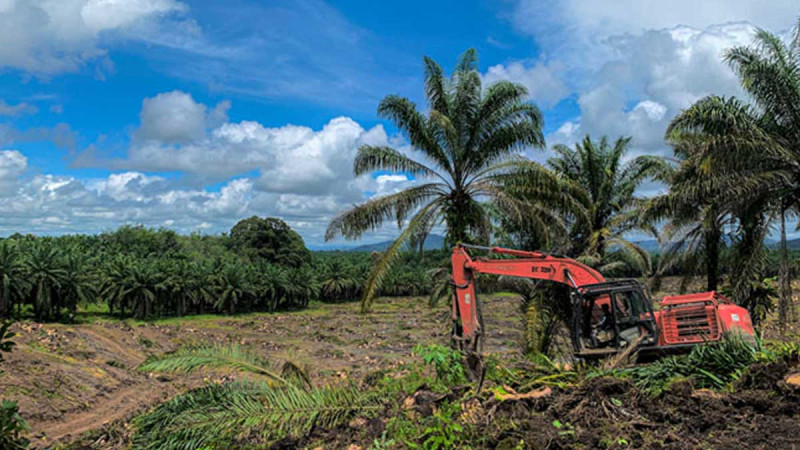
InfoSAWIT, JAKARTA — Debate over the planned relocation of oil palm farmers from Tesso Nilo National Park (TNTN) has resurfaced. Ahmad Zazali, SH., MH., Head of the Center for Law and Conflict Resolution (PURAKA), emphasized that any government policy must not undermine the rights of communities that have long resided and cultivated the area. He believes the relocation agenda is strongly tied to the carbon project financed under the FOLU Net Sink 2030 scheme.
“Tesso Nilo is not an empty landscape without social history,” Zazali stressed on Wednesday (3/12/2025). He explained that the Tesso Nilo landscape has been a traditional territorial domain (perbatinan) since the Pelalawan Kingdom era in the 1790s—long before the region officially became part of Indonesia in 1946.
Long Trail of Land Governance in Tesso Nilo
Zazali outlined how traditional governance structures lost administrative authority following the 1965 Villages Law, although socially the perbatinan continued to be recognized as customary landholders.
Key milestones include:
• 1974: Perbatinan land designated as a logging concession (HPH).
• 1986: Forest areas formally designated under TGHK.
• 1993: Industrial plantation forest (HTI) permit issued to PT RAPP via Decree No. 130/Kpts-II/1993.
• 2002: WWF and BKSDA proposed establishing TNTN, despite extensive community plantations already present.
• 2004 & 2009: TNTN designated and later expanded, even as tens of thousands of hectares were already farmed by residents.
• 2014: Final gazettement issued, with community plantations reaching nearly 30,000 hectares.
“It is inaccurate to call them encroachers. Many opened land long before TNTN existed, with legitimate rights granted through customary mechanisms,” he noted.
Suspected Link to Carbon Projects
Zazali argued the relocation plan is economically driven and linked to carbon financing. He referenced public concerns raised by parliament over the composition of the FOLU Net Sink task force.
PURAKA is urging the government to consider alternatives to relocation, including reducing HTI concessions around TNTN. He noted that elephant habitat spans not only the park but also areas within PT RAPP (APRIL Group) and large-scale plantations of PT Inti Indo Sawit (Asian Agri Group).
Zazali proposed several steps aligned with recommendations from Komnas HAM and recent parliamentary meetings:
• Establish formal dialogue with independent mediators.
• Reduce HTI concessions to create dedicated elephant conservation zones.
• Involve communities in elephant habitat restoration, including reforestation of reclaimed concession areas.
“Relocation is not the only option. The government must recognize the area’s social history and consider cutting back HTI concessions to protect both wildlife and community rights,” he concluded. (T2)