InfoSAWIT, JAKARTA – Indonesia is intensifying efforts to transform palm oil research into commercial innovation as the government positions scientific development as a key driver of the country's B50 biodiesel implementation and higher-value downstream industries.
Coordinating Minister for Economic Affairs Airlangga Hartarto said research and innovation must become the foundation for strengthening Indonesia's global competitiveness as the world's largest palm oil producer.
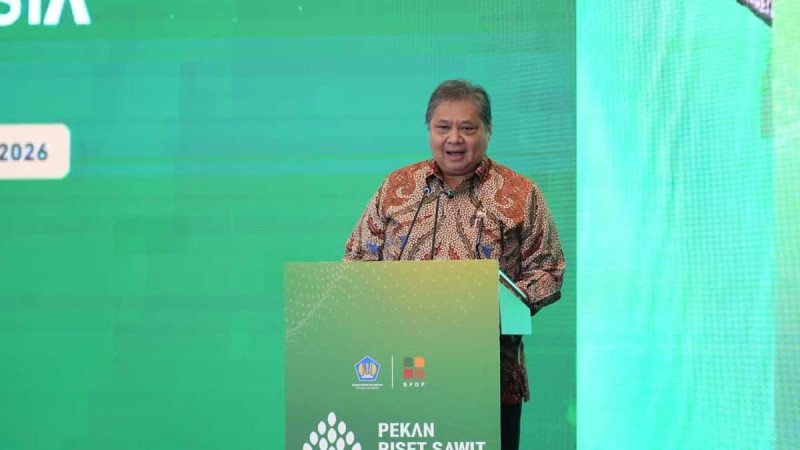
Speaking at the closing ceremony of Indonesia Palm Oil Research Week (PERISAI) 2026, Airlangga emphasized the need to integrate research, public policy, industrial investment, and manufacturing capabilities to generate innovations that deliver tangible economic benefits.
He praised the Palm Oil Plantation Fund Management Agency (BPDP) for consistently bringing together researchers, universities, government institutions, investors, and industry players through collaborative research initiatives.
According to Airlangga, Indonesia needs more applied research capable of producing commercially viable technologies and high-value palm-based products. He also highlighted innovations developed by university students, including palm-derived polyurethane foam materials and anode materials utilizing oil palm fresh fruit bunches.
BPDP data show that the palm oil industry remained one of Indonesia's key economic pillars in 2025, contributing approximately 3.5% of national GDP. Palm oil exports reached USD 30.87 billion, with export volume climbing to 38.84 million tonnes, representing an annual increase of about 11.05%.
Airlangga noted that the mandatory B50 biodiesel program, implemented on July 1, 2026, and officially launched by President Prabowo Subianto on July 9, demonstrates how research can successfully evolve into national policy supported by industrial readiness and investment.
He said the success of B50 should pave the way for broader downstream development, including green diesel, Sustainable Aviation Fuel (SAF) produced from Used Cooking Oil (UCO), and palm-based gasoline technologies.
These innovations, he added, are expected to generate greater added value while attracting new downstream investment opportunities.
Despite the industry's strong performance, Airlangga cautioned that long-term competitiveness cannot rely solely on production growth. Technological capability, plantation productivity, downstream product diversification, and sustainable governance must continue advancing together.
PERISAI 2026 also highlighted the growing role of young researchers through the National Student Palm Oil Research Competition, which attracted participants from 40 Indonesian universities. Ten finalists were selected after a two-day evaluation, with three outstanding projects receiving awards.
Airlangga encouraged universities to ensure that research outcomes move beyond academic publications and enter commercial application, while maintaining protection for researchers' intellectual property rights.
Beyond palm oil, the government is also accelerating rejuvenation programs for Indonesia's cocoa and coconut plantations, recognizing that productivity improvements in these predominantly smallholder sectors can directly enhance farmer livelihoods.
He concluded by calling on BPDP, universities, research institutions, businesses, and other stakeholders to strengthen collaboration so that research can continue supporting industrial competitiveness, farmer welfare, and national economic growth. (T2)
Source: InfoSAWIT