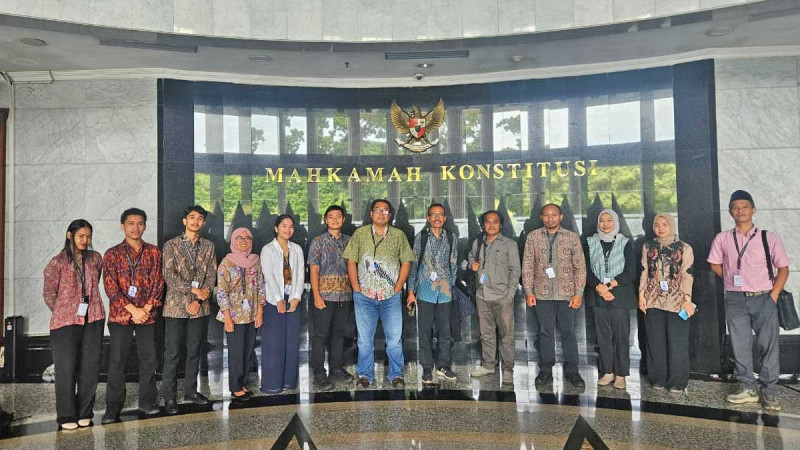
InfoSAWIT, JAKARTA – Indonesia's Coalition for Agrarian Reform and Land Rights Protection (KEPAL) has renewed its appeal to the Constitutional Court to annul several land acquisition provisions contained in the Job Creation Law, arguing that the legislation threatens farmers' rights, indigenous communities, and agrarian justice.
In a statement received by InfoSAWIT, the coalition said the contested provisions prioritize investment interests while weakening safeguards for customary land rights and local communities that have managed their territories for generations.
Sawit Watch Executive Director Achmad Surambo argued that the law's land procurement framework lacks adequate protection mechanisms for indigenous peoples and civil society.
He also criticized the extensive authority granted to Indonesia's Land Bank Agency, warning that it could facilitate the transfer of community-managed land for investment projects under the National Strategic Projects (PSN) scheme.
According to Surambo, although Constitutional Court Decision No. 181/PUU-XXII/2024 strengthened legal protection against the criminalization of indigenous communities in forest areas, those protections would remain ineffective if communities continue facing displacement through land acquisition mechanisms.
The coalition therefore called on the Constitutional Court to revoke provisions that simplify land acquisition for strategic projects involving private investors, arguing that they conflict with Article 33 of Indonesia's Constitution.
A similar concern was raised by Marselinus Andri, Head of Advocacy at the Indonesian Oil Palm Smallholders Union (SPKS), who said the Job Creation Law has become the legal basis for forest area enforcement conducted by the Forest Area Enforcement Task Force (PKH), without sufficient protection for farmers and local communities.
SPKS estimates that more than a thousand oil palm smallholders have already been affected by enforcement actions, while thousands more remain at risk because their plantations fall within designated forest areas.
"The Constitutional Court needs to correct these legal provisions to ensure constitutional protection for farmers' rights," Andri said.
Sri Palupi of The Institute for Ecosoc Rights also argued that the ongoing judicial review demonstrates the law has failed to address structural inequalities in land ownership or resolve long-standing agrarian conflicts.
Meanwhile, the Indonesian Farmers Alliance (API) maintained that the legislation weakens farmers' position as key actors in national agricultural development while creating uncertainty over land tenure, seed ownership, and rural livelihoods.
KEPAL noted that the Constitutional Court had previously partially granted another judicial review of the Job Creation Law concerning labor provisions, and urged the justices to adopt a similar constitutional approach in reviewing land acquisition regulations.
The coalition concluded by urging the Court to uphold constitutional protections over land rights, approve the judicial review in full, invalidate the disputed provisions, and ensure Indonesia's agrarian policies remain aligned with the principles of social justice mandated by the Constitution. (T2)