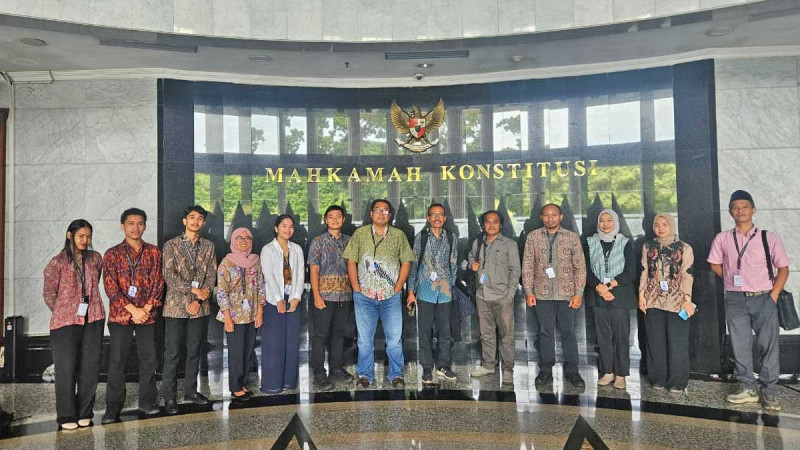
InfoSAWIT, JAKARTA – Indonesia's Constitutional Rights Defenders Committee (KEPAL) has formally submitted its final arguments to the Constitutional Court in three judicial review cases challenging key provisions of Law No. 6 of 2023 on Job Creation, marking the conclusion of court proceedings before judges begin deliberations.
According to an official statement received by InfoSAWIT on Saturday (July 11), the legal challenges are registered under Cases No. 168/PUU-XIII/2025, 203/PUU-XIII/2025, and 213/PUU-XIII/2025.
The petitions question several strategic provisions that the coalition argues have significant implications for agrarian reform, agriculture, food security, land acquisition, and community land rights.
Case No. 168 challenges provisions that petitioners argue revive legal norms previously declared conditionally unconstitutional by the Constitutional Court. These include regulations concerning government approval for smallholder seed distribution, foreign investment limits in horticulture, water resource management, sanctions affecting communities living in forest areas, and agrarian reform mechanisms involving Indonesia's Land Bank Agency.
Meanwhile, Case No. 203 focuses on agricultural and food policies, particularly provisions that could facilitate agricultural land conversion through National Strategic Projects (PSN) and potentially expand food imports.
Case No. 213 examines regulations governing land acquisition, the expanded definition of "public interest," compensation mechanisms, land management rights (HPL), and the authority granted to the Land Bank Agency, which petitioners argue could increase land concentration among investors.
KEPAL stated that throughout the hearings, the government and its expert witnesses failed to adequately address the constitutional concerns raised by petitioners, instead emphasizing policy justifications without demonstrating how the disputed provisions sufficiently protect citizens' constitutional rights to land and livelihoods.
One major concern relates to the government's explanation that the Land Bank Agency operates using a corporate approach, which the coalition argues reinforces fears that investment interests may take precedence over agrarian reform objectives.
Dewi Kartika, Secretary General of the Consortium for Agrarian Reform (KPA), said the hearings revealed fundamental issues within the Job Creation Law and urged the Constitutional Court to restore agrarian policies consistent with constitutional principles by strengthening protections for farmers and rural communities.
She also criticized the Land Bank's use of Management Rights (HPL), arguing that the mechanism is not recognized under Indonesia's Basic Agrarian Law of 1960 and could weaken community ownership rights.
KPA recorded at least eight agrarian conflicts over the past two years that it associates with land claims involving the Land Bank Agency.
Senior adviser to the Indonesia Human Rights Committee for Social Justice (IHCS), Gunawan, argued that the Constitutional Court has a responsibility to uphold consistency with its previous ruling that declared the Job Creation Law procedurally flawed and conditionally unconstitutional.
Meanwhile, Dwi Astuti, Chair of Bina Desa, said the controversy extends beyond individual articles, arguing that the law reflects a broader development model that increasingly prioritizes investment while reducing farmers', indigenous peoples', and coastal communities' access to land, seeds, water, and other livelihood resources.
Similarly, Rahmat Maulana Sidik, Executive Director of Indonesia for Global Justice (IGJ), maintained that the Job Creation Law has been problematic since its inception, both procedurally and substantively, particularly regarding provisions that could further liberalize foreign investment in sectors such as horticulture.
The coalition hopes the Constitutional Court will grant the judicial review requests and strike down provisions deemed inconsistent with Indonesia's Constitution, strengthening legal protections for farmers, indigenous peoples, fishers, and agrarian reform initiatives. (T2)