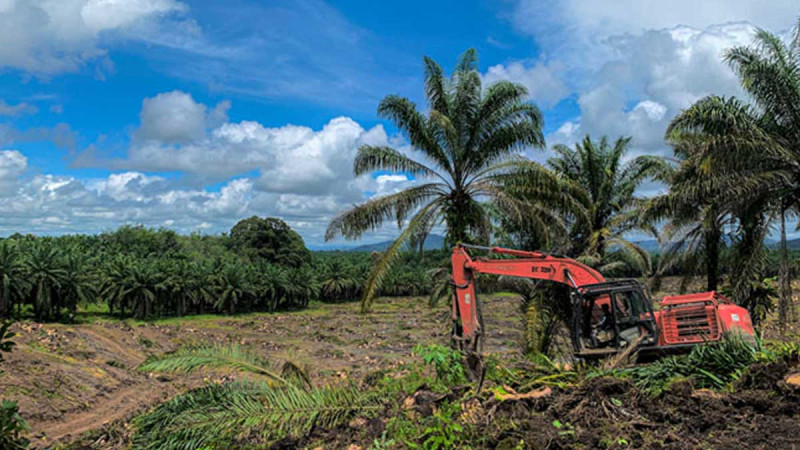
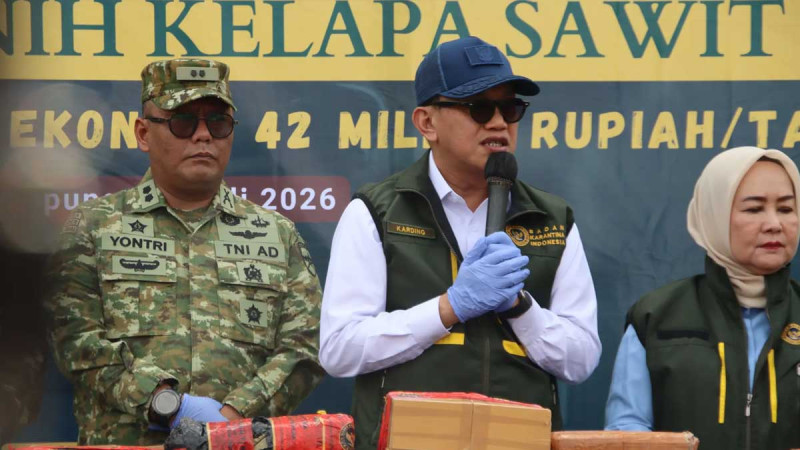
InfoSAWIT, JAKARTA - The government's step to take over problematic palm oil lands and plantations deserves appreciation. This policy serves as a stern warning to private companies, both local and foreign, as well as regional heads, not to recklessly open plantations in forest areas. It's time to stop relying on "maps on the table" and "envelopes that speak" in decision-making. Nature cannot continue to be a victim of human negligence.
According to data revealed by ATR/BPN Head Nusron Wahid (Kompas.com, 24/2/2025), 1.1 million hectares of palm plantations have been confiscated from a total of 3.7 million hectares that are problematic. This number could continue to increase up to 4 million hectares. The plantations already tracked by the Forest Area Management Task Force (PKH) will clearly not be maintained as before, and this will certainly impact productivity decline.
The wide distribution of confiscated land—from Central Kalimantan, East Kalimantan, Riau, Jambi, South Sumatra to North Sumatra—requires careful arrangement. Plantation management offices should be located in each respective province for more effective operations and to circulate business proceeds in the regions, strengthening the local economy.
Economic Scale Challenges and Management Complexity
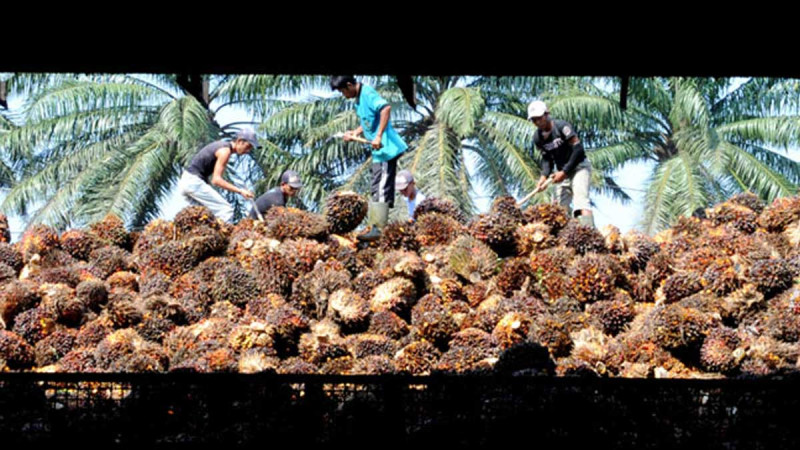
Ideally, palm plantation management should not exceed 500,000 hectares, equivalent to 100 plantation units each 5,000 hectares in size. Beyond that limit, efficiency and supervision will decrease drastically. Remember, each hectare of plantation contains about 130–135 palm trees—each tree is like a "living oil factory" that needs attention from root to fruit.
If one company manages 500,000 hectares, it means they are responsible for about 65 million palm trees. This scale requires mature management systems, human resources, and technology. Unfortunately, in many cases, expansion is not matched by technical and social readiness in the field.
Imagine, a plantation assistant leads 80 people and manages assets worth Rp62.5 billion. A plantation manager handles Rp625 billion, while the board of directors controls assets up to Rp62.5 trillion and 85,000 workers. This is not just about planting and harvesting—it's a major operation that demands high discipline, competence, and integrity.
Social and Technical Challenges
Forming a new company like PT Agrinas Palma Nusantara to manage confiscated plantations is indeed a bold step, but full of risks. Combining various work cultures, backgrounds, and old systems is not easy. It takes 4–5 years to build solid cohesion and a new work ethic.
From an agronomic technical perspective, differences in plant conditions, tree density, and productivity also require specific approaches. The solution is to increase training, capacity building, and knowledge exchange between regions.
However, the most realistic step is to integrate confiscated plantations into experienced PTPNs. For example, plantations in North Sumatra could be merged with PTPN I-IV, in Riau with PTPN V, in Jambi with PTPN VI, and so on. PTPNs have infrastructure, management systems, and human resources that have proven to produce the best national productivity.
Recommendations for New Governance
The maximum management limit should remain 600,000 hectares per entity. If it exceeds that, new companies can be formed—such as PT Agrinas Palma Nusantara 1 and 2—with professional training and recruitment systems. In Kalimantan, PTPN XIII could focus on West and South Kalimantan, while Agrinas Palma Nusantara holds East and Central Kalimantan. For eastern areas like Sulawesi, Maluku, and Papua, a new entity like PT Agrina Nusantara 2 could be formed.
PalmCo as a holding can adjust this structure, especially in Aceh and North Sumatra. Board appointments must be based on performance track records, not "position dowry." Professionalism and integrity are key so that targets for increasing BUMN dividends as expected by President Prabowo can be achieved.
Economic Potential and Social Impact
If 3.7 million hectares of confiscated land are optimally managed, BUMN plantation area will jump from 573 thousand hectares to 4.27 million hectares, or about 25% of the national total. With average FFB productivity of 23 tons per hectare per year, 23% yield, and CPO+PKO price of Rp12,000/kg, each palm BUMN has the potential to earn Rp38 trillion in revenue, with gross profit around Rp23 trillion.
Multiplied by 9 plantation BUMNs, the total dividends that can be contributed to the state could reach more than Rp30 trillion per year—a 1,000% increase compared to 2024. In addition, more than 2 million new jobs can be created in this sector, both direct and indirect.
The government's step to confiscate problematic palm land is a golden momentum to reorganize this strategic sector. With professional management, transparent governance, and sustainability orientation, Indonesia can build a palm industry that not only benefits the country but also preserves the environment and improves community welfare.
It's time for the palm sector to become a symbol of progress, not controversy. From plantations that were once problematic, now hope can grow towards sovereign, ethical, and sustainable palm oil. (*)
Author: Memet Hakim – Social & Plantation Observer
Disclaimer: The article is a personal opinion and fully the responsibility of the author and has no relation to InfoSAWIT.