InfoSAWIT, MEDAN – Strengthening partnerships between palm oil companies and smallholders is being highlighted as an important step toward developing a more capable and competitive farming workforce. Rumah Sawit Indonesia (RSI) Chairman Kacuk Sumarto said stronger institutional capacity among smallholders is needed to support the transformation of Indonesia's palm oil sector.
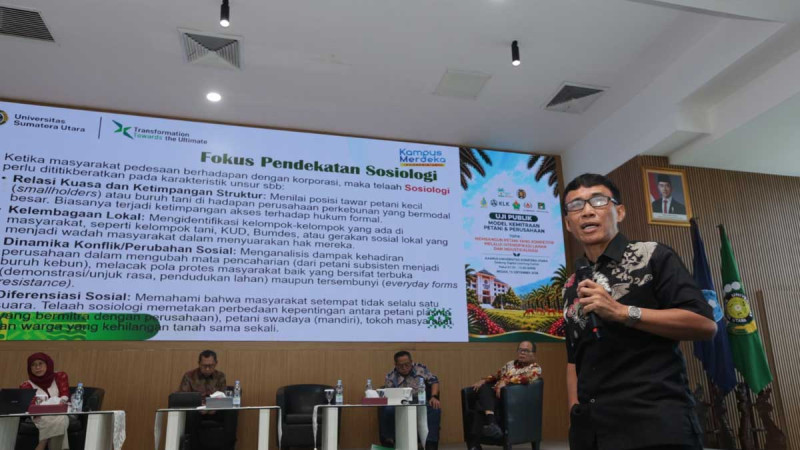
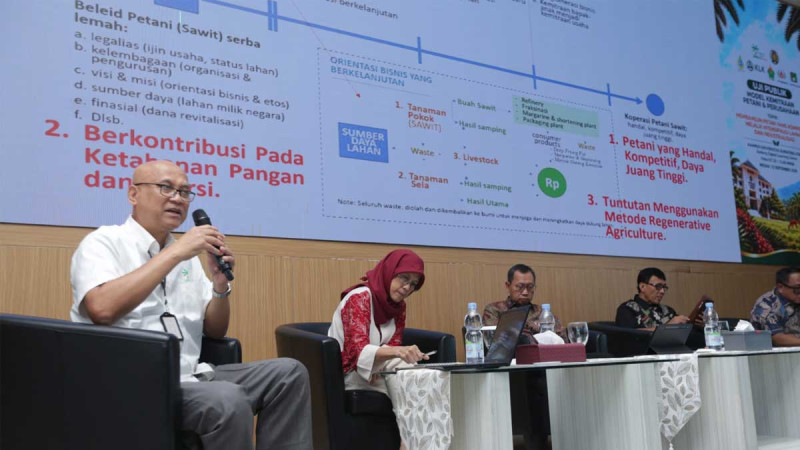
Kacuk delivered the remarks during a public consultation discussion at the University of North Sumatra (USU) in Medan. The event carried the theme “Smallholder–Company Partnerships in Building Reliable and Competitive Smallholders through Land Intensification and Industrialization.”
According to Kacuk, existing regulations concerning palm oil smallholders remain weak in several fundamental areas. Among the challenges are business licensing and land legality, weak farmer institutions, limited business vision and strategy, dependence on state-owned land resources, and restricted access to financing and revitalization funds.
“These fundamental conditions require strategic steps to strengthen the position of independent smallholders in a rational and sustainable manner,” Kacuk said.
Integrated Partnership Strategy
RSI has outlined an integrated series of stages for developing smallholder–company partnerships. The process begins with a preparation phase focused on resolving land status, business permits and legal land rights.
Legal improvements, Kacuk said, need to be accompanied by institutional consolidation involving local governments and cooperative offices. Other elements include preparing a business master plan and roadmap, establishing fair partnership arrangements, developing organizational structures, securing funding, conducting social and anthropological studies, and preparing community-based core energy initiatives.
Once the foundation is established, the strategy moves toward institutional development and a comprehensive partnership business model. Capacity building would cover soft skills, technical skills and personality development among smallholders.
The proposed development also includes new plantations and infrastructure, integrated businesses based on a circular economy, improved administration and monitoring and evaluation systems, absorption of harvested production, digital governance and sustainability certification.
The next stage focuses on scaling up businesses and corporatization. Smallholders would not remain focused solely on upstream plantation activities but could expand into consumer goods processing, local and regional markets, and the development of new products and markets.
At the final stage, the partnership model is envisioned to expand toward larger-scale business operations through continued corporatization.
Kacuk said the ultimate goal is the creation of an Independent Corporate Cooperative, positioning smallholders not merely as passive partners but as shareholders and managers of a cooperative-based corporate entity.
The broader transformation is intended to build competitive smallholders, strengthen the contribution of palm oil to national food and energy security, and respond to global demands through environmentally oriented regenerative agriculture. (T2)
Source: InfoSAWIT