JAKARTA, InfoSAWIT – Every dry season, as hotspots and forest and land fires return across parts of Sumatra and Kalimantan, Indonesia's palm oil industry often finds itself at the centre of public scrutiny.
The problem, however, is that the presence of a hotspot or a burned area within or near a plantation concession does not automatically explain how the fire started, who caused it, or whether the company was negligent.
Public debate surrounding forest and land fires, commonly known as karhutla, can quickly turn into broad generalisations that place the entire palm oil industry in the position of the accused. Satellite imagery may detect heat signatures within concession boundaries, but the legal process should not stop at the detection of a hotspot.
The fundamental question remains one of causation and evidence.
Palm Oil Should Not Become an Automatic Target
The palm oil sector is often treated as an easy target whenever fires occur, without sufficient consideration of local conditions, historical land-use dynamics or the actual source of ignition.
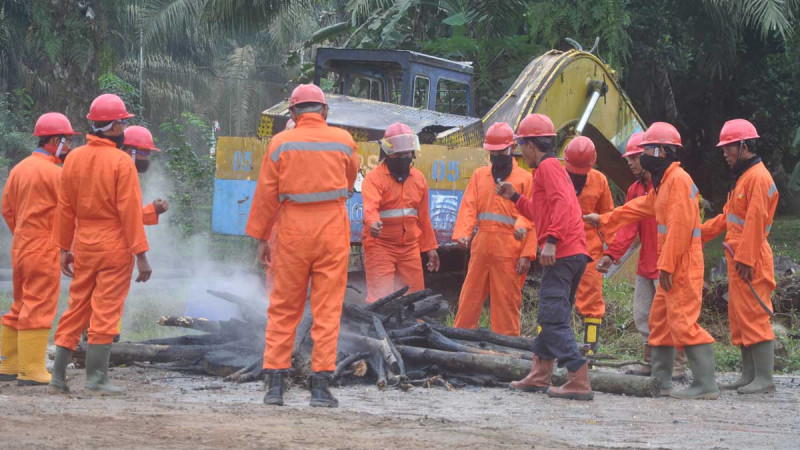
In some cases, corporate fire response teams may have already mobilised to contain a blaze and worked with neighbouring parties to extinguish it. Yet the fact that a fire occurred within or spread into a concession can still trigger legal action, even when evidence regarding the origin and cause of the fire remains unclear.
Law enforcement must therefore distinguish carefully between intentional wrongdoing and negligence.
Treating every fire within a concession as automatic proof of corporate wrongdoing risks undermining the basic principles of fair and objective law enforcement. Investigations should be based on verifiable evidence rather than public pressure or simplified assumptions.
The Economic Impact of Premature Enforcement
Unilateral sealing of plantation areas or the suspension of operations without an accountable investigation can create broader economic consequences.
When a plantation that forms part of a wider supply chain is suddenly disrupted, the impact can extend beyond the company itself. Workers may face uncertainty, supplies of fresh fruit bunches (FFB) from plasma smallholders may be affected, and downstream processing and export activities can also face disruption.
Legal uncertainty may also influence investment decisions.
Investors increasingly consider regulatory certainty and Environmental, Social and Governance (ESG) factors when assessing business risks. Inconsistent or disproportionate enforcement can create concerns about the predictability of Indonesia's investment environment.
At the same time, forest and land fires are not solely a corporate issue.
In areas surrounding plantation concessions, fire risks are often linked to complex social and economic conditions. Traditional land-clearing practices involving burning may still occur, while illegal encroachment and land speculation can also contribute to fires that later spread into plantation or forest areas.
Simplifying these complex conditions by automatically blaming the palm oil industry risks obscuring the real causes of the problem.
Strong Laws Require Fair and Objective Enforcement
Indonesia already has a strict legal framework governing forest and land fires.
Environmental, plantation and forestry laws provide significant criminal penalties and fines for those found to have intentionally burned land or forests, while negligence can also carry serious legal consequences.
Companies operating plantation concessions are also subject to strict responsibilities and can face substantial legal exposure when they fail to meet their obligations.
Where there is clear evidence that a company or its representatives deliberately used fire for land clearing, or failed to implement reasonable prevention and mitigation measures, firm enforcement is justified.
However, companies that have complied with applicable regulations, maintained adequate fire prevention systems and actively responded to fires originating outside their operational areas should also have their actions assessed fairly and proportionately.
Compliance and Prevention Remain Essential
The palm oil industry, meanwhile, must continue to demonstrate that its commitment to fire prevention goes beyond policy statements.
Companies are expected to maintain adequate fire-control equipment and personnel, conduct regular monitoring and ensure that emergency response systems are ready to operate when needed.
For plantations located on peat ecosystems, monitoring groundwater levels and maintaining appropriate peatland management systems are also important elements of fire prevention.
Community-based programmes, including efforts involving rewetting, revegetation and economic revitalisation, can further strengthen prevention in areas surrounding plantation concessions.
Compliance should not be viewed simply as a legal shield. It must become part of a broader strategy to reduce fire risks before they escalate.
Investigations Must Follow the Evidence
A credible investigation into forest and land fires should examine more than satellite images.
Authorities should assess the history and pattern of fire hotspots, weather and wind conditions, the direction in which the fire spread and verified evidence from the field.
The source of ignition, the response taken by relevant parties and the level of compliance with fire-prevention obligations should all form part of the investigation.
Forest and land fires are a multidimensional problem shaped by climate conditions, geography, land management and social dynamics.
For that reason, effective law enforcement must be fair, objective, non-discriminatory and grounded in evidence that can withstand scrutiny.
Indonesia's palm oil industry does not require special treatment. What it requires is the same principle that should apply to every party: accountability where wrongdoing is proven, and fairness where the facts demonstrate a different reality. (*)
By: Edi Suhardi, Sustainability Analyst
Disclaimer: This article reflects the personal views and opinions of the author and is solely the responsibility of the author. It does not represent the views or position of InfoSAWIT.