JAKARTA, InfoSAWIT – Indonesia's forestry and palm oil industries are calling for a stronger joint response mechanism to ensure forest and land fires can be tackled quickly, with companies, communities and government agencies able to reach fire locations without unnecessary delays.
The Indonesian Forest Concessionaires Association (APHI) and the Indonesian Palm Oil Association (GAPKI) are urging the development of a collaborative protocol involving all relevant stakeholders to improve coordination and remove barriers during emergency fire response operations.
The proposed mechanism would bring together local communities, companies, regional governments, the Indonesian Military (TNI), National Police (Polri), Manggala Agni, Regional Disaster Management Agencies (BPBD) and other relevant institutions.
The initiative is based on a simple principle: fires do not recognise administrative borders, concession boundaries or land ownership.
APHI Chairman Soewarso said forestry companies holding Forest Utilisation Business Licences (PBPH) have generally prepared resources for fire prevention and control, including personnel, command posts, vehicles, pumps, water sources and firefighting equipment.
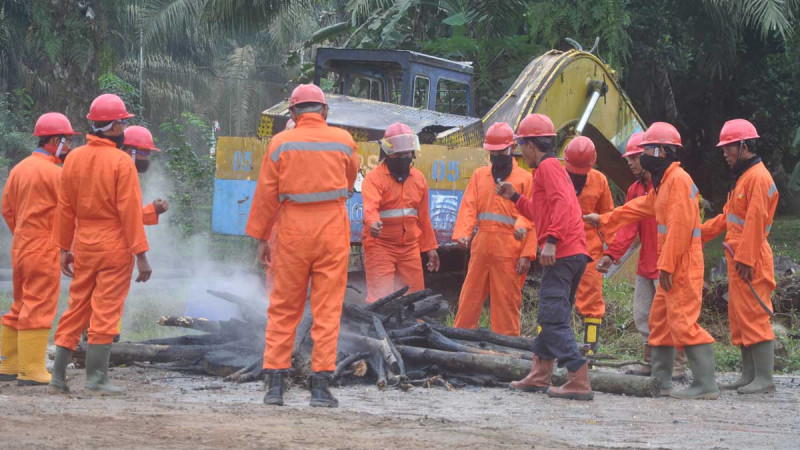
In certain situations, company fire brigades are also ready to assist in extinguishing fires outside concession areas to prevent flames from spreading into forests, settlements, community land or other operational areas.
Fast Response Is Critical
According to Soewarso, the first hours of a fire are often critical in determining whether it can be quickly contained or develops into a larger disaster.
Rapid intervention is particularly important in peatland areas and regions experiencing prolonged dry conditions, where fires can spread rapidly and become increasingly difficult to control.
Delays in reaching the fire location can significantly reduce the effectiveness of firefighting operations, especially when access is limited or water sources are located far from the affected area.
Soewarso also stressed that the presence of a company's firefighting team in a particular location should not be interpreted as an attempt to take control of community land.
The purpose of emergency response, he said, is to stop the spread of fire, protect local residents and prevent wider environmental damage.
GAPKI: Rapid Access to Fire Sites Is Essential
GAPKI Chairman Eddy Martono said palm oil companies are also strengthening their preparedness against the threat of forest and land fires.
Measures include routine patrols, hotspot monitoring, the deployment of firefighting teams and the use of high-capacity pumps, water tankers, heavy equipment, drones and other supporting facilities.
These resources can also be deployed to assist with fires occurring near company operational areas. However, their effectiveness depends heavily on whether personnel and equipment can reach the fire site quickly.
Eddy said cooperation and open access are essential during emergency situations.
Time that should be spent containing a fire, he warned, should not be lost because of misunderstandings or poor communication between stakeholders.
Building a Clear Emergency Communication System
GAPKI believes that cooperation between companies and local communities has already developed in several regions.
Fire-aware community groups, farmers, village governments, traditional leaders, security personnel and companies have become important components of early detection and fire response systems at the local level.
To strengthen this cooperation, GAPKI is encouraging fire-prone villages to establish more structured emergency communication systems.
Such arrangements could include emergency contact numbers, a single communication channel, maps showing access routes to fire locations, information on available water sources and lists of personnel who can be contacted immediately when a fire is detected.
A clearer communication mechanism, stakeholders believe, could reduce misunderstandings and accelerate decision-making during emergency operations.
Collaboration Before Fires Escalate
APHI and GAPKI emphasised that forest and land fires cannot be effectively addressed by a single institution or sector.
Fires can cross administrative borders, community land, forest areas and business concessions, making cooperation and clearly defined roles essential.
The two associations are therefore encouraging regional governments to facilitate the development of collaborative fire-response protocols before the peak of the dry season.
The proposed protocol should respect community rights while ensuring that firefighting teams can obtain the access needed to respond quickly when a fire is detected.
Community participation will also remain a key part of the system. During an emergency, coordination is needed to prevent firefighting efforts from being delayed by misunderstandings, communication problems or disputes over access.
By building trust, establishing clear responsibilities and strengthening coordination before a fire grows larger, APHI and GAPKI believe Indonesia can improve its ability to contain forest and land fires at an early stage.
The goal is to ensure that available personnel, equipment and resources can move quickly when they are needed most—before small fires develop into larger disasters affecting communities, businesses and the environment. (T2)
Source: InfoSAWIT