InfoSAWIT, MEDAN – Calls are growing for palm oil companies to strengthen Gender Committees as part of broader efforts to prevent and address sexual violence in the workplace.
The issue gained renewed attention following a sexual violence case involving EZ, a member of SERBUNDO and the Palm Oil Workers Coalition (KBS). The case has prompted stakeholders to push for stronger protection systems for women workers across Indonesia's palm oil industry.
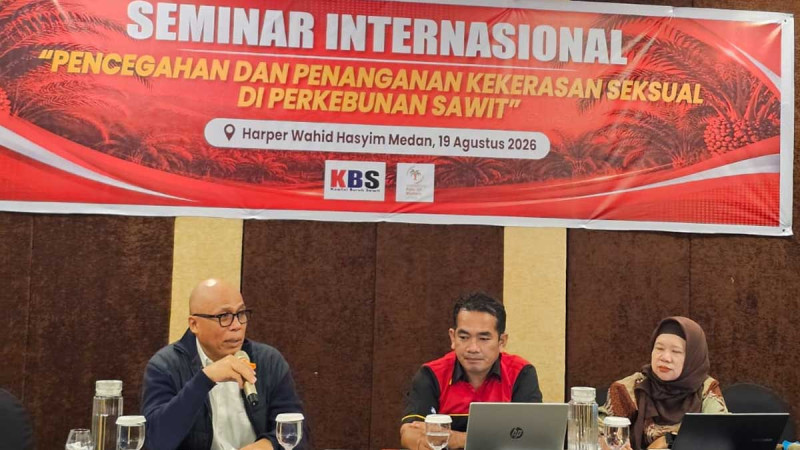
The call was raised during the International Seminar on the Prevention and Handling of Sexual Violence in Palm Oil Plantations, organised by KBS together with its global partner, International Palm Oil Workers (IPOW), in Medan on August 21, 2026. The Netherlands-based FNV also participated online, reflecting wider international concern over worker protection in the palm oil sector.
Sumarjono Saragih, Chairman of GAPKI's Human Resources Development Division, said efforts to address sexual violence must go beyond legal proceedings and focus on building stronger prevention systems within companies.
He said the industry must stand with victims, support law enforcement and ensure justice, while also taking concrete steps to prevent similar incidents from happening again.
According to Sumarjono, sexual violence can occur across different sectors. However, cases involving the palm oil industry can sometimes create broader negative perceptions of the sector as a whole.
For this reason, he said, the industry must respond by improving its systems rather than allowing individual cases to define the entire sector.
Gender Committees as a Prevention Mechanism
GAPKI issued its Guidelines for the Protection of Women Workers in 2021, identifying Gender Committees as one of the key mechanisms for creating safer workplaces and protecting workers' rights.
Sumarjono said the committees should not exist merely as formal structures. Instead, they should play an active role in prevention, dialogue, education, complaint handling and worker protection.
The North Sumatra case, he added, could become an important momentum for expanding the implementation of worker protection guidelines and strengthening sexual violence prevention efforts at the company level.
GAPKI has also opened the possibility of forming a multi-stakeholder coalition involving labour unions, government institutions, women's organisations, non-governmental organisations, certification bodies and other stakeholders.
Such collaboration is expected to strengthen education and awareness programmes, establish safer complaint mechanisms, improve protection for victims and promote workplace cultures based on dignity and equality.
The resolution of individual cases remains essential to ensuring justice for victims. However, stakeholders also see the broader challenge as building stronger prevention systems that can improve protection for women workers and support the social sustainability of Indonesia's palm oil industry.
Strengthening Gender Committees, therefore, is being positioned not simply as an administrative measure, but as part of a wider effort to ensure that palm oil plantations become safer and more dignified workplaces for women. (T2)
Source: InfoSAWIT