InfoSAWIT, JAKARTA – Indonesia’s National Research and Innovation Agency (BRIN) is advancing the use of microbial agents and nanotechnology as part of efforts to develop more sustainable approaches to managing diseases in plantation crops, including oil palm, rubber, coffee, cocoa, tea and sugarcane.
The approach reflects a growing push to reduce reliance on conventional chemical pesticides and move towards disease management systems that are more integrated, preventive, precise and environmentally sustainable.
The issue was discussed during BRIN’s EstCrops_Corner #30 webinar, titled “Innovative Microbial and Nanodelivery Approaches to Support Sustainable Estate Plant Diseases Management,” held by the Plantation Crops Research Center under BRIN’s Research Organization for Agriculture and Food on Friday, August 14.
Santoso, Head of BRIN’s Animal Husbandry Research Center, said plant diseases remain a major challenge across Indonesia’s plantation sector.
He said disease control strategies need to move beyond a heavy dependence on chemical pesticides and adopt a more integrated and environmentally responsible approach.
“Disease management needs to shift from dependence on chemical pesticides towards approaches that are integrated, preventive, precise and environmentally friendly,” Santoso said.
Microbial Agents Offer New Options for Plantation Disease Control
A range of microorganisms, including Trichoderma, Bacillus, Pseudomonas, mycorrhiza and endophytic microbes, have shown potential as biological control agents.
Beyond suppressing plant pathogens, these microorganisms may also support plant growth and improve crop resilience.
However, researchers noted that the wider application of microbial-based technologies still faces several challenges.
Formulation stability, shelf life and sensitivity to changing environmental conditions remain key issues that need to be addressed before biological control agents can be more widely adopted under field conditions.
These limitations have encouraged researchers to explore new delivery technologies capable of protecting active ingredients and improving their performance after application.
Nanoencapsulation Enhances Essential Oil-Based Biopesticides
One of the technologies being explored is nanoencapsulation, which is being developed to improve the stability and effectiveness of biopesticides based on essential oils.
Riki Warman, a junior researcher at BRIN’s Plantation Crops Research Center, presented research involving essential oils derived from citronella, clove and eucalyptus.
The formulations were developed to control anthracnose disease in chilli plants caused by the fungal pathogen Colletotrichum.
According to Riki, essential oils have considerable potential as natural biopesticides. Their direct use, however, remains limited because their active compounds can evaporate easily and are vulnerable to degradation caused by ultraviolet light, high temperatures and oxidation.
Nanoencapsulation offers a possible solution by protecting the active compounds within a nanoscale matrix.
The technology can also enable a gradual and controlled release of active ingredients after application, potentially extending their effectiveness.
Laboratory and limited-scale testing showed that the nanoemulsion formulation developed by the researchers had physical characteristics supporting formulation stability, with particle sizes distributed at the nanometre scale.
The formulation was also able to consistently suppress the development of the anthracnose pathogen for up to 14 days after application.
While its effectiveness remains below that of synthetic fungicides, the findings highlight the potential for developing natural biopesticides using more precise delivery technologies.
“Nanoencapsulation is a strategic step to overcome the physical limitations of essential oils, allowing their effectiveness to be maintained for longer and their potential as future biopesticides to be further optimised,” Riki said.
Bacterial Selection Shows Promise Against Rubber White Root Disease
BRIN is also developing biological control agents through the selection of beneficial bacteria with multiple disease-suppression mechanisms.
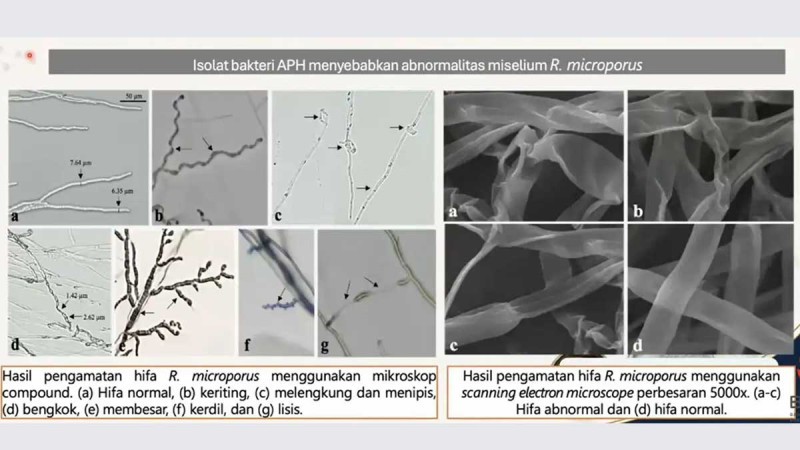
Widi Amaria, a junior researcher at the Plantation Crops Research Center, presented research on the selection of potential bacterial agents to control white root disease in rubber, caused by Rigidoporus microporus.
The selection process considered both safety and the ability of bacterial candidates to perform several biological control functions, including antibiosis, pathogen lysis, induction of plant resistance and plant growth promotion.
Of the 95 initial bacterial isolates screened, 22 candidates met the required safety criteria.
Further selection narrowed the group to 10 bacterial candidates considered suitable for additional development.
In in planta testing, the selected candidates demonstrated the ability to suppress disease development by up to 92.11%.
“Bacterial selection using a multi-mechanism approach can optimise the performance of biological control agents, not only in suppressing pathogens but also in improving plant growth and resilience,” Widi said.
Towards More Sustainable Plantation Protection
The development of microbial technologies and nanoencapsulation represents part of a broader effort to build more sustainable plant disease management systems.
For the plantation sector, these innovations could help reduce dependence on chemical inputs while introducing more preventive and precise disease-control strategies.
The research also opens opportunities for the future development of technologies that can support crop productivity while addressing environmental sustainability.
For commodities such as oil palm and rubber, where disease pressure can cause significant economic losses, advances in biological control and nanotechnology may eventually provide additional tools for plantation managers seeking more sustainable ways to protect their crops. (T2)