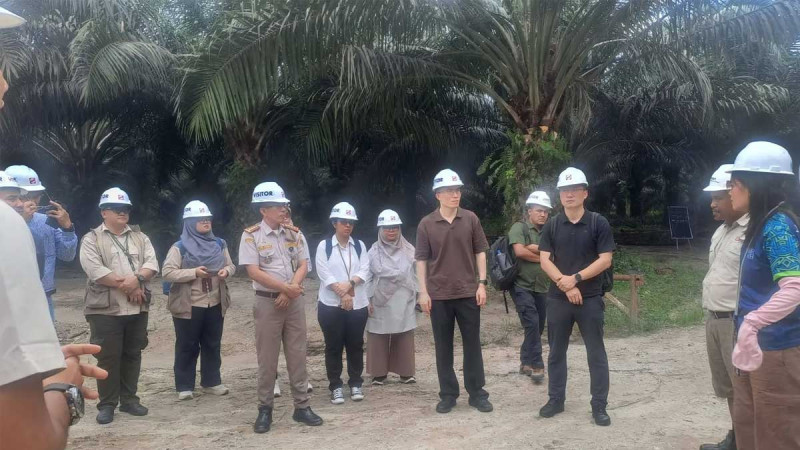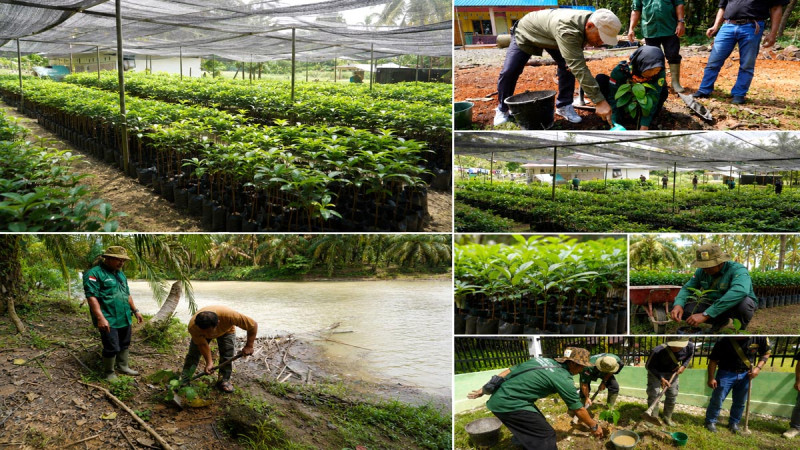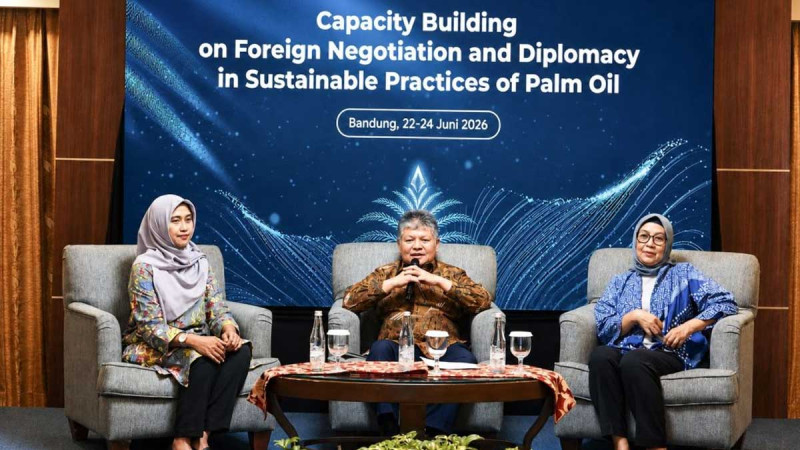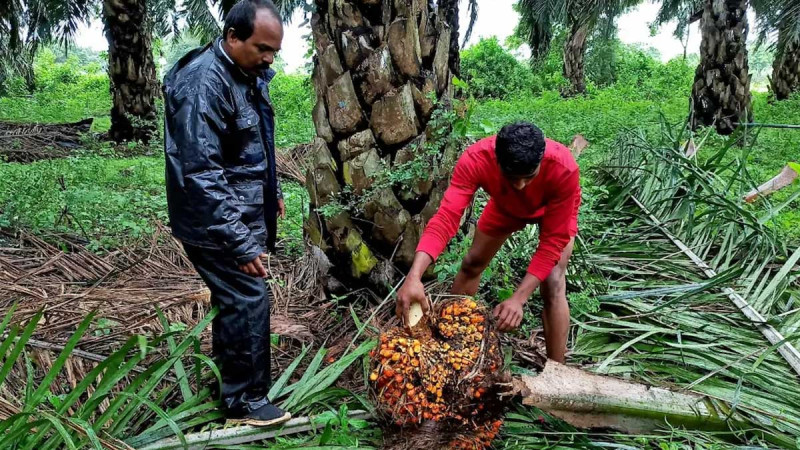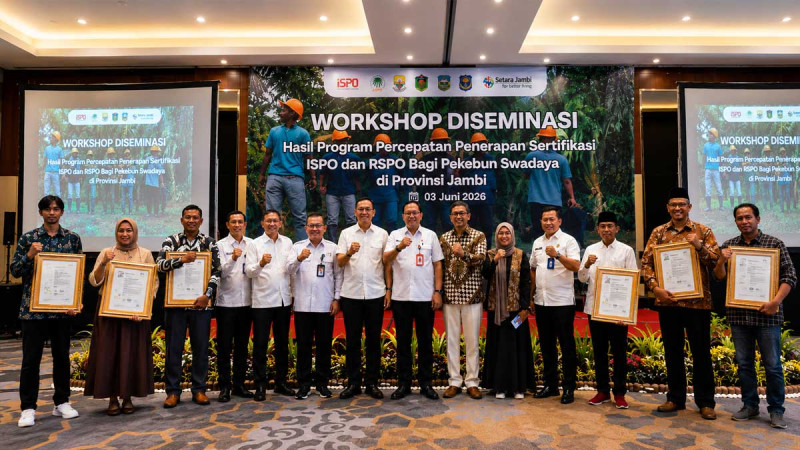
InfoSAWIT, JAMBI – A total of 2,266 independent Smallholders from three farmer organisations in Jambi Province have officially obtained dual certification under the Roundtable on Sustainable Palm Oil (RSPO) and Indonesian Sustainable Palm Oil (ISPO) schemes, covering a combined plantation area of 4,171.62 hectares.
The achievement marks Indonesia’s first large-scale dual certification model for independent Smallholders and highlights a collaborative effort involving multiple stakeholders to address long-standing barriers such as land legality, institutional capacity, and access to international sustainability standards.
The certification acceleration programme was initiated in November 2022 through collaboration between RSPO, the Jambi Provincial Government, Yayasan Setara Jambi, and regional administrations in Tebo, Sarolangun, and Tanjung Jabung Barat. The initiative aims to improve Smallholders’ access to sustainable palm oil markets worldwide.
Guntur Cahyo Prabowo, Head of Smallholder RSPO, described the certification as evidence that Indonesian independent Smallholders are capable of meeting globally recognised sustainability standards when supported by strong partnerships.
“This achievement is not merely a handover of certificates. It demonstrates that Indonesian independent Smallholders possess both the capacity and commitment to meet the highest sustainability standards,” Guntur said in an official statement received by InfoSAWIT.
“When government systems, farmer organisations, legal processes, and market actors collaborate, Smallholder inclusion and certification can be achieved. RSPO is proud to be part of this journey and remains committed to expanding its positive impact to more independent Smallholders across Indonesia,” he added.
The programme adopted a dual pathway approach, positioning ISPO as the foundation for national sustainability compliance and RSPO as the gateway to international sustainability standards.
This synergy enables Smallholders to satisfy domestic market requirements while simultaneously accessing export markets increasingly governed by strict sustainability regulations.
Members of Koperasi Konsumen Agro Tani Lestari (KKATL) in Sarolangun have already experienced the benefits of certification. Improved farm management practices and technical training have contributed to better productivity and stronger market access.
Sulistio of KKATL Sarolangun said certification and partnership arrangements had improved both marketing channels and farmer returns.
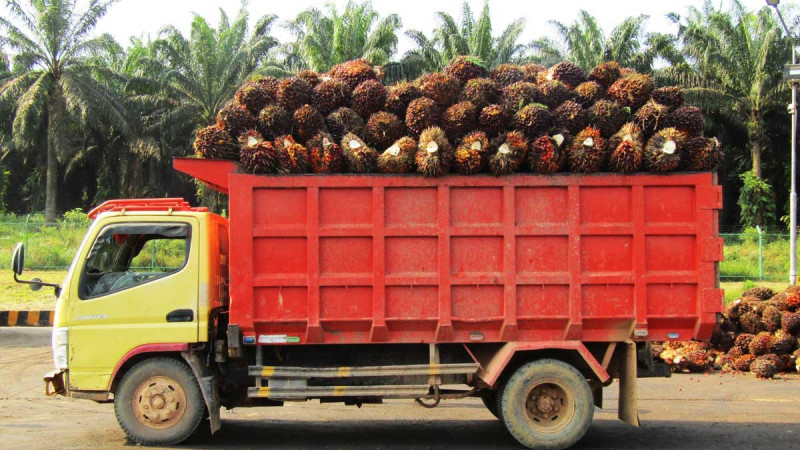
“After receiving training and improving farm management, we began seeing production improvements. More importantly, for over a year we have sold our fresh fruit bunches directly to PT Inti Guna Nabati through partnership arrangements, and the prices we receive are higher than those obtained by farmers outside such partnerships,” he said.
Beyond improving market access, the dual certification approach is considered more affordable for farmer groups while reducing administrative barriers often associated with certification processes.
Director of Oil Palm Crops at the Directorate General of Plantations, Ministry of Agriculture, Iim Mucharam, said the Jambi experience offers valuable lessons for future sustainability initiatives.
“One important lesson from Jambi is that Smallholders do not view sustainability standards as competing systems. They seek practical solutions that strengthen legal compliance, organisations, market access, and livelihoods,” Iim said.
“Moving forward, we believe there is value in exploring how different sustainability frameworks can become more complementary and mutually reinforcing. If farmers have already demonstrated compliance, our collective challenge is to make such achievements more efficient, more accessible, and ultimately more rewarding,” he added.
The success of the Jambi programme is expected to serve as a model for other regions across Indonesia seeking to expand Smallholders’ access to certification and sustainable palm oil markets.
Through collaboration between central and regional governments, civil society organisations, Yayasan Setara Jambi as implementing partner, and continued support from RSPO and ISPO, the initiative is expected to strengthen the position of Indonesia’s independent Smallholders within the global sustainable palm oil supply chain. (T2)