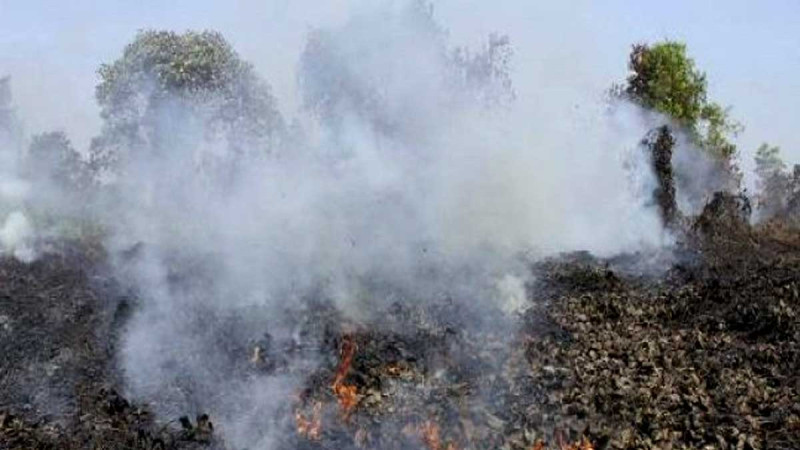
InfoSAWIT, BOGOR – Forest and land fires are threatening not only communities and the environment but also plantation workers. Across palm oil-producing areas of Sumatra and Kalimantan, workers continue to carry out their duties amid deteriorating air quality, prompting criticism that government policy has yet to specifically guarantee their safety.
Sawit Watch said Presidential Instruction (Inpres) No. 11 of 2026 on Strengthening Enforcement of the Ban on Land Clearing by Burning and Controlling Forest and Land Fires has not adequately addressed the protection of palm oil plantation workers.
In a press statement dated Sept. 10, 2026, Sawit Watch Executive Director Achmad Surambo said forest and land fires in several palm oil-producing areas had directly affected workers.
The Ministry of Health recorded more than 10 million people affected by forest and land fires across seven provinces: West Kalimantan, Central Kalimantan, South Kalimantan, East Kalimantan, Jambi, Riau and South Sumatra.
Surambo said the reported 366 percent surge in hotspots in August 2026 demonstrated the scale of the problem and could not be treated lightly. He argued that both the government and companies must take responsibility for the impacts, including those suffered by palm oil plantation workers.
Presidential Instruction Said to Overlook Worker Protection
Sawit Watch welcomed the issuance of Presidential Instruction No. 11 of 2026 as an effort to improve forest and land-fire governance. However, the organisation raised concerns over the absence of the Ministry of Manpower among the institutions specifically mandated under the instruction.
Surambo said the absence of the ministry reflected insufficient attention to the conditions faced by palm oil workers in fire-affected areas, where employees are still expected to work despite hazardous conditions.
The concern was echoed by Zidane, Sawit Watch’s Palm Oil Labour Specialist. He said plantation workers in Kalimantan and Sumatra continue to work amid dense smoke.
“So far, there have been no protective measures taken by companies. Workers continue to work as they would under normal conditions,” Zidane said in an official statement, as reported by InfoSAWIT, Sunday (Sept. 13, 2026).
For Sawit Watch, the situation directly concerns occupational health and safety. The organisation urged companies not to focus solely on production targets during forest and land fires but also to adjust working hours and prioritise the health and safety of workers and their families.
Sawit Watch Calls for Wage Guarantees
Sawit Watch is also calling on the government to take more concrete action. Plantation workers are considered a high-risk group because they live and work in areas affected by forest and land fires.
Surambo said fire management should not stop at suppression and prevention efforts. Protection for groups directly exposed to the disaster must also become part of government policy.
“This instruction should not only be about response, but also about protecting the main affected group, namely palm oil plantation workers,” he said.
He called on the President to instruct the Ministry of Manpower to take concrete steps to safeguard the occupational health and safety of workers and their families.
Sawit Watch also stressed the importance of ensuring that workers continue to receive wages when fire-related conditions disrupt plantation activities.
The criticism places worker protection among the issues that need to be incorporated into forest and land-fire governance in palm oil plantation areas. For Sawit Watch, controlling fires cannot be limited to regulating sources of ignition and enforcing the ban on land clearing by burning. It must also ensure the safety of the people working on the front lines of plantation operations when an ecological disaster occurs. (T2)