InfoSAWIT, JAKARTA – Indonesia’s palm oil supply chain is facing growing traceability challenges as palm oil mills operating without their own plantations become increasingly widespread, according to the Indonesian Palm Oil Association (GAPKI).
GAPKI has warned that poorly supervised mills could contribute to a range of problems, including fresh fruit bunch (FFB) theft, plantation-related conflicts and difficulties in tracing the origin of palm oil feedstock.
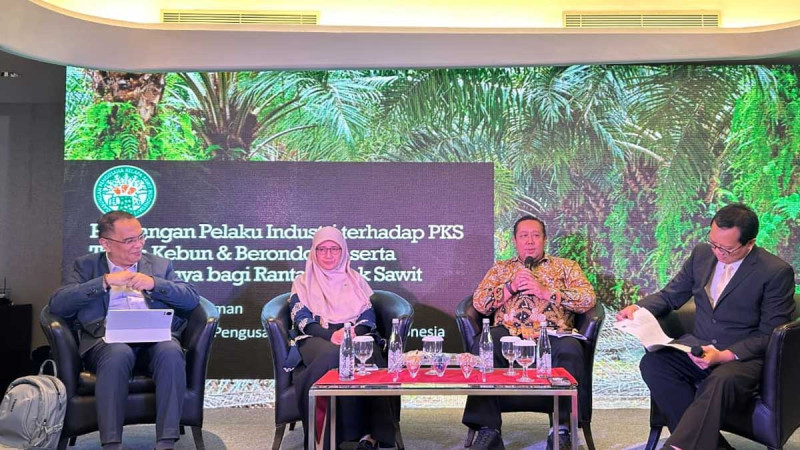
The issue was raised during a multi-stakeholder forum titled Strengthening a Transparent, Inclusive and Sustainable Palm Oil Supply Chain, organized by the United Nations Development Programme (UNDP) in Jakarta on Thursday, September 10, 2026.
The forum brought together government representatives, industry players, farmer organizations, academics, international development partners and civil society groups.
GAPKI Deputy Chairman for General Affairs II, Susanto, said the palm oil industry plays a strategic role in Indonesia's economy and supports the livelihoods of millions of farmers and workers.
He stressed that transparency, inclusiveness and sustainability must therefore become integral elements of supply-chain governance.
According to Susanto, transparency requires a traceability system capable of tracking palm oil from plantations through to finished products. At the same time, inclusiveness must ensure that smallholders are not treated merely as suppliers but recognized as partners within the broader industry ecosystem.
GAPKI supports these objectives through the implementation of the Indonesian Sustainable Palm Oil (ISPO) standard, farmer capacity building, supply-chain digitalization and dialogue among stakeholders.
Palm Oil Mills Without Plantations Raise FFB Concerns
GAPKI Sustainability Affairs official Agam Fatchurrochman said Indonesia's palm oil ecosystem is relatively integrated, with more than 1,200 palm oil mills, more than 80 refineries and export networks reaching more than 150 countries.
However, he warned that this integration could be disrupted if the trading and sourcing of raw materials are not adequately regulated.
Agam highlighted rising cases of FFB theft and looting in several regions. At some plantations operated by GAPKI members, losses attributed to theft were reportedly as high as 50% to 60%.
At the same time, illegal loading ramps have emerged around plantation areas. These facilities could increase the risk of conflict and potentially become collection points for FFB from unclear sources.
“This issue requires joint supervision and cannot be handled by companies alone,” Agam said.
He also pointed to differences in compliance between conventional and non-conventional palm oil mills. Conventional mills are generally subject to regular inspections and supervision, while non-conventional facilities may not face equivalent oversight.
The gaps cover areas including establishment legality, metrology and trading practices. Beyond legal concerns, these issues could also affect the quality of CPO produced.
Raw materials sourced from loose fruit, for example, tend to have higher free fatty acid (FFA) levels and less consistent quality.
Most Loading Ramps in West Kalimantan Unlicensed
The governance of loading ramps has also emerged as a major concern.
GAPKI West Kalimantan representative Aris Supratman said 359 loading ramps were identified across the province in 2025. Of these, only 97 had obtained permits, leaving 262 loading ramps without licenses.
GAPKI recognizes that loading ramps serve an important function for smallholders, particularly in areas where farmers have limited access to processing facilities.
However, the association argues that such facilities must be incorporated into a regulated and supervised system.
Loading ramps should be registered and meet defined standards rather than being established freely without regard to legal requirements or trading practices.
GAPKI does not advocate eliminating palm oil mills without plantations altogether. Freedom to conduct business remains a principle the association supports, but such operations should comply with the same rules and standards as other participants in the palm oil supply chain.
EUDR Raises the Bar for Traceability
Supply-chain governance is becoming increasingly important as global markets demand more detailed traceability.
As one of the world's largest palm oil producers, Indonesia is facing growing pressure to trace palm oil feedstock back to the plantation level.
Agam questioned whether non-conventional mills are sufficiently prepared to implement the principles of No Deforestation, No Peat and No Exploitation (NDPE) and meet increasingly stringent traceability requirements ahead of the effective implementation of the European Union Deforestation Regulation (EUDR) on December 30, 2026.
The origin of raw materials can no longer be treated solely as a trading issue. Weak traceability could ultimately affect the reputation of Indonesian palm oil in international markets.
GAPKI maintains that freedom to conduct business should be protected as a foundation of Indonesia's economy. At the same time, the industry cannot be permissive toward unclear supplies that compromise quality or create opportunities for theft and conflict.
The association is therefore calling for common standards across the entire supply chain, including compliance with environmental impact assessments, UKL-UPL requirements, PROPER and ISPO.
It also supports stronger supervision through plantation-level traceability mapping, including tier-3 supply bases, as well as coordination among government agencies.
Smallholders Remain Trapped in Long Supply Chains
The issue of mills without plantations and loading ramps is closely linked to the challenges faced by independent smallholders.
Ratnawati Nurkhoiry, a researcher at the Indonesian Oil Palm Research Center (PPKS), said independent smallholders represent a significant part of Indonesia's smallholder plantation sector.
They continue to face problems including land legality, untraceable seed sources, low productivity and lengthy marketing chains.
These conditions can leave farmers dependent on agents and loading ramps. Low productivity limits income, while restricted access to capital and markets makes it difficult for farmers to break away from lengthy trading chains.
“This is a vicious cycle,” Ratnawati said.
In this context, loading ramps can emerge as a response to the needs of smallholders. However, the longer the marketing chain, the smaller the share of the final value received by farmers.
Ratnawati said Indonesia has approximately 442 palm oil mills without plantations. Their presence has two sides: they can create unhealthy competition for supplies, but under certain circumstances they can also provide farmers with opportunities to obtain better prices.
Research by PPKS in North Sumatra has shown that better governance can generate tangible benefits. The transformation of a trading business into an RSPO-certified cooperative was reported to have increased farmer productivity and income while reducing production risks by as much as 55%.
Loading Ramps Should Be Regulated, Not Eliminated
Windrawan Inatha, a Strategic Advisor at CECT Trisakti University with an RSPO background, offered a different perspective.
He argued that loading ramps would be difficult to eliminate because they perform important economic and social functions for smallholders.
Rather than removing them, he said, the focus should be on regulating their operations.
Loading ramps do more than collect FFB. They can also provide farmers with access to informal financing when formal financial services are difficult to reach.
Windrawan noted that Indonesia has around 3.22 million oil palm smallholders, but only about 1.54 million have obtained Cultivation Registration Certificates (STDB). Meanwhile, ISPO compliance remains below 2%.
He therefore proposed integrating loading ramps into the formal traceability system rather than treating them solely as facilities that need to be eliminated.
One possible approach would be to standardize transaction records so the origin of FFB can be verified and the risk of stolen fruit entering the supply chain reduced.
Windrawan also referred to the 2020 position of the Business Competition Supervisory Commission (KPPU), which stated that palm oil mills without plantations could support healthy competition if appropriately regulated.
Going forward, he suggested that ISPO should extend beyond plantation ownership and strengthen oversight of companies' supply bases.
A pilot project involving UNDP could provide an initial opportunity to test such a model.
For Indonesia's palm oil industry, the challenge is no longer simply maintaining production. It is ensuring that every FFB entering the processing chain has a clear and verifiable origin.
As international markets impose increasingly stringent requirements, transparent supply-chain management will become an increasingly important factor in determining the competitiveness of Indonesian palm oil. (T2)
Source: InfoSAWIT