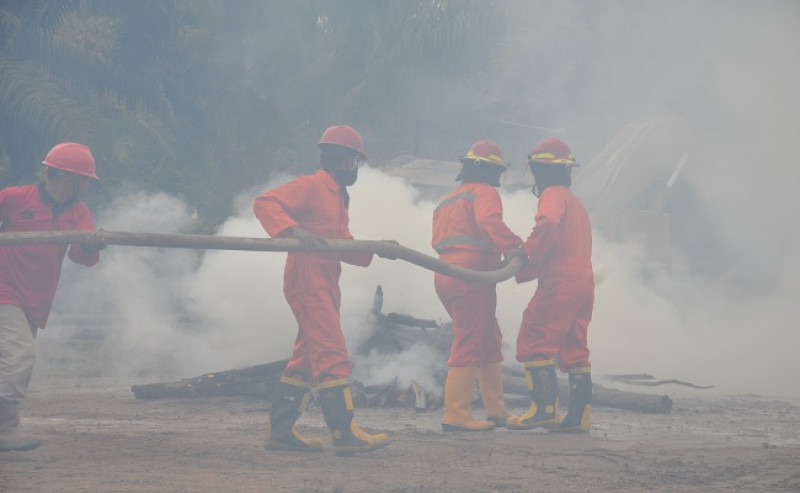
JAKARTA, InfoSAWIT – The Association of Indonesian Forest Concessionaires (APHI) and the Indonesian Palm Oil Association (GAPKI) have called on their members to strengthen forest and land fire prevention measures, particularly in areas entering the dry season and facing elevated fire risks.
APHI Chairman Soewarso said prevention must remain a priority for companies holding Business Licensing for Forest Utilization (PBPH). According to him, preparedness should not begin only after a fire breaks out but must be built through a systematic prevention framework from the outset.
“We urge all APHI members to remain vigilant and not wait until a fire occurs. Early detection, regular patrols, water-source checks, equipment and personnel readiness, and an immediate response to detected hotspots are essential,” Soewarso said in a statement received by InfoSAWIT on Friday, August 14, 2026.
He emphasized that all components of fire prevention and suppression must remain operational and ready for deployment. These include personnel, firefighting equipment and infrastructure, water sources, hotspot monitoring systems and rapid-response mechanisms, all of which should be inspected regularly.
APHI also urged companies to strengthen coordination with Manggala Agni, regional disaster management agencies (BPBD), local governments, law enforcement authorities and neighboring companies.
Such cross-sector coordination is considered crucial because fires can spread beyond administrative boundaries and concession areas. Faster communication can help ensure potential fires are identified and contained before they expand.
Community Involvement Key to Fire Prevention
APHI said communities living around company concession areas should be an integral part of fire prevention strategies. Companies are encouraged to expand education on zero-burning land clearing, strengthen Fire-Aware Communities and Fire-Aware Villages, and develop joint patrols.
“Forest and land fire prevention cannot be carried out solely from within company areas. Communities must be involved as key partners because they are closest to the locations and can serve as the frontline in detecting and preventing fires,” Soewarso said.
He added that alternative economic empowerment should go hand in hand with public education. Such initiatives could help reduce dependence on land-clearing practices that involve the use of fire.
APHI also called on companies to document prevention activities, including patrols, public outreach, training, equipment inspections, hotspot monitoring, wetting of fire-prone areas and community assistance.
Such documentation can serve not only as evidence of preparedness but also as a basis for evaluating and continuously improving fire prevention and control systems.
GAPKI Calls for Stronger Plantation Monitoring
GAPKI Chairman Eddy Martono Rustamadji echoed the call, urging palm oil companies to increase vigilance and ensure that plantation activities are free from land clearing and land management practices involving fire.
“We urge GAPKI members to ensure that all prevention systems operate properly, from hotspot monitoring and field patrols to firefighting team readiness, equipment and water supplies, as well as coordination with communities and regional stakeholders,” Eddy said.
He stressed that forest and land fires are not merely environmental issues. Their impacts can extend to public health, social activities, economic conditions and the sustainability of business operations.
Palm oil companies are therefore encouraged to strengthen monitoring both inside and around plantation areas. Consistent engagement with farming and plantation communities is also needed to strengthen awareness of zero-burning land management.
GAPKI further encouraged companies to provide adequate fire prevention and suppression infrastructure while developing productive economic activities for surrounding communities.
“Companies must be present alongside communities, not only when fires occur. Education, training, joint patrols and alternative economic development must be carried out consistently so that prevention becomes a shared culture,” Eddy said.
Weather Changes Require Greater Vigilance
APHI and GAPKI also called for stronger cross-sector coordination through education, integrated patrols, human resource development, early-detection technology and stronger community-based fire prevention groups.
The two associations said regional and local weather forecasts should be communicated more intensively to companies and communities. Corporate management is expected to actively monitor weather developments through official channels of Indonesia’s Meteorology, Climatology and Geophysical Agency (BMKG) and other reliable weather information sources.
Weather information can help companies determine alert levels, improve personnel and equipment readiness, and strengthen preventive measures in areas facing higher fire risks.
Amid the potential for increased fire threats, APHI and GAPKI stressed that rapid response remains critical. Any indication of a fire should be reported and addressed immediately by deploying available resources before the flames can spread.
Through the joint appeal, APHI and GAPKI emphasized that preventing forest and land fires requires the involvement of businesses, government institutions, communities and other stakeholders. The effort also forms part of the forestry and palm oil sectors’ commitment to environmental protection and sustainable business operations. (T2)