InfoSAWIT, MUSI BANYUASIN – Indonesia is encouraging plantation cooperatives to move beyond their traditional role as farmer organizations and become more active players in the palm oil downstream industry, including by owning and operating crude palm oil (CPO) mills.
The initiative is expected to help palm oil smallholders capture greater added value from their production while strengthening their bargaining position across the palm oil supply chain.
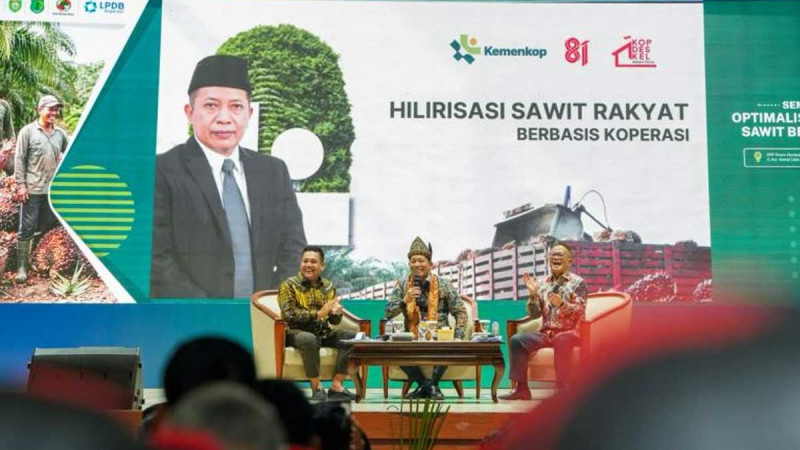
The proposal was raised by Cooperatives Minister Ferry Juliantono during the National Seminar on “Optimizing and Downstreaming Palm Oil through Cooperatives” in Musi Banyuasin, South Sumatra, on Tuesday (August 11, 2026).
According to Antara, as cited by InfoSAWIT on Thursday (August 13, 2026), Ferry said accelerating cooperative-based palm oil downstreaming would require collaboration among government institutions, cooperatives, farmers, and industry players.
One strategic partner identified by the minister is PT Agrinas Palma Nusantara (Persero), which has been mandated by the government to manage palm oil plantations resulting from enforcement actions by the Forest Area Enforcement Task Force (Satgas PKH).
2,587 Plantation Cooperatives Seen as Downstreaming Base
Ferry said active cooperatives located around palm oil plantation areas have significant potential to strengthen supply chains and participate more directly in processing plantation commodities.
He encouraged cooperatives to establish their own CPO mills, allowing them to process members’ fresh fruit bunches (FFB) and potentially gain greater economic value from downstream activities.
“Cooperatives are encouraged to establish their own CPO mills so that the demand for cooking oil and its derivative products can be fulfilled independently by cooperatives,” Ferry said.
The Ministry of Cooperatives records 2,587 cooperatives operating in the plantation sector. The number represents a potentially significant institutional base for developing cooperative-led palm oil downstreaming models across plantation-producing regions.
According to Ferry, downstream development also requires new strategies and instruments to improve the productivity of smallholder plantations.
One approach is to consolidate palm oil farmers into cooperative business entities, allowing economic activities to be managed at a larger and potentially more competitive scale.
At least two business models could be developed. The first would strengthen existing plantation cooperatives. The second would consolidate primary cooperatives through larger-scale business entities.
Financing will also be critical. Plantation cooperatives can utilize financing support from the Revolving Fund Management Institution for Cooperatives (LPDB Koperasi) to expand their businesses, including investments in palm oil processing facilities.
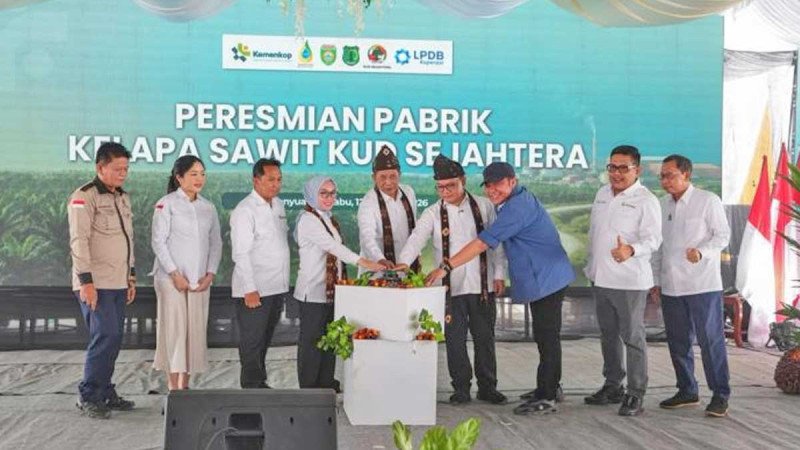
One example is Koperasi Mandiri Makmur, which has secured LPDB Koperasi financing for a CPO mill project. Construction of the facility has reportedly reached around 45 percent.
Agrinas Palma to Partner with Local Cooperatives
Meanwhile, President Director of PT Agrinas Palma Nusantara (Persero) Mohammad Abdul Ghani said the company would prioritize cooperatives located around plantations managed by the company as partners in plantation activities.
Cooperatives could participate in a range of operations, including crop maintenance, harvesting, and other plantation activities.
Abdul Ghani explained that Agrinas Palma is required to allocate at least 20 percent of the plantation land entrusted to the company as plasma plantations for local communities.
To implement the scheme, the company plans to work with cooperatives as one of its key partners.
“We will prioritize cooperatives around the land as vendors for crop maintenance, harvesting, and other activities. With the large area under our management, cooperatives will become key partners in supporting palm oil downstreaming as well as food security,” he said.
The cooperative-based approach is expected to give farmers a more strategic position within the palm oil value chain. Rather than remaining primarily suppliers of FFB, cooperatives could gradually expand their role into processing, services, and other downstream activities.
For Indonesia’s palm oil smallholders, the development of cooperative-owned CPO mills could therefore become an important step toward increasing value capture at the farmer level, provided that financing, management capacity, raw material supply, and market access can be secured. (T2)