InfoSAWIT, JAKARTA – Differences in oil palm fruit colour often lead to misjudgments during harvesting, with many field workers relying solely on colour to determine ripeness. However, an industry expert says fruit colour is a genetic characteristic rather than an indicator influenced by fertilization, plant age, or field management practices.
According to Herwin Butarbutar, a member of the Indonesian Planters Society (IPS), every oil palm tree inherits its fruit colour type through genetics, meaning colour alone should never be used as the primary criterion for determining harvest maturity.
"Many planters and harvesters still assume that all ripe oil palm fruits must turn red. That assumption is inaccurate because each palm has its own genetically determined fruit colour type," Herwin explained in remarks shared through the IPS WhatsApp Group and cited by InfoSAWIT on Tuesday (June 30, 2026).
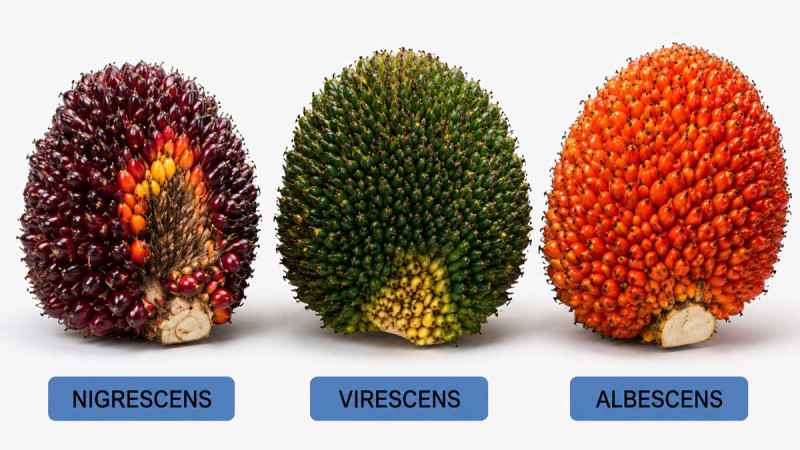
He identified three commonly recognized fruit colour types in oil palm—Nigrescens, Virescens, and Albescens. These are not commercial seed varieties such as Socfindo, Topaz, Dami Mas, Sriwijaya, Lonsum, or PPKS, but rather genetic classifications describing how fruit colour changes during ripening.
Nigrescens fruits are dark purple to blackish when immature due to dominant anthocyanin pigments. As they ripen, they gradually change to dark red or reddish-black, although the colour shift is relatively subtle. For this reason, harvest maturity should be assessed primarily by the number of naturally detached loose fruits rather than colour alone.
By contrast, Virescens fruits are green when young because of their chlorophyll content. As ripening progresses, chlorophyll breaks down while carotenoid pigments become more prominent, causing the fruit to change to yellow, orange, or orange-red, making maturity easier to recognize.
The rarest type, Albescens, produces immature fruits with ivory or cream-coloured exocarps due to minimal anthocyanin formation and very low chlorophyll levels. As the fruit matures, carotenoids develop, turning the fruit yellow to orange—a characteristic that can sometimes cause ripe bunches to be mistaken for immature fruit.
Genetics, Not Agronomic Practices
Herwin emphasized that fruit colour is determined by genes controlling pigment formation in the fruit's outer skin rather than by fertilizer application, soil conditions, climate, palm age, or crop management.
Anthocyanins produce purple, dark red, and black pigments characteristic of Nigrescens, while chlorophyll is responsible for the green appearance of immature Virescens fruit. Carotenoids generate the yellow and orange colours that appear during ripening across all fruit types.
"As a result, fertilization cannot transform Nigrescens into Virescens or Albescens," Herwin explained. "Good nutrition improves palm growth, bunch size, oil yield potential, and overall plant health—but it does not alter genetically inherited fruit colour."
Environmental factors such as rainfall, soil type, climate, and palm age may influence the brightness or intensity of the colour, but they do not change the underlying fruit colour type established by genetics.
No Impact on Oil Extraction Rate
Herwin also dismissed the widespread belief that one fruit colour type naturally produces higher Oil Extraction Rate (OER) than another.
To date, he said, there is no scientific evidence showing that Nigrescens, Virescens, or Albescens inherently deliver superior oil extraction performance.
Instead, OER is determined primarily by seed genetics, harvesting at the correct stage of ripeness, crop management, tree health, timely processing of fresh fruit bunches (FFB), and effective grading at the palm oil mill.
Consequently, if all three fruit colour types originate from the same genetic variety, are harvested at identical maturity levels, and processed under similar conditions, their oil extraction potential is expected to be essentially the same.
Do Not Confuse Fruit Colour with Seed Variety
Herwin further reminded planters not to confuse fruit colour types with commercial seed varieties.
Seed varieties such as Socfindo DxP, Sriwijaya DxP, Topaz DxP, Dami Mas DxP, Lonsum DxP, and PPKS DxP determine production potential, oil yield, disease resistance, growth characteristics, and environmental adaptability. Fruit colour types, on the other hand, simply describe the natural colour transition during fruit ripening.
He concluded by urging harvesters to follow established harvesting standards based on loose fruit counts and other maturity indicators rather than relying solely on fruit colour.
"Fruit colour is the tree's genetic identity, while ripeness is a physiological condition. They are not the same. Understand the genetic characteristics, recognize the correct maturity stage, and harvest according to company standards to maximize productivity and oil extraction," Herwin said. (T2)