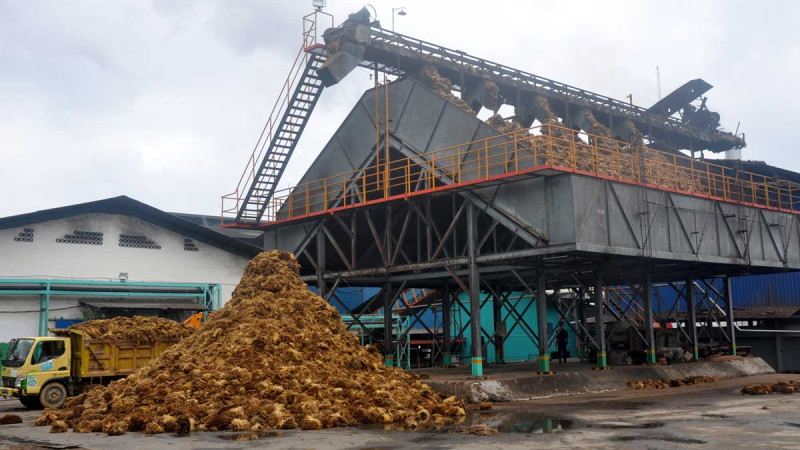
InfoSAWIT, JAKARTA – Oil palm empty fruit bunches (OPEFB), commonly known in Indonesia as tandan kosong kelapa sawit (TKKS), could be transformed from plantation waste into a higher-value biomaterial capable of removing heavy metals from contaminated water.
Research has explored lignin extracted from OPEFB as a potential adsorbent for lead ions, or Pb²⁺. The approach could open a new pathway for converting palm oil biomass waste into environmentally useful materials while supporting the development of a circular economy in the palm oil industry.
The research, written by Mirza Ardella Saputra, Ph.D., from Universitas Airlangga, processed lignin extracted from OPEFB into particles ranging from the nano to submicron scale.
The particle-size reduction process combined ball milling, solvent shifting and ultrasonication. Characterization results showed that ultrasonication was capable of reducing lignin particle size to approximately 268 nanometers, indicating the formation of nanolignin with characteristics suitable for use as an adsorbent.
Nanolignin Tested for Lead Removal
To enhance its functional properties, the nanolignin was chemically modified through a Mannich reaction using triethylamine as a tertiary amine source.
The modification was confirmed through CHN elemental analysis and Fourier Transform Infrared (FTIR) spectroscopy, which identified the addition of nitrogen-containing functional groups to the lignin structure.
The material’s ability to remove Pb²⁺ ions was then evaluated through batch adsorption tests. Remaining metal ions were analyzed using Inductively Coupled Plasma Optical Emission Spectrometry (ICP-OES).
The results showed different adsorption performances among the tested materials. Nanolignin produced through the solvent-shifting process recorded the highest adsorption performance, achieving a Pb²⁺ removal efficiency of 83.9%.
Interestingly, nanolignin modified with tertiary amine groups recorded a lower removal efficiency of 74.2%. The finding indicates that adding nitrogen-containing groups does not necessarily improve a material’s adsorption performance.
Computer Simulation Explains Adsorption Mechanism
Researchers also used computational approaches based on Density Functional Theory (DFT) combined with the Nudged Elastic Band (NEB) method to better understand how Pb²⁺ interacts with lignin.
The calculations indicated that Pb²⁺ adsorption on unmodified lignin can occur spontaneously without an activation-energy barrier and is exothermic. The adsorption energy was approximately -0.33 eV, with the interaction primarily involving the formation of a bond between Pb²⁺ and phenolic hydroxyl groups in lignin.
A different pattern emerged in lignin modified with nitrogen atoms. Although the material showed a stronger final adsorption energy of approximately -1.3 eV, an activation barrier of around 1.5 eV appeared during the transition process.
The simulation also showed that Pb²⁺ changes position during adsorption. Initially, the ion is located above an aromatic ring containing the nitrogen dopant before moving toward a phenolic oxygen atom and eventually forming a stronger Pb-O bond.
The findings suggest that the final strength of the interaction between Pb²⁺ and lignin is not the only factor determining adsorption efficiency. Energy barriers and the characteristics of functional groups on the material’s surface also influence the ability of lignin to capture heavy-metal ions.
Turning Palm Oil Waste into Higher-Value Biomaterials
The research also highlights a limitation of using large tertiary amine groups to improve Pb²⁺ adsorption in lignin-based materials. Chemical modification does not automatically enhance performance when the added functional group restricts access to active sites on the material.
From a palm oil industry perspective, the utilization of lignin from OPEFB as an adsorbent could create opportunities to convert plantation waste into higher-value biomaterials.
Such applications could strengthen the circular economy approach in the palm oil sector by turning biomass residues into functional materials for environmental applications rather than treating them solely as waste. (T2)
Source: InfoSAWIT