InfoSAWIT, PONTIANAK – Managing forests and land in West Kalimantan requires an approach that sees ecosystems, crops, soil and community livelihoods as interconnected parts of a single landscape. Such an approach is considered essential to maintaining ecological functions while ensuring communities continue to gain economic benefits from the land they manage.
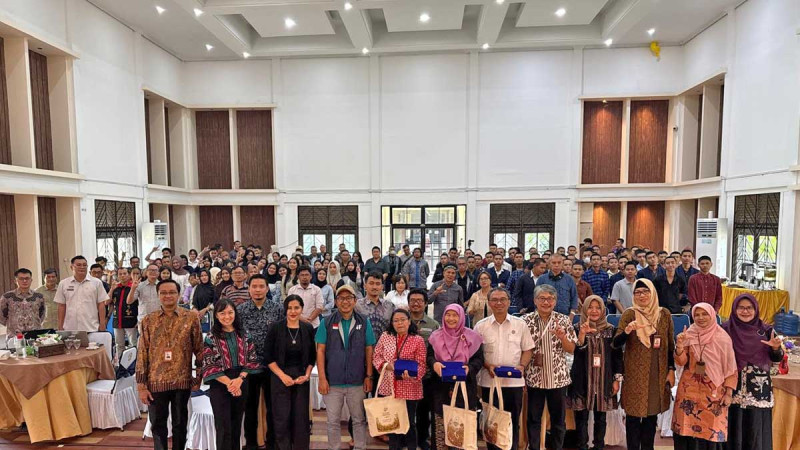
The idea emerged during the Sustainable Landscape Seminar and Festival organized by the Farmers for Forest Protection Foundation (4F), Tanjungpura University (UNTAN) and the National Research and Innovation Agency (BRIN) in Pontianak, West Kalimantan, on Wednesday (12/8/2026).
The event brought together researchers, academics, government representatives, smallholders, Indigenous communities, civil society organizations and businesses to discuss landscape management based on scientific evidence as well as community experience on the ground.
4F Executive Director Tirza Pandelaki said research findings need to be brought together with local knowledge so they do not remain confined to academic documents.
“After working with communities across various village landscapes, we have seen that forest protection and livelihoods cannot be separated. That is why we want the research discussed today not to end as reports, but to be discussed collectively and assessed for practical application in the field,” Tirza said in an official statement received by InfoSAWIT on Sunday (16/8/2026).
Dean of the Faculty of Forestry at Tanjungpura University, Dr. Ir. Farah Diba, S.Hut., M.Si., said sustainability principles must reconcile ecological and economic interests.
Scientific evidence, she said, needs to be translated into practical solutions that communities can implement while also generating economic benefits.
“Sustainability must balance ecological and economic interests. Scientific evidence therefore cannot remain in laboratories; it must be applied in communities and deliver tangible benefits, including improving local economies,” she said.
Tembawang Seen as Important Part of Village Landscapes
One study presented at the event examined regenerating forests, low-density forests and tembawang or agroforestry systems, which remain important components of West Kalimantan’s community landscapes.
4F Spatial Expert Harits Yowansyah Pandayu Putra said spatial analysis showed that young regenerating forests and low-density forests continue to face the risk of losing their tree cover.
An analysis overlaying deforestation data from the Ministry of Forestry for 2023–2025 with High Carbon Stock (HCS)-based forest cover data indicated a tendency toward deforestation in both forest classes.
“Forest protection is not only needed in areas where forest cover remains dense. Regenerating forests also need to be protected so their potential for recovery is not lost again,” Harits said.
The 4F study also identified around 27,316 indicative tembawang locations in Sanggau Regency, along with approximately 103,584.63 hectares of areas with potential for agroforestry development.
The data could serve as an initial basis for identifying priority areas for forest protection, restoration and agroforestry development. However, the indicative tembawang locations still require field-level verification.
4F researcher Amir Mahmud, M.Si., An, said tembawang are more than clusters of trees remaining between plantation areas. For local communities, they carry ecological, social, historical and economic functions.
The diversity of plants can provide food, fruits, timber, medicinal plants and sources of income. At the same time, tembawang serve as repositories of community knowledge and cultural values.
However, these agroforestry systems face pressure from land-use changes, including conversion to oil palm plantations.
Oil palm provides an important source of cash income for communities. Yet converting diverse landscapes into monoculture plantations can reduce the diversity of livelihood sources.
“The issue is not about putting oil palm against agroforestry. It is about developing agroforestry models that can meet communities’ current economic needs without losing their social and ecological functions,” Amir said.
He added that agroforestry development needs to consider land characteristics, commodity choices, farmers’ capabilities and market opportunities, supported by institutions, knowledge, financing, supply chains and appropriate policies.
Soil Conditions Linked to Palm Oil Health
The interconnected nature of landscapes was also reflected in BRIN research on soil and plant health.
Research presented by Dr. Ir. Asri Insiana Putri, M.P., showed that plant conditions are linked to microbial communities living around plant roots, known as the rhizosphere.
Metagenomic research in Menyabo, Gunam and Embala villages in Sanggau Regency found differences in fungal communities between the rhizospheres of healthy oil palm trees and those experiencing health problems.
One finding showed that Fusarium had a higher relative abundance in diseased plants. Meanwhile, healthy plants located near natural forest areas showed different microbial community conditions, including the presence of Trichoderma virens, which has potential as a biological control agent.
BRIN research on the nitrogen-fixing bacteria Azotobacter also found that forest and tembawang areas had greater vegetation diversity, litter, organic carbon, moisture and soil microbial diversity.
“Plant health is not only about the plant itself. Soil contains microbial communities with important functions, while landscape conditions also influence the environment in which those microorganisms live,” Asri said.
The findings show that plantation and agricultural land management cannot be completely separated from surrounding environmental conditions. Soil quality, vegetation diversity and microbial communities form part of an ecosystem that can influence plant health.
Farmers Call for Benefits for Forest Protectors
The scientific perspective discussed at the seminar was accompanied by the experience of communities dealing directly with landscape changes.
Isa Kenedy, a smallholder representative and member of the Forest Guardians Team in Setawar Village, Sekadau Regency, said oil palm remains economically important to local communities. At the same time, forests are equally important for maintaining environmental conditions and supporting the sustainability of plantations.
He said increasing the economic value of oil palm needs to be accompanied by greater awareness of the importance of protecting customary forests and community-managed forests so they are not entirely converted into plantations.
“If the forest disappears, what will we leave for our children and grandchildren? Communities that protect forests therefore need incentives. It should not be only those who clear forests who benefit. Those who preserve forests must also receive benefits,” Isa said.
The view places community incentives at the center of forest protection efforts. Communities living around forest areas need strong economic reasons to maintain forest cover while developing sustainable livelihoods.
Landscape Festival Seeks to Turn Research Into Action
The Sustainable Landscape Seminar and Festival also provided a platform for communities to showcase products derived from their landscapes.
Eleven 4F-assisted villages brought and marketed various non-timber forest products and local goods. Community products were also featured in a non-timber forest products competition designed to highlight economic opportunities emerging from village landscapes.
The event also included the signing of a memorandum of understanding between BRIN and UNTAN and the handover of Azotobacter isolates to UNTAN to support further research and innovation tailored to local environmental conditions.
Tirza said the festival was intended to bring scientific knowledge together with community experience.
“Through this festival, we want to show that communities have knowledge, experience, products and economic potential that grow from their landscapes. Research helps us understand landscapes, while communities know how those landscapes are managed and utilized,” she said.
The next challenge is ensuring that knowledge and experience do not end with discussions, but are translated into land-management practices that generate economic benefits while maintaining ecological functions.
A landscape approach, therefore, is not only about protecting forests. It is also about managing soil, crops, plantations, tembawang and community livelihoods as interconnected elements of a more integrated landscape. (T2)