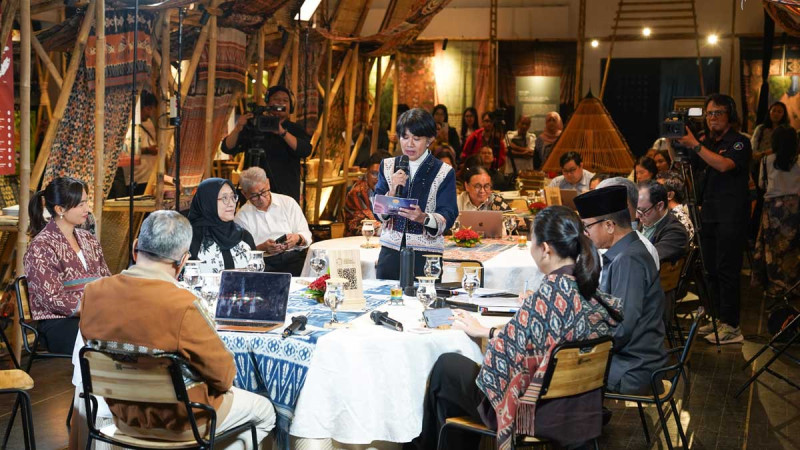
InfoSAWIT, JAKARTA – Stronger collaboration across government ministries and multiple sectors is essential to accelerate the development of a restorative economy that improves community welfare while safeguarding environmental sustainability, speakers said during the opening day of the Kunstkring Dialogue: Restorative Economy Forum in Jakarta.
The forum, held at Tugu Kunstkring Paleis on June 24, brought together policymakers, academics, development practitioners, and Indigenous community representatives to explore policy frameworks that can support Indonesia's transition toward a more inclusive and sustainable economic model.
Organized by the Bambu Lingkungan Lestari Foundation (YBLL) in partnership with Penabulu-Oxfam, the event also formed part of the "Weaving Wonders: Weaving, Food, Energy, and Women—From Cultural Heritage to Economic Power" exhibition presented by the Uma Nusantara Foundation.
A central theme of the discussion, "Building a Supportive Ecosystem for a Restorative Economy: Policies and Services for Local Initiatives," highlighted the pivotal role of women in driving equitable economic development—from household enterprises to village-based community initiatives.
Deputy Minister of Women's Empowerment and Child Protection Veronica Tan said women's economic empowerment cannot be achieved through isolated government programs, stressing that meaningful progress requires coordinated action across ministries and public institutions.
She noted that the ministry's limited institutional mandate makes cross-sector collaboration indispensable for expanding opportunities for women entrepreneurs and strengthening their contribution to Indonesia's economic development.
According to a statement received by InfoSAWIT on Saturday, the forum's opening session was moderated by senior journalist Desi Anwar and featured a panel of senior government officials, including Minister of Villages and Development of Disadvantaged Regions Yandri Susanto, Deputy Minister of Tourism Ni Luh Puspa, Deputy Minister of Industry Faisol Riza, and Director General of Social Forestry at the Ministry of Forestry Catur Endah Prasetiani.
Yandri emphasized that rural development strategies should balance economic growth with environmental protection and cultural preservation by strengthening the entire village economic ecosystem rather than focusing solely on production.
Meanwhile, Ni Luh Puspa highlighted the strategic role of women in advancing a restorative economy through community-based tourism and the sustainable management of local natural and cultural resources.
The dialogue continued with a second session featuring Deputy Minister of Trade Dyah Roro Esti Widya Putri, representatives from the Ministry of Environment, the Ministry of Agrarian Affairs and Spatial Planning, and Indigenous leaders from Flores, who discussed policy coordination and local governance in support of restorative economic development.
The first day concluded with a cultural dinner showcasing traditional cuisine from Wogo Indigenous Village in Ngada Regency, East Nusa Tenggara. The culinary presentation underscored the contribution of local women in preserving cultural heritage while demonstrating how Indigenous knowledge and local traditions can generate sustainable economic opportunities.
The Kunstkring Dialogue runs through June 26, with subsequent sessions focusing on a range of strategic issues, including gender-responsive renewable energy, the ASIK Economy—an Indonesian concept centered on Nature, History, Imagination, and Collaboration—and strengthening the role of Indigenous communities in managing conservation landscapes.
Organizers said the forum aims to foster stronger cooperation among government institutions, civil society organizations, and local communities in developing restorative economic models that promote inclusive growth while protecting Indonesia's environmental and cultural assets. (T2)