InfoSAWIT, BOGOR – Regenerative agriculture is emerging as a promising pathway for Indonesia's independent oil palm smallholders to improve soil health while contributing to national climate change mitigation efforts, according to new research presented at a FORTASBI workshop.
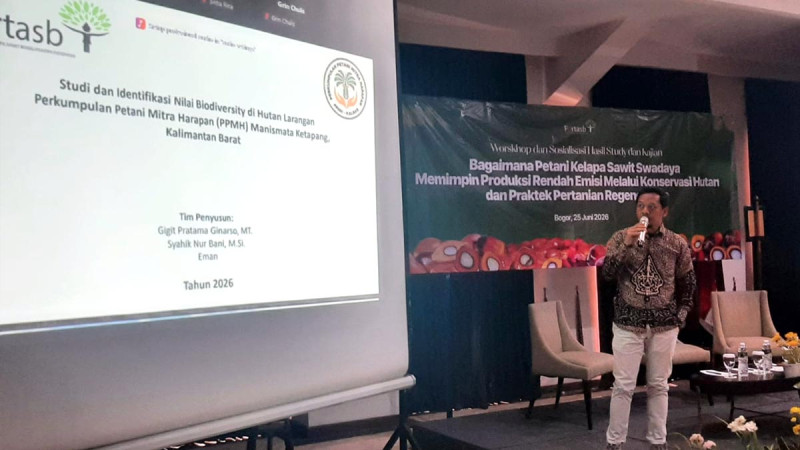
The findings were presented during the workshop titled How Independent Oil Palm Smallholders Lead Low-Emission Production through Forest Conservation and Regenerative Agriculture, attended by InfoSAWIT on Thursday (June 25).
Researcher Dr. Yanto Rochmayanto outlined a study examining the role of regenerative farming in increasing soil organic carbon (SOC), one of the most important indicators of long-term carbon sequestration in agricultural landscapes.
Independent smallholders currently account for roughly 40% of Indonesia's palm oil production. As global markets increasingly demand lower-emission commodities, regenerative agriculture is attracting attention as an approach that goes beyond sustainability by restoring ecosystem functions while maintaining productivity.
"Regenerative agriculture represents a transition toward 'beyond sustainability' by improving environmental conditions rather than simply maintaining them," Yanto explained.
The study was conducted in Simalungun, North Sumatra, and Tebo, Jambi, where farmer groups have begun adopting regenerative practices such as compost application, livestock manure, empty fruit bunch mulching, organic waste recycling, and reduced use of chemical herbicides and pesticides.
Researchers found that plantations implementing regenerative practices consistently recorded higher soil organic carbon levels than conventionally managed farms.
In North Sumatra, SOC increased by approximately 6.03%, with regenerative plots averaging 41.35 tonnes of carbon per hectare compared with 39 tonnes on conventional plots. In Jambi, SOC increased by around 2.09%, with empty fruit bunch applications producing the strongest results.
Although several differences were not yet statistically significant, Yanto noted that changes in soil carbon typically require many years to become fully measurable.
"Improvements in soil organic carbon occur over annual and even decadal timescales. Short-term monitoring often cannot fully capture those changes," he said.
The research estimates regenerative farming could increase soil carbon storage by between 1.35 and 2.35 tonnes per hectare, equivalent to reducing greenhouse gas emissions by approximately 4.94 to 8.62 tonnes of carbon dioxide per hectare.
Beyond climate mitigation, regenerative agriculture was found to improve soil structure, enhance moisture retention, increase organic matter, reduce dependence on synthetic fertilizers, and encourage circular economy practices through recycling plantation residues.
Despite its potential, researchers acknowledged that wider adoption remains constrained by limited access to organic materials, relatively high implementation costs, delayed economic returns, insufficient technical knowledge, and restricted financing opportunities.
The study recommends expanding farmer training, strengthening producer organizations, promoting circular economy initiatives, introducing financial incentives, and increasing collaboration among government agencies, industry players, and farmer organizations.
According to Yanto, Indonesia's independent oil palm growers have the potential to become major contributors to climate action while maintaining productive and economically viable plantations.
"Independent smallholders can become an important part of the climate solution through better soil carbon management and wider adoption of regenerative farming systems," he concluded. (T3)