InfoSAWIT, JAKARTA – The government officially issued Government Regulation (PP) No. 45 of 2025 concerning amendments to PP No. 24 of 2021 regarding administrative sanctions in the forestry sector on September 19, 2025. This regulation was originally expected to be a solution for millions of hectares of existing palm oil plantations that lack permits within forest areas. Through a fine mechanism, ongoing businesses were hoped to gain legal certainty.
However, instead of providing certainty, the new regulation has triggered a fresh wave of uncertainty that threatens the continuity of the national palm oil industry.
Muhamad Zainal Arifin, Director of the Center for Natural Resources Law Study and Advocacy (PUSTAKA ALAM), described the issue of palm oil land legality as a "ticking time bomb" inherited since the deregulation era of the 1990s. At that time, location permits and Right to Cultivate (HGU) titles often overlapped with forest areas whose designation process was incomplete.
“PP 45/2025 should have arranged this issue fairly. Instead, it took a shortcut that sacrifices business certainty and agrarian rights,” Zainal said in an official statement received by InfoSAWIT on Sunday (9/28/2025).
Shift in Legal Philosophy According to Zainal, the most fundamental shift is evident in the legal philosophy adopted. Law No. 6 of 2023 on Job Creation (Cipta Kerja) mandated the settlement of pre-existing land issues with administrative fines, not criminal penalties, adhering to the principle of ultimum remedium. However, Article 3 paragraph (5) and Article 35A of PP 45/2025 introduce a "re-possession" mechanism. After the fine is paid, the land is not automatically legalized but is instead seized by the state and transferred to State-Owned Enterprises (BUMN).
"This is clearly contrary to the spirit of the Job Creation Law," he asserted.
Another problem arises with the fine calculation method. The Job Creation Law stipulated that tariffs be calculated based on a percentage of profit, making it more proportional. PP 45/2025, however, sets a fixed tariff of Rp25 million per hectare per year.
Consequently, the fine value has jumped sharply. In certain cases, a fine calculated at around Rp500 billion under the Law could balloon to Rp2.5 trillion under the new PP.
"This change not only eliminates fairness but also creates extreme disparity," Zainal noted.
The issue is further complicated by the fact that the Forest Area Control Task Force (PKH Task Force) uses location permit data as the basis for calculating area, not real cultivated land data. There are cases where a company that has only planted three hectares is forced to pay a fine for 8,700 hectares of land.
Criticism is also directed at the institutional aspect. Under the Forestry Law and the Forest Damage Prevention Law, the primary authority rests with the Minister of Forestry. Yet, PP 45/2025 significantly strengthens the position of the ad-hoc PKH Task Force.
"The Task Force now has the authority for verification, recommendation, and even the execution of re-possession. Yet this institution is not recognized in the Law. Practically, it has morphed into a shadow government," Zainal said.
Threat of Palm Oil Crisis The heaviest impact of this regulation targets land rights. The UUPA (Basic Agrarian Law) asserts that HGU can only be revoked for public interest with compensation. However, through the re-possession mechanism, HGU can be lost merely because the land is deemed to be in a designated forest area. This condition causes financial institutions to hesitate in channeling credit to the palm oil sector because the legal status can change at any time.
Other risks include an almost certain increase in lawsuits at the State Administrative Court. Agrarian disputes in the field are also feared to escalate. From an economic perspective, the threat of a CPO supply crisis cannot be ignored. If productive land is transferred to BUMNs that are not necessarily efficient, Indonesian palm oil production could be severely hit. This is particularly critical as more than half of the world's RSPO-certified palm oil originates from Indonesia.
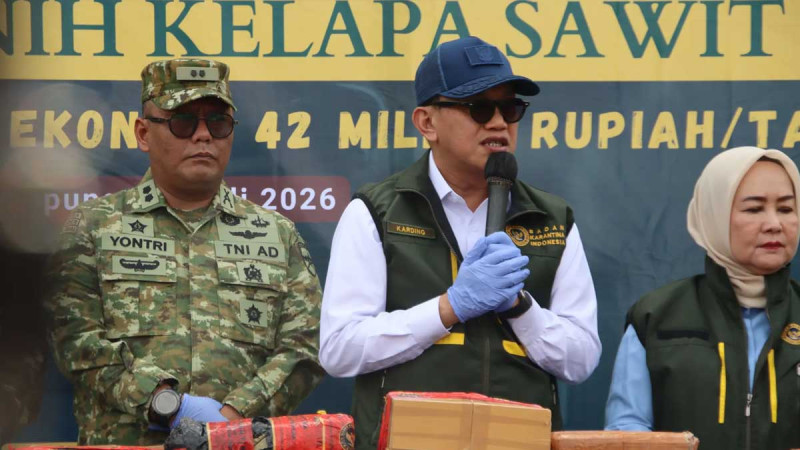
As of September 2025, the PKH Task Force claimed to have re-possessed 3.3 million hectares of land. If the fine is calculated at Rp250 million per hectare, the total liability companies must pay reaches Rp831 trillion. This burden is deemed likely to paralyze palm oil companies and affect the 16.5 million workers who depend on this industry.
Instead of becoming a regularization solution, PP 45/2025 is perceived as a veiled instrument of seizure. The regulation shifts the philosophy of the fine from legalization to nationalization, applies suffocating flat rates, strengthens an ad-hoc Task Force, and weakens the principle of legal certainty.
"If not immediately corrected, PP 45/2025 could be the starting point of a major crisis for Indonesian palm oil—a crisis of legality, finance, and social stability," Zainal asserted.
With external pressure from environmental issues and boycotts, the Indonesian palm oil industry is now being squeezed by contradictory domestic regulations. The bleak portrait of the national palm oil sector is becoming increasingly evident. (T2)