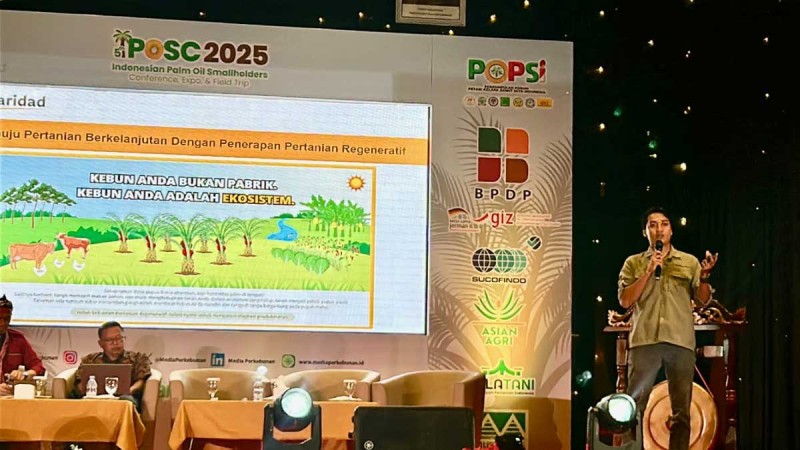
InfoSAWIT, KUBU RAYA – Stagnant productivity in smallholder palm oil plantations presents a serious challenge for independent farmers across many regions. To address this issue, Solidaridad Indonesia participated in the Indonesian Palm Oil Smallholders Conference (IPOSC) & Expo 2025, promoting a science-based solution: regenerative agriculture.
Under the theme “Stakeholder Synergy to Overcome Stagnant Smallholder Palm Oil Productivity,” the largest conference in West Kalimantan served as a crucial platform for Solidaridad to bridge the knowledge and technology gaps often faced by independent smallholders.
“Productivity stagnation is not an issue that can be solved with short-term fixes,” asserted Yeni Fitriyanti, Country Manager for Solidaridad Indonesia, in an official statement received by InfoSAWIT on Sunday (9/28/2025). “Dependence on chemical inputs without restoring soil health will only create a new cycle of problems. The best investment farmers can make is to maintain soil health as their source of livelihood.”
During a session titled “Innovation in Biofertilizers and Compost as the Foundation for Regenerative Agriculture for Sustainable Palm Oil Productivity,” Solidaridad emphasized that soil must be viewed as a living ecosystem that supports long-term productivity. Through regenerative practices, farmers can improve soil health, strengthen the resilience of their farms against climate change and pests, and simultaneously unlock new economic opportunities.
Practical Solutions on the Ground Solidaridad encourages farmers to practice intercropping by planting corn, legumes, or horticultural crops between young palm oil trees. This method has proven to provide alternative income, reduce dependence on chemical fertilizers, and improve the soil ecosystem.
Additionally, Solidaridad set up an educational booth at the conference, offering practical information on regenerative farming practices, making liquid organic fertilizers (LOF), and financial literacy for farm management.
From 2012 to 2024, Solidaridad has trained over 19,785 independent palm oil smallholders across 10 districts and 425 villages in West Kalimantan. This year, Solidaridad aims to provide additional training to about 9,000 farmers through its Field Schools (SL), covering good agricultural practices (GAP), best management practices (BMP), and multi-stakeholder collaboration (MSP).
With this extensive track record, Solidaridad reaffirmed its commitment to continuously strengthening the capacity of independent palm oil smallholders, not just to boost productivity but also to enable farmers to build resilient and environmentally friendly farms.
IPOSC 2025 itself saw attendance from over 1,000 participants, including farmers, plantation companies, cooperatives, central and local government officials, and civil society organizations, underscoring the necessity of cross-stakeholder synergy in tackling the stagnation of national palm oil productivity. (T2)