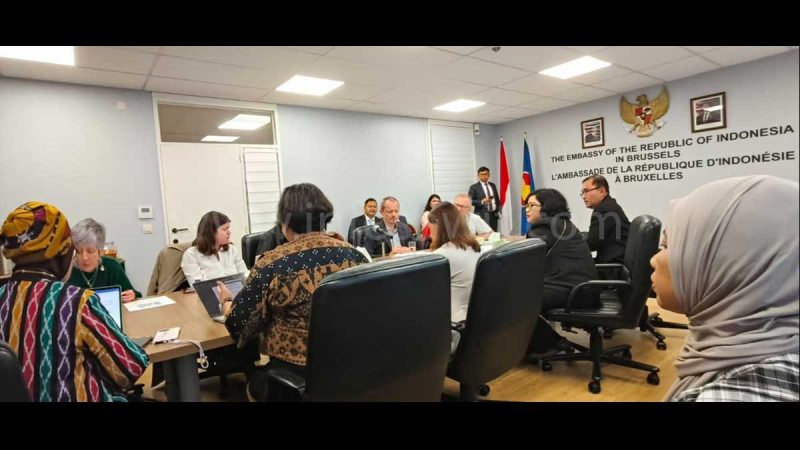
InfoSAWIT, BRUSSELS – The atmosphere in a meeting room in Brussels, Belgium, last weekend felt different. Three female palm oil farmers from Indonesia sat side-by-side with European diplomats, business players, and policymakers. With trembling yet firm voices, they expressed concerns that the European Union Deforestation Regulation (EUDR) could become a new threat to the livelihoods of small-scale farmers in their home country.
They were Nurhayati from North Sumatra (Koperasi Usaha Dagang Lestari), Umi Syamsiatun from Merangin, Jambi (Bumdes Harapan Makmur), and Cici Tiansari from Sarolangun, Jambi (Koperasi Agro Tani Lestari). Their presence was not merely symbolic. They carried the voices of thousands of independent palm oil farmers—especially women—who are often in the most vulnerable position in the global palm oil supply chain.
The roadshow, titled "Smallholder Roadshow of Indonesia's Leading Commodities," also included rubber, cocoa, and coffee farmers. The series of events held in Brussels, London, and Rome provided a platform for direct dialogue between farmers and European stakeholders who play a major role in determining the future of sustainable commodity trade.
Good Regulation That Leaves Room for Concern
The EUDR was established with a noble goal: to prevent deforestation and forest degradation caused by global commodity supply chains. However, for small-scale farmers in producing countries like Indonesia, this regulation presents serious challenges. Requirements such as mandatory digital land maps, verified formal legality, and a product traceability system from upstream to downstream become a heavy burden for independent farmers who have minimal access to information and technical support.
"We don't export directly to Europe. Our products are only fresh fruit bunches that are processed by large companies into CPO and PKO. This means we still contribute to the European market. But when the EUDR comes into effect, we are the ones who will be most impacted. Companies could drop us from the supply chain for being a high-risk source of non-compliance," said Umi Syamsiatun in an official statement received by InfoSAWIT on Tuesday (9/16/2025).
A similar sentiment was shared by Nurhayati. She emphasized that the farmers do not reject the regulation. "We do not reject the EUDR, because its goal aligns with our commitment to preventing forest destruction. We have made efforts, from ISPO to RSPO certification. But with the complicated EUDR requirements, we worry that the European Union will soon abandon smallholders," she stated.
More than just an economic threat, these female farmers warned of the social impact that could arise. If independent farmers are excluded from the supply chain, the risk of losing their livelihoods will grow. This could widen the gender gap and weaken the position of women in the plantation sector.
"The EU should implement this regulation in phases, both in terms of time and requirements. We need time to adapt and the opportunity to be involved in collaborations to prevent deforestation. We want to be part of the solution, not victims of policy," Umi added.
Cici Tiansari also emphasized the importance of cross-party collaboration. According to her, sustainability can only be achieved if all actors in the supply chain, including female farmers, have an equal place and support.
Their presence was appreciated by the Indonesian Embassy in Brussels, which facilitated the meeting. Rukaiyah Rafik, the companion for the female palm oil farmers on this roadshow, stressed that this type of forum is important to open the eyes of European policymakers.
"This is an important step to ensure the voices of female farmers are no longer ignored. This dialogue is hoped to pave the way for fair, inclusive regulations that truly promote sustainability. Without smallholders upstream, the goal of no deforestation is impossible to achieve," she said.
What these female farmers voiced truly illustrates a major dilemma in global trade. On one hand, the world demands sustainable products. But on the other hand, without real support, regulations could end up marginalizing those who most need market access: small-scale farmers.
The presence of Nurhayati, Umi, and Cici in Europe serves as a reminder that global policies should not be born in meeting rooms far from the realities on the ground. Their voices affirm that true sustainability can only be realized when it involves all parties, including the female farmers who have been at the forefront of protecting the earth while providing for their families. (T2)