InfoSAWIT, JAKARTA – A 20-year requirement included in a government circular concerning the protection of communities living for generations in forest areas has drawn scrutiny from Indonesian civil society group Sawit Watch.
The organization argues that the time limit does not appear to directly originate from the Constitutional Court's ruling that forms the legal basis for the policy.
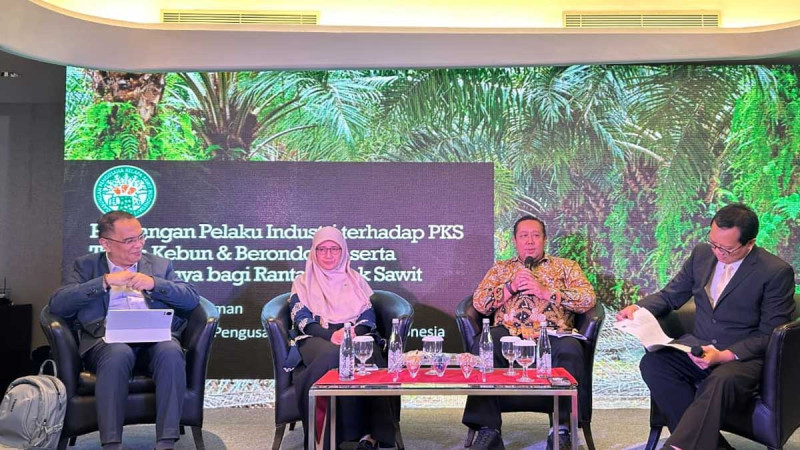
Sawit Watch Executive Director Achmad Surambo raised the issue during the Pre-National Conference on Smallholder Plantations II webinar on Friday, September 4, 2026. He said the circular contains several provisions that appear inconsistent with the substance of the Constitutional Court decision.
One of the main concerns is the requirement that communities must have occupied or lived in an area for 20 years to qualify under the relevant provision.
Surambo questioned the legal basis for setting the threshold, arguing that the concept of a community living in an area for generations should focus more on intergenerational relationships and factual conditions than on an arbitrary number of years.
“If it is said that 20 years is required, that is something we believe is outside the Constitutional Court's ruling,” Surambo said during the webinar.
Generational Ties Cannot Simply Be Reduced to Years
For Sawit Watch, the term “hereditary” or “intergenerational” should not automatically be measured by a fixed period.
Surambo argued that an intergenerational relationship can exist even when a community has not been present in an area for 20 years. A relationship involving grandparents and grandchildren, for example, can already demonstrate continuity across generations.
The organization therefore favors a declarative and factual approach, in which the existence of a community is assessed based on actual conditions on the ground rather than solely on formal government recognition.
This approach, Sawit Watch argues, is particularly important for communities whose traditional rights may not yet be fully reflected in administrative documents.
Concerns Over the Definition of Commercial Activity
Sawit Watch also questioned another requirement related to the distribution chain for agricultural products.
According to Surambo, the circular includes provisions concerning the absence of buyers, middlemen or financiers in the distribution of community-produced goods.
He said such a requirement could be too restrictive if applied rigidly to communities living in forest areas.
Communities may maintain economic relationships with other parties and sell part of their agricultural output to meet household needs. The existence of a transaction, therefore, should not automatically mean that an activity is commercial in nature.
Selling Produce Does Not Automatically Mean Commercialization
Surambo emphasized that the purpose of a transaction should also be considered.
If agricultural products are sold to pay for children's education, clothing or other basic household needs, he argued that the activity should not necessarily be categorized as commercial.
By contrast, activities designed to expand capital, maximize profits or involve major investors have a different character. Indicators of commercial activity could include structured corporate involvement and management practices resembling those of a formal business enterprise.
The distinction is important for smallholder oil palm plantations, where farmers may sell fresh fruit bunches (FFB) as part of their livelihood without necessarily operating a large-scale commercial enterprise.
Circular Letter Should Not Create New Legal Norms
Another issue raised by Sawit Watch concerns the legal position of a circular letter.
Surambo argued that an administrative circular should not be used to introduce new requirements that effectively narrow the meaning of a Constitutional Court ruling.
He cited the 20-year requirement as an example. If the Constitutional Court ruling itself does not establish such a threshold, he questioned whether an implementing circular should be allowed to create one.
Sawit Watch also questioned the use of the term “mandatory” regarding registration with local governments. According to Surambo, such a requirement could shift the policy from a factual and declarative approach toward one dominated by formal administrative recognition.
Toward a More Restorative Approach
Sawit Watch is calling for implementation of the Constitutional Court ruling through a more restorative and socially just framework.
Under this approach, policies affecting communities that have long lived in forest areas should consider their history of land use, dependence on natural resources and livelihood needs rather than relying primarily on enforcement and administrative requirements.
The debate over where to draw the line between non-commercial and commercial activities also remains unresolved, particularly in relation to smallholder oil palm plantations.
Surambo acknowledged that the issue requires further discussion and consultation as the government works to determine how the Constitutional Court's ruling should be implemented in practice. (T2)
Source: InfoSAWIT