InfoSAWIT, JAKARTA – As forest and land fires spread across parts of Sumatra and Kalimantan, concerns are growing over the safety of palm oil plantation workers who continue working as smoke blankets several areas.
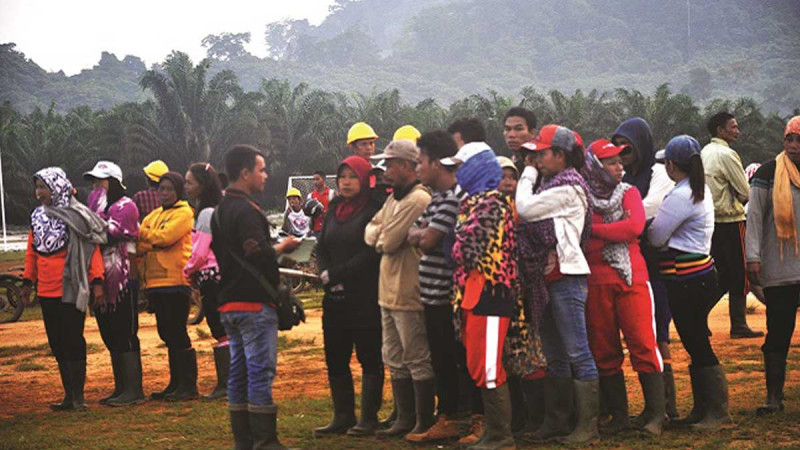
The Transnational Palm Oil Labour Solidarity (TPOLS) network has raised concerns about the protection of plantation workers amid deteriorating air quality. According to the network, workers in several palm oil plantations have reportedly been required to continue working despite heavy smoke reducing visibility and making breathing more difficult.
Citing a statement received by InfoSAWIT on Wednesday, September 9, 2026, TPOLS said the situation had been reported at plantation sites in both Kalimantan and Sumatra. Workers said plantation activities continued even as smoke began to affect their breathing and daily work in the field.
One of the workers, Damianus Fansi, from Central Kalimantan, said the company provided workers with only thin masks. He said workers received four masks per week and that there were no reductions in working hours despite the worsening conditions.
“The company only distributes thin masks. Even then, we only receive four masks a week. There are also no restrictions on working hours. All workers continue working normally,” Damianus said.
Similar concerns were raised by Agil, a labor union leader in West Kalimantan. He said smoke had caused breathing difficulties among workers, while adequate protective masks remained difficult to obtain.
“The smoke makes it difficult for us to breathe. Even while struggling to breathe, we have difficulty finding thicker masks and still have to work,” Agil said.
Workers Reportedly Trapped by Fire and Smoke
The risks facing plantation workers extend beyond exposure to hazardous smoke.
In one incident in Palangka Raya, 12 palm oil plantation workers were reportedly trapped by fire and smoke before eventually being evacuated.
TPOLS said the incident highlighted the need to place occupational health and safety at the center of forest and land fire response efforts in plantation areas.
Kamil, from West Kalimantan, also pointed to gaps in corporate assistance for workers affected by poor air quality. According to him, basic supplies such as masks, clean water, oxygen and medicines have not been adequately provided.
The situation becomes more serious when plantation operations continue despite deteriorating air quality.
TPOLS has called on companies to temporarily halt work, both indoors and outdoors, whenever fire conditions threaten workers' safety. Evacuation, health protection and workers' rights, the group said, should take priority during emergency conditions.
Forest Fires Also Affect Workers' Families
The consequences of the fires are not limited to the workplace. Women and families in affected communities are also facing additional pressure as livelihoods and economic activities are disrupted.
Irene Natalia Lambung, chairwoman of BEK SP Mamut Menteng, said women were carrying heavier care responsibilities during the disaster while household incomes declined as agricultural land was burned.
She said women had been forced to postpone farming activities while seeking ways to secure food and income for their families.
Psychological pressure has also increased, with concerns over family safety, the possibility of recurring fires and wildlife entering residential areas adding to the burden faced by women during the crisis.
TPOLS Calls for Greater State and Corporate Responsibility
TPOLS argues that recurring forest and land fires should not simply be viewed as the result of natural phenomena or extreme weather.
Rizal Assalam of TPOLS said a series of floods, landslides, forest fires and damage to people's living environments should also be examined in the context of spatial governance and corporate oversight.
The organization cited research by Yayasan Lokahita and several civil society organizations estimating that oil palm plantations cover around 10.70 million hectares across Sumatra, exceeding an estimated ecological carrying-capacity threshold of approximately 10.69 million hectares.
The same research reportedly found around 5.97 million hectares of oil palm plantations located in areas facing ecological constraints.
TPOLS also highlighted the presence of significant plantation concessions in areas severely affected by flooding. The figures cited in its release include approximately 231,095.73 hectares of oil palm concessions in Aceh, 65,707.93 hectares in Mandailing Natal, North Sumatra, and 24,004.33 hectares in Pesisir Selatan, West Sumatra.
Combined, the three areas account for approximately 320,807.98 hectares of oil palm concessions within landscapes severely affected by flooding, according to the cited release.
Meanwhile, Sawit Watch Executive Director Achmad Surambo pointed to a reported 366 percent increase in fire hotspots. He linked the escalation to strategic national projects, including food estates, as well as policies encouraging biofuel and biodiesel use.
Surambo also stressed the need for concrete emergency measures for palm oil workers, including adjustments to working hours, reductions in daily production targets and stronger prioritization of occupational health and safety.
TPOLS Sets Out Demands
TPOLS said both the government and corporations have responsibilities in responding to and recovering from ecological disasters.
The network called for forest and land fire policies that do not disproportionately blame small farmers and local communities. It also urged an end to oil palm plantation expansion and what it described as corporate impunity for environmental destruction and land dispossession.
Among its other demands, TPOLS called for the disasters in Aceh, North Sumatra and Kalimantan to be declared national disasters, stronger guarantees for workers' safety and rights, and restoration of the rights of communities affected by forest and land fires.
The organization also called for improved gender-disaggregated data on disaster victims and immediate restoration of damaged ecosystems, including peatlands.
Amid the fires, communities, civil society organizations and labor unions have established solidarity posts to assist affected residents. Assistance includes masks, medicines, hand sanitizer and oxygen.
For TPOLS, such community solidarity is important during disasters, but it should not become a justification for the state or corporations to step away from their responsibilities in responding to and recovering from ecological disasters. (T2)