InfoSAWIT, PUTUSSIBAU – The Kapuas Hulu Regency Government in West Kalimantan will review the Spatial Utilization Suitability Approval (PKKPR) granted to PT Equator Sumber Rezeki (PT ESR) following growing concerns over land-use planning, indigenous territories, and orangutan habitat within the company's concession area.
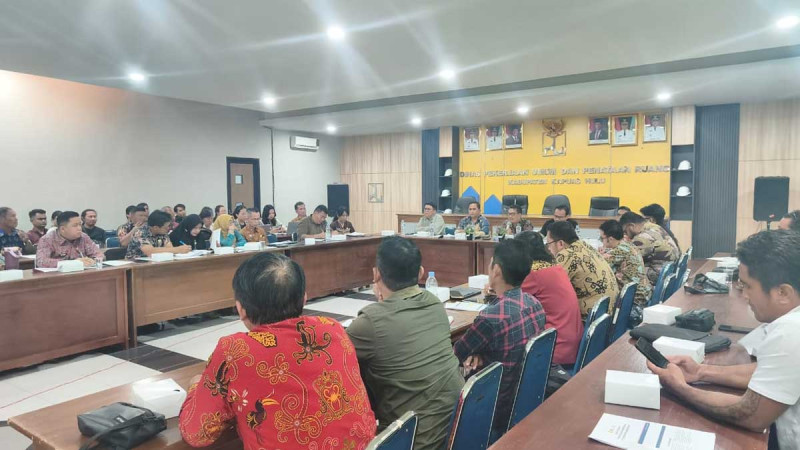
The decision follows a multi-stakeholder mediation forum hosted by the Kapuas Hulu Public Works and Spatial Planning Agency (PUPR), which brought together around 60 participants, including representatives from local government, academia, civil society organizations, indigenous communities, and the company itself.
The meeting focused on requests from indigenous communities for the government to reassess PT ESR's PKKPR, which is scheduled to expire in October 2026. Participants urged authorities to ensure that the permit accurately reflects current spatial planning conditions and realities on the ground before any extension or further approval is granted.
Marthen, Head of the Kapuas Hulu PUPR Office, said all feedback received during the forum would be incorporated into the evaluation process. The local government plans to conduct field verification, remap areas proposed for exclusion from the concession, and undertake internal assessments before determining its next course of action.
Environmental organization Satya Bumi presented findings alleging that PT ESR cleared approximately 4,480.55 hectares of forest between 2024 and June 2026, including around 3,715 hectares located within the habitat of the Bornean orangutan (Pongo pygmaeus). The group also highlighted indications that parts of the concession overlap peatland areas, although it acknowledged that government peatland hydrological maps do not classify the site as a protected peat hydrological zone, suggesting further verification is necessary.
Civil society groups further argued that sections of the concession overlap with Provincial Strategic Areas, recognized indigenous forests, and customary territories, raising concerns over biodiversity conservation, indigenous land rights, and potential future land-use conflicts. Representatives from several indigenous villages voiced opposition to the plantation's planned expansion, citing fears over shrinking customary forests, reduced access to traditional resources, and threats to local water sources.
Meanwhile, Link-AR Borneo stated that, based on clarification from the local ATR/BPN Land Office, PT ESR's Right-to-Cultivate (HGU) permit remains under processing. The organization alleged that land clearing and planting activities had already begun before the HGU was officially issued.
Responding to the concerns, Kapuas Hulu Regional Secretary Ambrosius Sadau said PT ESR had obtained the necessary legal permits through the applicable procedures but emphasized that the company must respect both supporters and opponents of the project while ensuring that its operations do not harm surrounding communities.
Academics participating in the discussion also noted that Indonesia's Online Single Submission Risk-Based Approach (OSS-RBA) system may not always capture complete spatial data, potentially creating legal, environmental, and social challenges if permits are not followed by comprehensive field verification. The mediation concluded with recommendations for a transparent, science-based review of PT ESR's concession before any further decisions are made. (T2)
Source: InfoSAWIT