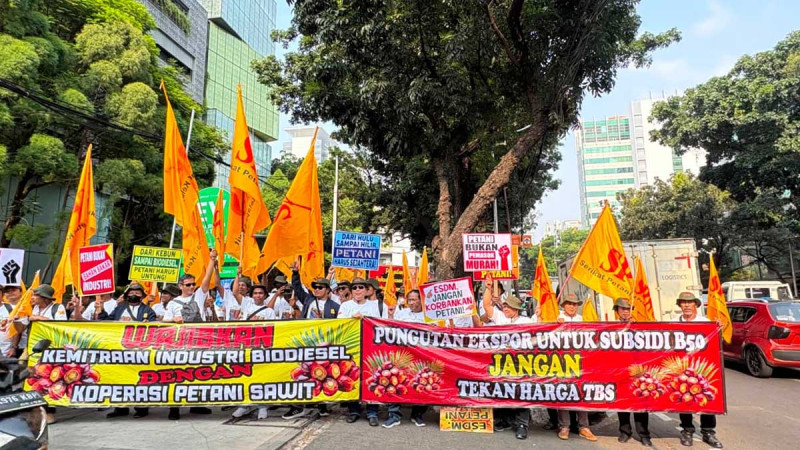
InfoSAWIT, JAKARTA – Indonesian oil palm smallholder organizations have called on President Prabowo Subianto to reassess the role of Danantara Sumberdaya Indonesia (DSI), warning that additional layers in the palm oil supply chain could ultimately reduce farmer incomes and undermine market efficiency.
In a statement received by InfoSAWIT on June 24, 2026, the Indonesian Oil Palm Farmers Organization (POPSI) and the Central Kalimantan chapter of the National Palm Oil Activists Network (JPSN) expressed concerns over DSI’s potential involvement in the country’s palm oil trading system.
POPSI Chairman Mansuetus Darto said any institution participating in the sector should generate measurable benefits for the industry. However, he argued that the implementation of Government Regulation No. 24 of 2026 has yet to demonstrate clear added value for stakeholders across the palm oil supply chain.
According to Darto, DSI risks becoming an additional intermediary in a business ecosystem that already includes smallholders, traders, palm oil mills, refiners, and exporters.
“If DSI becomes directly involved in trading activities and captures margins, it could reduce the efficiency improvements that the industry has been striving to achieve,” he said.
Darto argued that if the government’s objective is to address under-invoicing and improve export revenue collection, strengthening existing institutions such as the Directorate General of Customs and Excise, the Financial and Development Supervisory Agency (BPKP), and independent surveyors would be a more effective approach.
He emphasized that Indonesia’s palm oil industry should prioritize efficiency, transparency, sustainability, and improved economic returns for smallholders rather than adding new entities to the trading chain.
JPSN Central Kalimantan Chairman Kobar Sembiring echoed those concerns, saying a review of DSI has become increasingly important as rural communities continue to face mounting economic pressures.
According to Kobar, rising living costs and persistently high logistics expenses have narrowed profit margins for many oil palm smallholders.
“Any policy that potentially lowers the FFB prices received by smallholders would further increase economic pressure on palm-growing communities,” he said.
He noted that the impact of palm oil trade policies extends beyond farmers themselves, affecting approximately 16,000 palm oil-dependent villages across Indonesia whose local economies rely heavily on the sector.
Both organizations said they support government efforts to improve palm oil governance but urged policymakers to focus DSI’s role on transparency, monitoring, and coordination rather than direct commercial trading activities.
They also called for stronger data management systems, enhanced oversight mechanisms, and greater public accountability to ensure that reforms strengthen Indonesia’s palm oil competitiveness while safeguarding the livelihoods of millions of smallholders and rural residents. (T2)