InfoSAWIT, KARACHI — The Council of Palm Oil Producing Countries (CPOPC) has concluded its mission in Karachi carrying a strong message: Asia is now at the center of global palm oil demand, shaping market direction and influencing supply chain resilience. The visit also reaffirmed CPOPC’s commitment to strengthening cooperation with Pakistan, one of the region’s most strategic palm oil markets.
The mission highlighted Asia’s increasingly decisive role in supporting market stability, safeguarding supply chains, and ensuring food security — amid shifting dynamics in the global vegetable oils trade. For CPOPC, the relationship between producing and consuming nations is no longer merely transactional, but an essential foundation for the long-term sustainability of the global palm oil market.
During its visit, the CPOPC delegation engaged with key stakeholders ranging from government officials and industry players to members of the diplomatic community. The meetings served as a platform to exchange views on market outlook, supply resilience, and global challenges affecting vegetable oil trade.
The discussions also underscored Pakistan’s growing importance — not only as one of the world’s largest palm oil importers, but also as a rising force influencing regional trade flows as global demand increasingly tilts toward Asia.
CPOPC Secretary-General: Pakistan Is More Than an Import Market
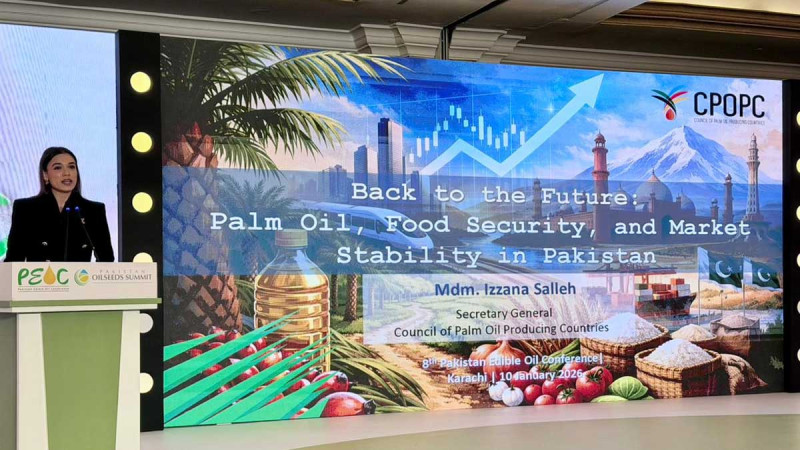
A key highlight of the mission took place at the 8th Pakistan Edible Oils Conference (PEOC) 2026, where CPOPC Secretary-General Izzana Salleh delivered a presentation emphasizing that Pakistan has evolved from a buyer market into a strategic partner shaping the future of palm oil in Asia.
“Pakistan is not merely an import market, accounting for around 4.3% of global palm oil consumption, but has now become a strategic partner that helps shape price stability, food security, and the future of palm oil in Asia,” Izzana said.
She noted that Pakistan imports around 3.3 million tons of palm oil per year for domestic consumption, placing it among the world’s largest importers alongside India and China.
Asia Strengthens as Traditional Markets Lose Influence
Izzana further pointed to Asia’s growing collective strength in the palm oil market. With India (18%), China (11%), and Pakistan (9%), the three countries account for nearly 40% of total global palm oil imports.
This trend confirms that Asia is not only the largest consumer region, but is also increasingly defining price stability, trade flows, and sustainability pathways — surpassing traditional markets such as the European Union.
In Pakistan’s case, palm oil is seen as irreplaceable within the national food system, supporting household affordability, sustaining small and medium-scale food processors, and helping stabilize vegetable oil supplies amid global volatility.
CPOPC stated that palm oil supplies more than 50% of Pakistan’s vegetable oil needs and contributes around 70%–75% of national vegetable oil consumption, particularly for ghee and cooking oil.
“Palm oil supplies more than half of Pakistan’s vegetable oil needs and remains the most affordable option for households and food producers. Any supply disruption would directly impact food security and economic stability,” Izzana stressed, as stated in an official release quoted by InfoSAWIT on Tuesday (January 20, 2026).
She also highlighted the role of Pakistan’s small and medium enterprises (SMEs), which contribute nearly 40% of GDP and 25% of exports, making stable palm oil supply critical for the country’s domestic economy.
A New Sustainability Direction: From Compliance to Contribution
On sustainability, CPOPC emphasized the importance of shifting the narrative from “compliance” to “contribution” — meaning sustainability efforts must strengthen, not weaken, food security and supply reliability for importing countries such as Pakistan.
While more than 20% of global palm oil supply is now certified sustainable, Izzana said a more inclusive approach is needed — including recognition of national standards and tangible support for smallholders, to avoid new frictions in international trade.
As part of the mission, the delegation also paid courtesy visits to Indonesian and Malaysian diplomatic representatives in Karachi, meeting with Indonesian Ambassador to Pakistan Chandra W Sukotjo, Indonesian Consul General Muzakir, and Malaysian Consul General Herman Hardynata Ahmad.
The discussions centered on strengthening collaboration with Pakistan’s palm oil stakeholders, correcting misinformation related to palm oil and climate narratives, and reinforcing Pakistan’s position as a long-term key market for producers.
Pakistan’s Youth Voices Enter the Conversation
CPOPC also used the mission to officially introduce Pakistan’s #YoungElaeis Ambassador, Muhammad Awais Shahid, to industry stakeholders — marking a new chapter in youth engagement within palm oil dialogue.
Through digital content, Awais has been promoting data- and science-based messaging. In one of his videos, he explained the nutritional value of red palm oil, which is rich in natural beta-carotene that the body converts into vitamin A.
CPOPC views this initiative as proof that the future of palm oil communication will not only be shaped by institutions, but also by young voices who promote knowledge, transparency, and public literacy.
With Asia becoming the key center of demand growth, CPOPC stressed that trusted partnerships between producers and consumers will be essential to keeping supplies stable, prices balanced, and food security strong in the years ahead. (T2)