InfoSAWIT, JAKARTA – For more than four decades, palm oil has supported Indonesia’s economy. Now, as the country prepares to enter the era of B50 biodiesel, it faces two major challenges: safeguarding the supply of green energy and strengthening the genetic foundation of oil palm so that productivity can remain high and sustainable for future generations.
The government’s plan to increase the mandatory biodiesel blend to 50 percent (B50) has raised concerns among palm oil stakeholders. While the policy is expected to support global palm oil prices, it also exposes a critical vulnerability—Indonesia’s stagnant plantation productivity, which threatens the availability of raw materials needed to meet the policy’s ambitious targets.
Under the B50 scheme, half of Indonesia’s national diesel energy demand will be met by palm oil–based biodiesel. “This means 50 percent of our biodiesel will come from crude palm oil. The impact will be enormous,” said Baginda Siagian, Director of Oil Palm and Other Palms at the Directorate General of Plantations, Ministry of Agriculture, speaking at an event attended by InfoSAWIT in Bogor in late October 2025.
According to Baginda, B50 is not merely a technical figure but a turning point that will significantly reshape the palm oil supply chain from upstream to downstream. While biodiesel demand in 2024 absorbed around 12 million tons of CPO, B50 implementation could push domestic absorption to 18–19 million tons.
“This means most palm oil will be consumed domestically. The consequence is reduced exports, and farmers could suffer if productivity does not improve,” he warned.
Indonesia’s palm oil productivity has long been stuck at around 3.5 tons of CPO per hectare per year, despite its potential to reach 5–6 tons. “We don’t need to talk about 7 or 10 tons yet. Just reaching 5 tons per hectare would already transform the national production landscape,” Baginda emphasized.
Multiple factors contribute to this stagnation, including the widespread use of uncertified seeds. Studies in South Sumatra show that 45 percent of smallholder plantations use fake seeds, while in Riau the figure can reach 70 percent. “This is a major irony. How can we talk about efficiency when the planting material itself is unreliable?” he said.
Another serious threat is Ganoderma, a root rot disease Baginda likened to a “submarine underground”—invisible but silently destroying palm roots. “If we fail to control it over the next 20 years, our oil palm sector could collapse by 2060–2070. This is no exaggeration,” he stressed.
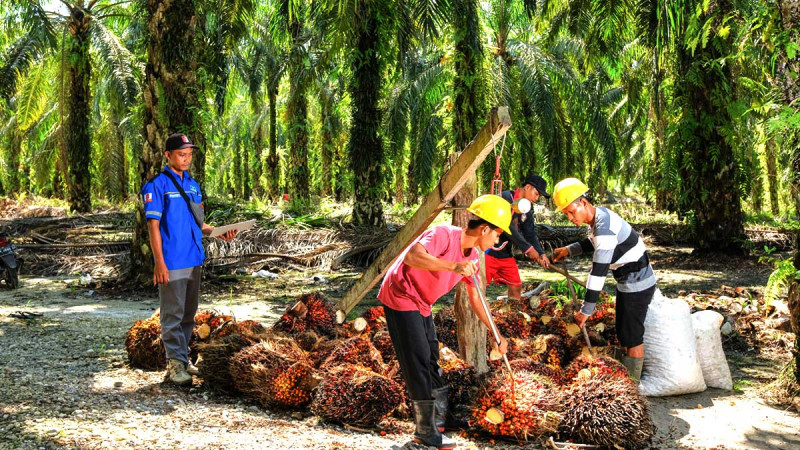
To address these challenges, the Ministry of Agriculture, together with the Palm Oil Plantation Fund Management Agency (BPDP), is racing against time through the Smallholder Oil Palm Replanting Program (PSR). Thousands of hectares of aging plantations are being replanted with certified high-quality seeds.
The government is also investing in human capital. “Nearly 10,000 smallholders and their children have received scholarships for vocational education in plantations. We also provide production roads, agricultural machinery, and technical assistance,” Baginda explained. (T2)
For more details, see InfoSAWIT Magazine, November 2025 edition.