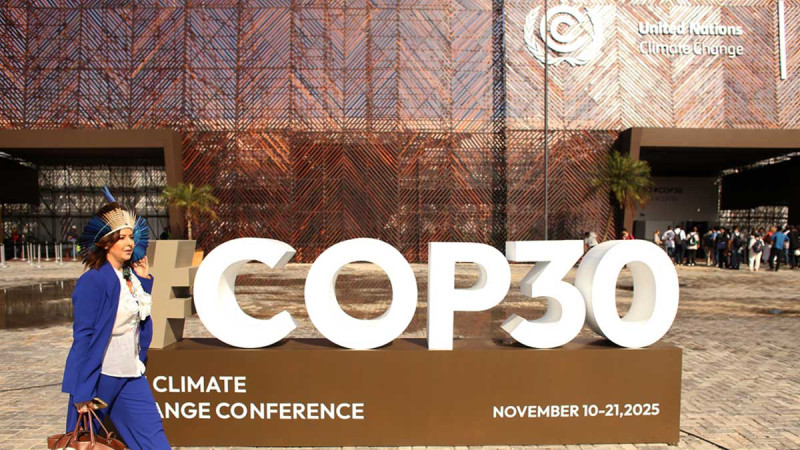
InfoSAWIT, JAKARTA — Carbon trading is once again in the spotlight ahead of the 30th UN Climate Change Conference (COP30), which will take place in Belém, Brazil, from 10–21 November 2025.
At the Indonesia Pavilion, climate finance and carbon trading are the main agenda items, with the government preparing a special forum to connect potential sellers and buyers of carbon credits. The narrative sounds promising: saving forests while generating new income through carbon trade.
Yet, behind the optimistic tone lies a crucial question: does carbon trading truly reduce emissions, or does it merely turn the climate crisis into a new economic commodity?
In principle, carbon trading is part of the Paris Agreement, a global pact to limit global temperature rise to below 1.5°C above pre-industrial levels. Exceeding that threshold could trigger ecosystem collapse—melting polar ice, rising sea levels, more extreme weather, and mass species extinction.
However, on the ground, implementation does not always align with this goal. Many observers argue that Indonesia’s climate policies remain unbalanced. The energy sector, particularly coal-fired power plants (PLTU), which contribute the most emissions, has not been addressed seriously. Meanwhile, the forestry sector continues to bear the main burden, as if forests alone could offset the carbon “sins” of other industries.
The popular slogan “sell carbon, save forests, and earn income” oversimplifies the issue. Most carbon mechanisms in Indonesia are offset-based, not cap-and-trade. In the offset system, companies unable to directly reduce emissions can buy carbon credits from projects that absorb carbon—such as forest or peatland restoration. This voluntary system often serves as a shortcut to compensate for pollution without changing production practices.
In contrast, a cap-and-trade system is mandatory. The government sets emission limits for certain sectors, and companies that emit below the cap can sell their surplus to others exceeding their limits. Yet, this mechanism has not been fully implemented in Indonesia, as national emission caps have not been established.
As stated in an official release received by InfoSAWIT on Monday (Nov 10, 2025), this condition makes Indonesia’s carbon market resemble a “compensation market” rather than a strict emission-control instrument.
On one hand, forests are being positioned as a magnet for carbon investment; on the other, deforestation continues under large-scale development projects. This paradox leaves Indonesia in a dilemma—protecting forests for carbon credits while opening new land for emission-heavy industries and infrastructure.
Another challenge lies in data credibility. International studies show that many carbon projects exaggerate emission-reduction claims, sometimes by 30–100%. An investigation by The Guardian (2023–2024) revealed that about 90% of carbon credits under the REDD+ scheme did not represent real emission reductions. This revelation shook public trust in global carbon markets and prompted major revisions to calculation methodologies.
Governance issues also persist. Indonesia’s Measurement, Reporting, and Verification (MRV) system is criticized for lacking transparency and robust data integrity. Institutional overlaps, inconsistent baselines, and weak accountability mechanisms heighten the risk of double counting—where a single emission reduction is claimed twice.
Social risks are another concern. Many offset projects overlap with customary lands or local community areas, limiting access to natural resources. Critics call this phenomenon “new ecological colonialism”—forests are preserved not for the people who live there, but to offset emissions from distant corporations or countries.
Globally, systems such as the European Union Emission Trading System (EU ETS) are often cited as successful because they rest on strong data foundations, strict rules, and firm penalties for violators. Indonesia, however, is still at the early stage of developing such a system.
Experts argue that if carbon trading is to become an effective mitigation tool—not merely a business opportunity—then MRV systems must be strengthened and data integrity safeguarded. More importantly, emission reductions must occur at the source, especially in the energy sector, rather than being “purchased” through forest carbon credits.
Ultimately, what the world needs is not just a bustling carbon market, but genuine commitment to cut emissions and keep the planet’s temperature under control. (T2)