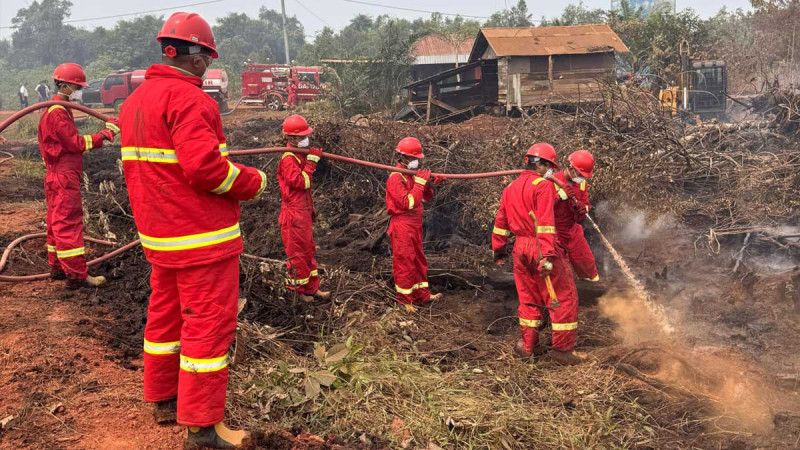
InfoSAWIT, MEDAN – Musim Mas Group has deployed more than 1,000 personnel, 16 firefighting vehicles and a helicopter to strengthen efforts to control forest and land fires in Indonesia’s Central Kalimantan province as dry conditions increase the risk of further outbreaks.
Since July 8, 2026, the company’s teams have also assisted firefighting operations in 13 affected villages, extending support beyond its operational areas.
According to a statement received by InfoSAWIT on Wednesday, Oct. 7, the response combines ground firefighting, aerial water bombing, hotspot monitoring and the construction of firebreaks to contain the spread of fires.
The affected villages include Sebabi, Kenyala, Tanah Putih, Hanjalipan, Tangar, Baampah, Penyang, Camba, Soren, Bagendang Tengah, Natai Baru, Palangan and Kandan.
Ground and Aerial Firefighting Operations
Bangun Hapsoro, Musim Mas Group’s survey manager and coordinator for the company’s fire response operations in Kalimantan, said the firefighting strategy is adjusted according to site conditions and accessibility.
“We cannot rely on just one method in the field. Some teams work from the ground, water bombing is used to reach difficult locations, while heavy equipment is deployed to create firebreaks and prevent the flames from spreading,” Bangun said.
The helicopter is equipped with a bambi bucket capable of carrying around 800 liters of water per drop. Under certain conditions, aerial water bombing can be conducted up to around 30 times a day.
After the initial aerial operation, ground teams continue spraying and cooling affected areas to ensure that fires and remaining embers are fully extinguished.
Fires on peatlands present additional challenges because flames may disappear from the surface while combustion continues underground.
“In peatlands, the work is not finished when the fire is no longer visible. We continue cooling the area and making sure there are no remaining embers,” Bangun said.
More Than 1,000 Employees Involved
More than 1,000 Musim Mas staff and employees in Central Kalimantan have been involved in rotating firefighting teams for more than two months.
Suparman, assistant head of the Musim Mas Group Training Center, said personnel have had to work through fatigue and heavy smoke during the response.
“We are tired. For more than two months, we have remained on standby and worked in shifts. But what we want is simple: for the fires to be extinguished quickly, for the air to improve and for people to return to their activities comfortably,” he said.
Water availability has also emerged as a challenge. Several reservoirs and rivers have shrunk or dried up during the dry conditions, making coordination with local authorities and communities increasingly important.
Health Posts Established for Communities
Alongside firefighting efforts, Musim Mas Group has established five free health posts in several locations in East Kotawaringin Regency in cooperation with local health authorities and community health centers.
Company doctor and health-post coordinator Dr Yulin Effendi said each post serves around 100 to 120 patients. Respiratory complaints, including coughing and shortness of breath, account for approximately 30-40% of cases.
The health services include medical examinations, medicines, vitamins, masks and oxygen for residents who require it.
Collaboration Key to Fire Prevention
Rihel Magat, acting head of the East Kotawaringin Regional Disaster Management Agency (BPBD), said forest and land fire management requires coordination among local governments, communities, subdistrict administrations and private companies.
“Forest and land fire management requires a working group. It cannot involve only the local government, but also communities, subdistrict authorities and the private sector,” Rihel said.
Musim Mas has also distributed firefighting equipment, including water pumps, hoses, nozzles and other supporting equipment, to 14 villages in East Kotawaringin.
The company said the assistance is intended to strengthen communities’ ability to respond to fires at an early stage before they spread.
Zero-Burning Policy and Early Detection
Beyond firefighting, Musim Mas Group implements a Zero Burning Policy, prohibiting the use of fire in land management.
The policy is supported by satellite-based hotspot monitoring, field verification, drones for difficult-to-reach areas and fire-watch towers.
The company also maintains trained firefighting teams, firefighting vehicles and equipment, as well as water reservoirs.
At the community level, its Fire-Free Community (Masyarakat Bebas Api) program has been running since 2016, focusing on education, patrols, capacity building and firefighting equipment support.
The program also promotes fire-free land preparation and recognizes villages that successfully remain fire-free for an entire year.
The response in Central Kalimantan highlights the importance of combining firefighting capacity with early detection, water availability, health services and community participation, particularly while dry weather continues to elevate forest and land fire risks in the region. (T2)