InfoSAWIT, JAKARTA — Indonesia’s Ministry of Agriculture is exploring ways to increase the use of palm-based ingredients in poultry feed to reduce the country’s reliance on imported soybean meal (SBM). Research is underway in collaboration with the National Research and Innovation Agency (BRIN) and universities to determine how far palm-derived materials can replace imported feed ingredients.
Makmun, Director of Livestock Downstreaming at the Ministry of Agriculture, said palm-based ingredients could help reduce SBM imports if their share in feed formulations could be raised to more than 10%.
“If it can exceed 10%, it would reduce our SBM imports, as these could be substituted with palm-based materials. Hopefully, the research can move faster,” Makmun said during a regional inflation control coordination meeting in 2026, monitored through the Ministry of Home Affairs’ official YouTube channel on Tuesday, October 6, 2026.
According to information reported by InfoSAWIT, the use of palm-based materials in poultry feed remains limited, partly because of their physical characteristics and suitability for poultry nutrition. Palm shells, for example, have a hard texture, requiring further assessment to ensure they do not interfere with chickens’ digestive systems.
Current palm-based ingredients account for around 5% of feed formulations, Makmun said. Further research is needed to identify suitable formulations and increase the use of palm-derived products in the livestock sector.
Palm Kernel Meal Already Used in Feed Formulations
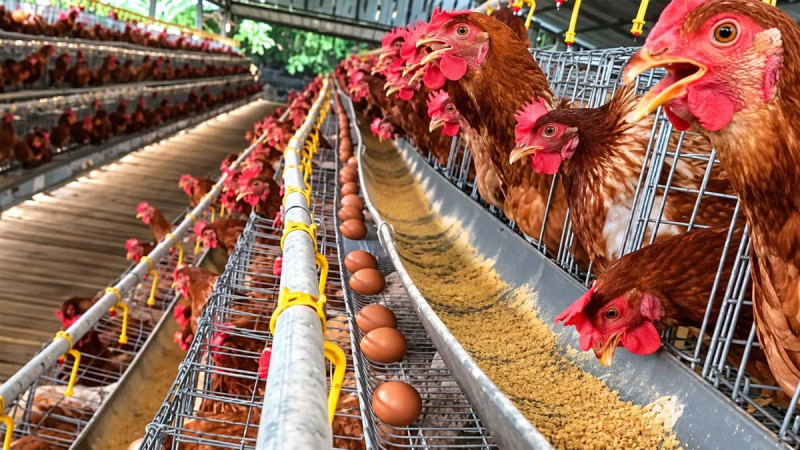
Data presented by the ministry show that locally sourced ingredients account for approximately 60% of broiler feed formulations. Corn represents the largest share at 45%, followed by rice bran and other local ingredients at 5%, palm kernel meal (PKM) at 5%, and CPO or fat at 5%.
Imported ingredients account for the remaining 40%. Soybean meal represents 25% of the formulation, followed by distillers dried grains with solubles (DDGS) at 5%, meat and bone meal (MBM) at 3%, and corn gluten meal (CGM) at 3%. Other imported ingredients include poultry by-product meal or hydrolyzed chicken feather meal at 2%, minerals or calcium at 1%, and vitamins and feed additives at 0.5% each.
For layer feed, locally sourced ingredients contribute 63%, comprising corn at 45%, rice bran and other local ingredients at 8%, PKM at 5%, and CPO or fat at 5%.
Imported ingredients make up the remaining 37%, including soybean meal at 20%, DDGS at 7%, MBM at 3%, CGM at 3%, and poultry by-product meal or hydrolyzed chicken feather meal at 2%. Minerals or calcium account for 1%, while vitamins and feed additives each contribute 0.5%.
Palm Oil Downstreaming Could Expand Domestic Feed Options
The substantial share of soybean meal in broiler feed highlights the poultry industry's continued dependence on imported raw materials. Increasing the use of palm-derived ingredients could provide an alternative domestic supply while creating additional markets for palm oil derivatives beyond food and energy.
However, expanding substitution will depend on research into nutritional composition, safety and technical feasibility. Any new formulation must meet poultry nutritional requirements without compromising animal performance.
The ministry expects joint research involving BRIN and universities to accelerate progress. If higher substitution rates prove viable, palm-based feed ingredients could help reduce Indonesia’s dependence on imported soybean meal while strengthening links between the palm oil and livestock industries. (T2)