InfoSAWIT, JAKARTA – Indonesia's efforts to tackle forest and land fires, locally known as karhutla, need to move beyond enforcement after fires occur and place greater emphasis on prevention at the community and landscape level.
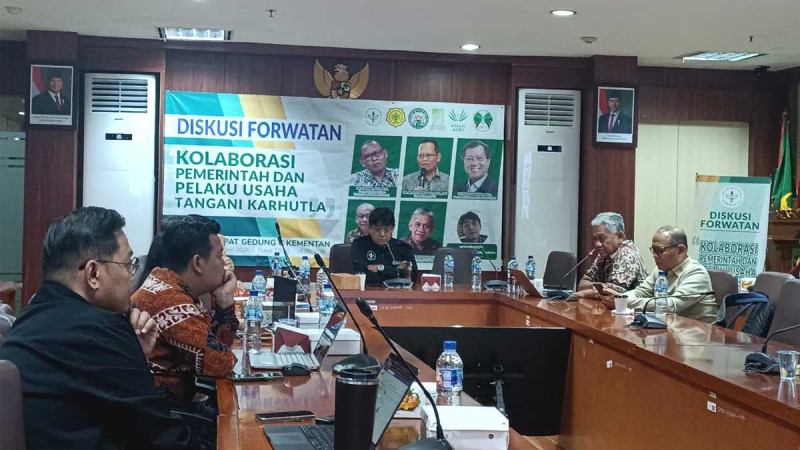
The issue was highlighted during a discussion organized by the Forum Wartawan Pertanian (Forwatan) under the theme “Government and Business Collaboration in Tackling Forest and Land Fires” at the Ministry of Agriculture's Building C in South Jakarta on Thursday (October 1, 2026).
The forum brought together representatives from the forestry and plantation sectors, government officials and legal experts, including Indonesian Forest Concessionaires Association (APHI) Chairman Soewarso, forestry expert Dr. Petrus Gunarso, Ministry of Agriculture Plantation Protection Director Hendratmojo Bagus Hudoro, GAPKI Executive Director Mukti Sardjono and legal expert Dr. Sadino from Al Azhar University Indonesia.
Social and Land Governance Factors
APHI Chairman Soewarso said forest and land fires should not be viewed solely as a fire-related problem, arguing that their underlying causes are also connected to social and economic conditions as well as land governance.
“Forest and land fires are an effect, not the main cause. The real underlying issue lies in socio-economic factors,” Soewarso said.
He pointed to the continued use of fire by some communities to clear land because it is considered a relatively cheap and quick method.
He also highlighted areas with unclear land control or open access status, where uncertainty over spatial planning and land tenure can make fire risks more difficult to manage.
Most Hotspots Outside Formally Managed Plantations
Forestry expert Dr. Petrus Gunarso presented a spatial analysis based on data from Indonesia's Sipongi fire information system, palm oil land-cover data and forest-area maps.
According to his presentation, around 84% of hotspots were located outside formally managed palm oil plantation areas. These areas included non-managed or open-access land, including converted forests, protected forests and other open areas.
Meanwhile, approximately 16% of hotspots were located within formally managed plantation areas.
Petrus also compared the situation with Sarawak, Malaysia, which he said had experienced relatively fewer major fire incidents. Among the factors highlighted was greater clarity regarding land rights and spatial planning.
28,692 Hotspots Recorded in September
Data from the Ministry of Forestry's Sipongi Forest and Land Fire Information System recorded 28,692 hotspots between September 1 and 30, 2026.
Ministry of Agriculture Plantation Protection Director Hendratmojo Bagus Hudoro said Central Kalimantan recorded the highest number, with 10,896 hotspots, followed by West Kalimantan with 3,969, South Sumatra with 3,506, South Papua with 1,396 and South Kalimantan with 1,073.
However, Bagus stressed that hotspots are indicators of high temperatures and do not automatically mean that a fire has occurred.
“Hotspots are indicators of high temperatures that need to be verified through factual checks or ground checks. They do not necessarily represent actual fire incidents,” he said.
Despite this distinction, authorities have maintained vigilance as dry plantation conditions during the dry season can increase the risk of fires.
The Ministry of Agriculture has implemented several mitigation measures, including establishing 251 hectares of no-burn land-clearing demonstration plots, forming Fire-Aware Farmer Groups in six high-risk provinces and requiring more than 2,000 plantation business permit holders to meet fire prevention and response infrastructure standards.
Industry Calls for Village-Based Prevention
Legal expert Dr. Sadino highlighted the application of the strict liability principle in forest and land fire cases.
He said the application of absolute liability needs to take geographical conditions and possible external intervention into account. He also raised concerns over civil lawsuits involving very large compensation claims, which he said could place significant burdens on companies if environmental damage calculations are applied uniformly to areas with different characteristics.
Meanwhile, GAPKI Executive Director Mukti Sardjono said all 751 GAPKI member companies had met the required qualifications for disaster prevention facilities and infrastructure and had strengthened monitoring of potential fire triggers.
GAPKI and its members, he added, are also working with the Ministry of Forestry, Ministry of Environment, APHI and local governments on forest and land fire prevention and response.
According to Mukti, fire prevention cannot be limited to company concession boundaries because fires can spread across administrative borders.
“Fire does not recognize administrative boundaries, so prevention based on villages surrounding concessions is our main focus,” he said.
The discussion underlined that tackling forest and land fires requires more than law enforcement. Clearer land governance, community-level prevention, stronger preparedness among businesses and coordination across sectors are also needed to prevent fires from developing into wider disasters. (T2)