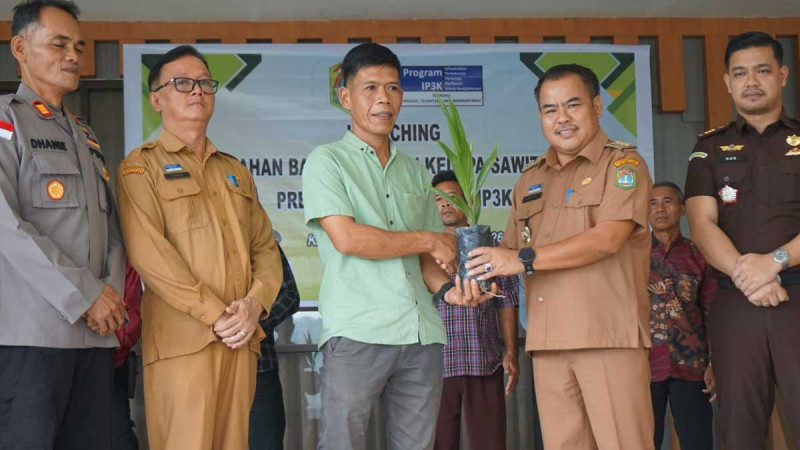
InfoSAWIT, SEKADAU — The Sekadau Regency Government in West Kalimantan has distributed 57,700 oil palm seedlings to 21 farmer groups across 18 villages under its Infrastructure, Plantation, Agriculture and Fisheries for Community Welfare (IP3K) program in the 2026 budget year. The assistance covers a total area of 422 hectares and is intended to strengthen smallholder plantations and improve rural livelihoods.
The seedlings were officially handed over by Sekadau Regent Aron at the regency office on Monday, October 5, 2026. The program is implemented through the local Food Security, Agriculture and Fisheries Agency (DKP3).
DKP3 Acting Head Sandae said the IP3K program had been implemented consistently since 2022. By 2026, cumulative assistance had reached 132 farmer groups, covering 2,224 hectares.
The seedlings come from authorized suppliers and have undergone certification and labeling by the West Kalimantan Provincial Plantation Seed Supervision and Certification Unit (UPT SBP).
Farmers receiving the assistance are expected to transfer seedlings aged three to five months into larger polybags and maintain them until they are ready for field planting. Proper maintenance and cultivation practices are considered essential to supporting healthy plant growth.
Oil Palm Remains an Important Economic Driver
Regent Aron said oil palm plantations play a strategic role in supporting Sekadau’s economy, with smallholder development offering opportunities to increase household income and improve living standards.
According to local government data, Sekadau ranks seventh in West Kalimantan by oil palm plantation area and fifth by total production. The regency ranks second in the province for production from independent smallholder plantations.
“Oil palm has become a leading commodity. People see that those who own two to three hectares of oil palm land are much more prosperous than others,” Aron said, according to information from the Sekadau Regency Government reported by InfoSAWIT on Tuesday, October 6, 2026.
He stressed, however, that government assistance was intended as a stimulus rather than full financing for plantation development. The support is allocated for one hectare per household, with farmers encouraged to expand their plantations independently to generate sustainable income.
Protecting Local Land Ownership
Beyond increasing plantation productivity, the IP3K program is also intended to help local communities retain ownership of their land.
Aron warned residents against selling their land when facing financial difficulties, emphasizing the importance of preserving local ownership for future generations.
“People should not be forced to sell their land to newcomers when economic conditions become difficult, leaving local residents without land in their own villages,” he said.
The regent also referred to recent weakness in fresh fruit bunch (FFB) prices, linking the situation to dry weather and constraints in CPO distribution. He expressed hope that prices would recover as weather conditions and water transportation routes returned to normal.
The Sekadau administration plans to evaluate the implementation of IP3K to improve the distribution and management of seedlings and ensure that assistance reaches the intended beneficiaries.
Through the program, the local government hopes to develop smallholder oil palm plantations not only as a source of agricultural production but also as a foundation for household prosperity and the protection of community land ownership. (T2)