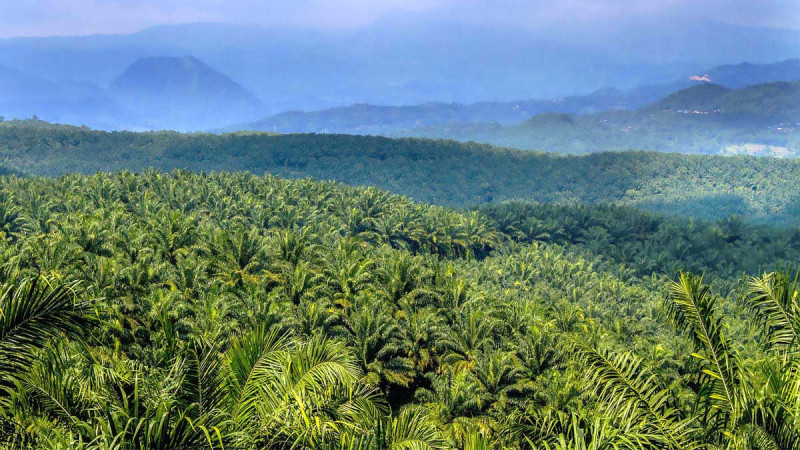
InfoSAWIT, JAKARTA – The Indonesian government has outlined three strategic priorities for the national palm oil industry in 2026: increasing plantation productivity, accelerating downstream industrial development, and strengthening plantation governance. The policy direction was presented by Acting Director General of Estates at the Ministry of Agriculture, Ali Jamil, Ph.D.
According to InfoSAWIT, citing the "Ngobrol Sawit 2026" webinar held in Jakarta on Tuesday (July 7), Ali Jamil emphasized that the palm oil sector remains one of Indonesia's most strategic industries, supporting economic growth, employment, food security, and energy resilience.
Indonesia currently manages approximately 16.83 million hectares of oil palm plantations, producing around 45.4 million tonnes of crude palm oil (CPO), making the country the world's largest palm oil producer.
Beyond production, the industry contributes significantly to the national economy, generating approximately US$22.85 billion in export earnings from 32.34 million tonnes of exports. The sector also provides employment for around 4.2 million direct workers and 12 million indirect workers, while contributing approximately 3.5% to Indonesia's Gross Domestic Product (GDP).
Domestic demand continues to expand as well. Around 10.29 million tonnes of palm oil are used annually for cooking oil and food manufacturing, while the B40 biodiesel mandate is expected to require 15.6 million kilolitres of biodiesel, equivalent to 14.5 million tonnes of CPO. Future implementation of the B50 programme is projected to increase demand to 20.1 million kilolitres, or approximately 18.7 million tonnes of CPO.
Smallholder Productivity Remains a Major Challenge
Despite controlling nearly 6.9 million hectares, or 41% of Indonesia's total oil palm area, smallholders continue to record relatively low productivity.
Current yields average only 2–3 tonnes of CPO per hectare annually, well below the potential 4–6 tonnes per hectare achievable through certified planting materials and improved agricultural practices.
Ali Jamil identified several persistent obstacles, including ageing plantations, the widespread use of uncertified seeds, land legality issues, weak farmer institutions, volatile fresh fruit bunch (FFB) prices affecting replanting programmes, and limited land registration among independent growers.
Government Strategies to Boost National Production
To address these issues, the government will accelerate the Smallholder Replanting Programme (PSR) while expanding access to farm inputs, strengthening plantation governance through STDB registration and certification, improving farmer capacity through training, widening access to People's Business Credit (KUR), and encouraging integrated farming systems combining oil palm with livestock and intercrops.
For large-scale plantations, policy priorities include regulatory certainty, enforcement of the 20% community plantation obligation, gradual resolution of plantations located within forest areas, acceleration of the B50 biodiesel roadmap, downstream industrial expansion, and greater utilization of palm biomass and other value-added by-products.
Downstream Industry and Partnerships
The government also considers downstream development a key driver of future competitiveness. Policies will encourage higher mill efficiency, segregation between food-grade and non-food-grade CPO, wider adoption of Good Agricultural Practices (GAP), better organization of independent smallholders, and faster replanting implementation.
Partnerships involving growers, plantation companies, cooperatives, financial institutions, and government agencies are expected to become the foundation for improving productivity while ensuring the long-term sustainability of Indonesia's palm oil industry.
With stronger productivity, accelerated downstream development, improved governance, and empowered smallholders, the government remains optimistic that Indonesia's palm oil sector will continue enhancing farmer welfare while reinforcing its contribution to economic growth, food security, and national energy resilience. (T2)